
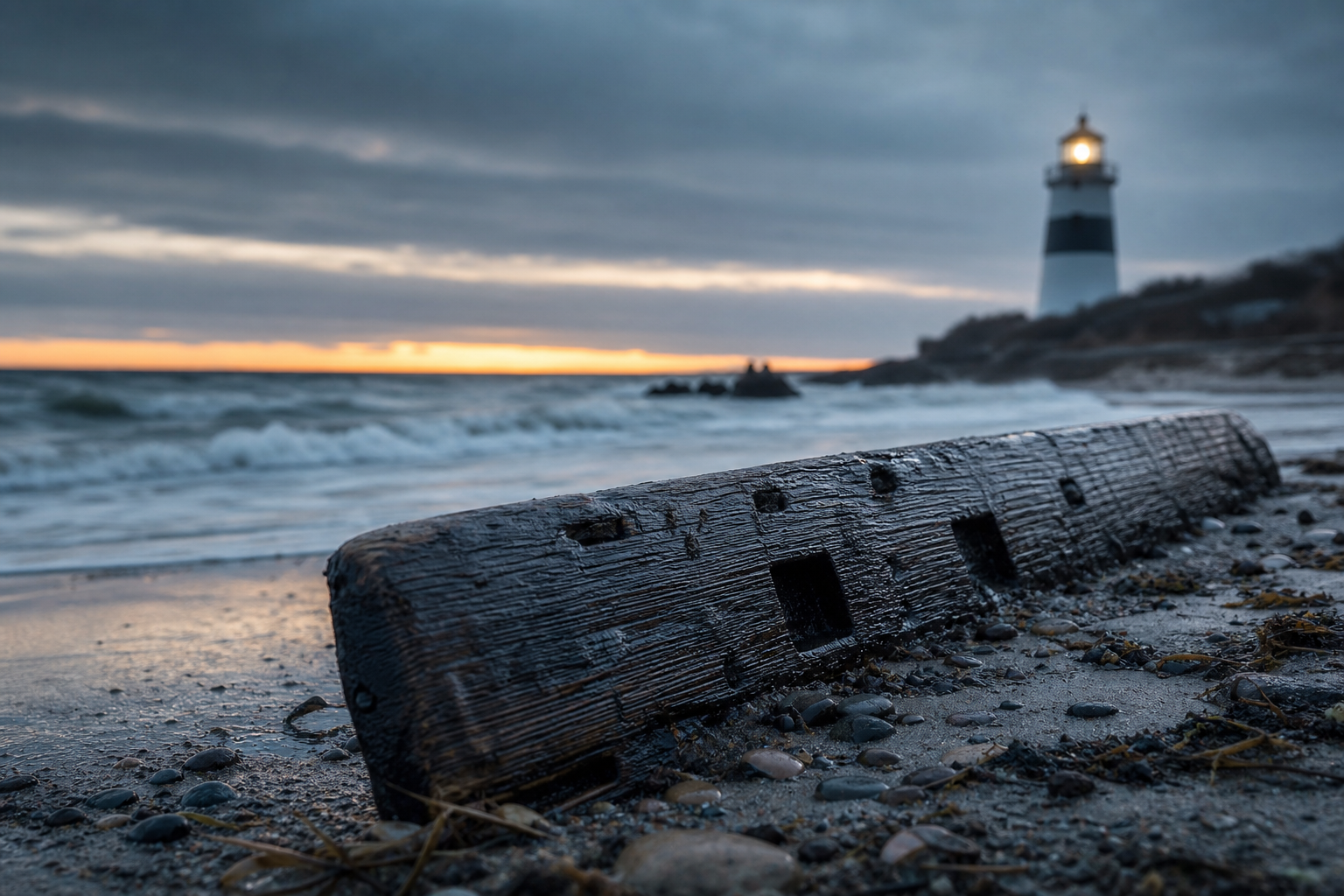
What exactly do you learn from a piece of wood that a storm drags back onto a Nantucket beach? On Saturday, September 26, 2026, a nor'easter battered the island, and Jason Graziadei, editor-in-chief of the Nantucket Current, filmed wooden remnants surfacing on the south shore. He believes they likely came from the Warren Sawyer, a three-masted schooner bound for Boston from New Orleans with cotton and scrap iron, which wrecked near Miacomet Beach on the night of December 22, 1884. That timber can show how the hull was fastened and how long salt water takes to gnaw a vessel down to its ribs.
About the hours before the wreck, it says very little. The same goes for most of the hundreds of ships lost around the island in that century, whose remains come down to debris, a date, and sometimes a name in a customs record. So the sharper question is what it would take to hear the people aboard. For one Nantucket ship, the answer is a first mate who picked up a pen.
The shipwreck coverage has done the sensible thing. It shows the timber and relays Graziadei's careful guess about where it came from. Somewhere near the end comes the observation that hundreds of ships wrecked around Nantucket in the nineteenth century, squeezed into a single clause when it could fill a book. The island's fortunes depended on sending its men farther out, eventually into the open Pacific after sperm whales, while the shoals near home kept claiming vessels of their own. Left unexplored is what that life asked of the people inside it, and how rarely any of them left a record sturdier than a tide table. A beach find is a fine prompt, and it stops at the waterline, which is exactly where the human part of the story begins.
Stove by a Whale, by Thomas Farel Heffernan, gives you the nearest thing to that missing voice for the Essex. In November 1820 the whaleship was rammed and sunk by a sperm whale in the open Pacific, leaving her crew in small boats thousands of miles from land. Owen Chase, the first mate, wrote an account of the attack and of the months that followed. The book reproduces that contemporary narrative, so you meet the event through someone who was on deck when the animal turned toward the ship. The first thing you meet is plain shock.
Whalemen hunted these animals for their oil, and the whole logic of the trade assumed the whale was the one in danger. Chase describes a creature that seemed to strike with intent, and you can feel a practical man wrestling with an idea outside his experience. Calling the whale enraged is essentially his interpretation, and it is hard to blame him. Anyone would reach for a motive after an animal the size of a house picked their hull as a target. After the sinking, the story slows, and the slowing is the reason to spend time with it.
The survivors drifted for about three months in open boats. A firsthand account of that stretch cannot hurry past the days when nothing happens except that everyone grows weaker. Popular retellings of the Essex tend to leap to its grim ending, the part people half remember. Chase makes you sit through the reckonings of food and distance that led there, and the dread builds in that enforced patience. Chase also had reasons to tell it a certain way. A first mate writing soon after a disaster has every incentive to present himself well, and he had a career to protect in a whaling world where a man's reputation followed him from ship to ship.
How much of the published narrative he shaped alone, and how much help he had, is something the text itself cannot settle. What you hold is testimony from a survivor with a stake in the telling. Read it with one eyebrow raised, the way you would read any report filed by the person in charge after something went badly wrong. Herman Melville drew on the Essex story, so the sinking usually turns up in conversation as backstory for Moby-Dick. Going to Chase directly returns the event to its Nantucket scale: one ship, one crew, families waiting on an island for word of men who were counting rations in the middle of the Pacific. Chase stays close to the water, tallying food and miles, and I think his account is the better guide to what the island actually lived through.
So what do you learn from a piece of wood? Enough to know that the Warren Sawyer existed, that it came apart near Miacomet Beach in 1884, and that the sea returns fragments of such things on its own schedule. If the Nantucket shipwreck left you wanting the people behind the planks, Stove by a Whale is a good place to turn, as long as you keep in mind that Chase is a witness with his own interests and an exact memory for hunger. Give it time. The narrative moves at the pace of the boats, and three months adrift does not reward skimming. Somewhere under the next storm, more timber is waiting, and it will be just as quiet as this piece.