
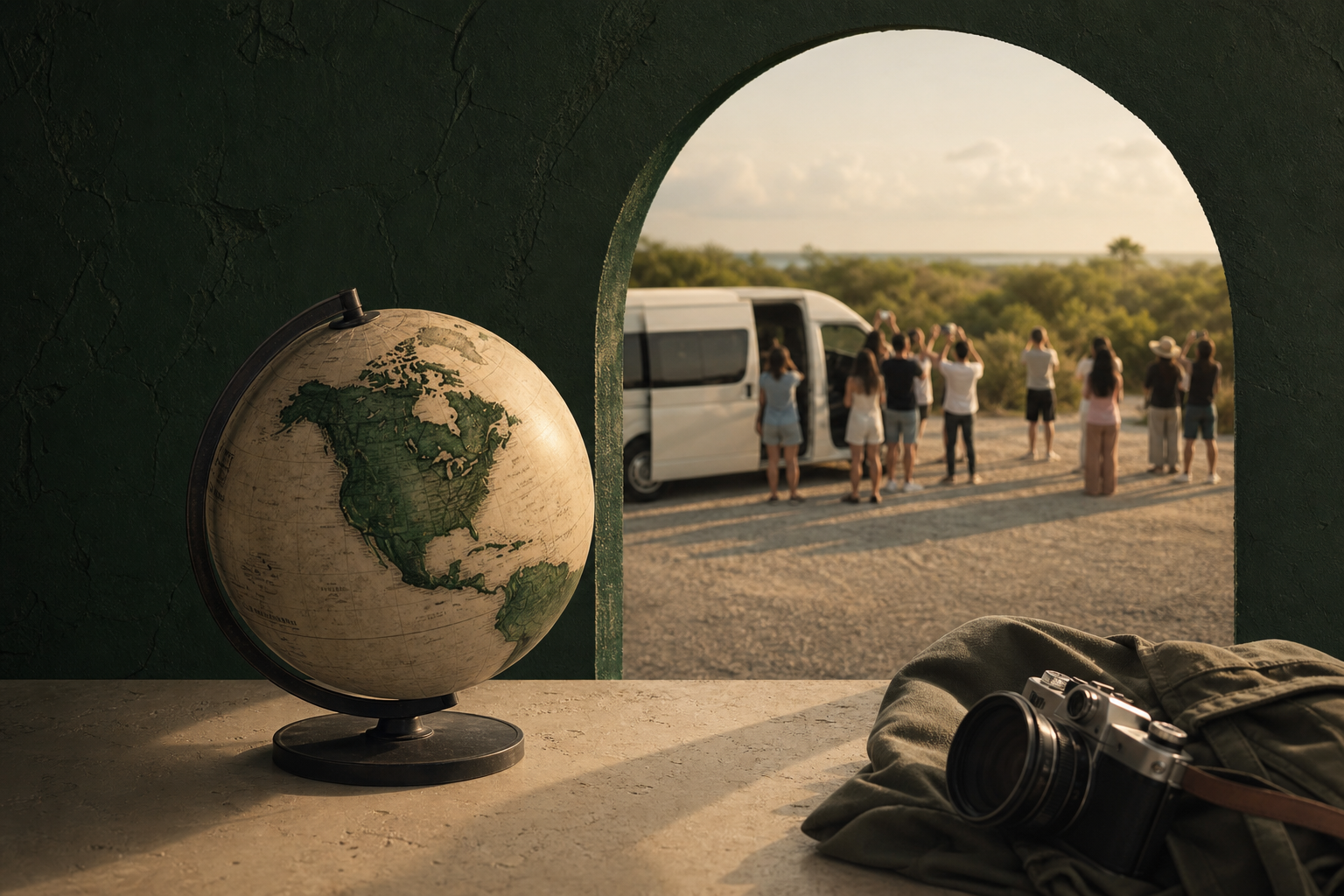
Somewhere on the highway south of Cancún, a white van pulls into a gravel lot and a dozen people step out already holding their phones at shoulder height. The cenote below has a wooden platform, a rope swing, and a line. Each swimmer gets about eight seconds of turquoise, filmed from nearly the same angle, and then the next person steps up. Nobody in the line looks put out. The water is lovely, and the clip will do well. Multiply that lot by a year and you arrive at the 2025 numbers. Mexico finished as North America's strongest travel and tourism performer, ahead of the United States and Canada on growth, visitor spending, and international arrivals. You have probably seen the headline. It leaves out the shape of the demand behind it, and how much of that shape was drawn on a phone screen.
The comfortable reading of those figures is that more of Mexico is finally getting its due. I am not convinced. A country-level total can climb sharply while the map of where people actually go gets smaller, and short-video platforms push hard in that direction. A scrolling timeline rewards whatever registers instantly on a small screen: bright water, a recognizable backdrop, a spot someone else made famous last month. Each successful post makes the next one at the same place more likely, because the location now has proof that it performs. The arrivals statistic confirms that visitors came and spent, and leaves open whether that money reached a highland market town or a canyon village many hours from the nearest beach club. Those places tend to stay off camera for a simple reason: they are hard to film in the time it takes a swimmer to hit the water.
Lonely Planet's nineteenth edition of Mexico, written by Joel Balsam and Jennifer Fernández Solano, is an old-fashioned object: a classic-format guidebook, the thick kind designed for trips of several weeks. The publisher describes an all-new structure and design, plus itineraries for extended journeys, day trips, walking tours, and activity-led outings. That format shapes everything that follows. A book built for three weeks has to account for the days between the famous stops, which is exactly where the scroll goes quiet. Take the Mercado Municipal in San Cristóbal de las Casas, which the book pitches as aromatic.
Smell is the one sense a phone cannot post. A market like that plays badly as a clip, since the light is dim, the aisles are crowded, and the pleasure accumulates over an hour of wandering and tasting. San Cristóbal sits in the highlands of Chiapas, far from the Caribbean coast in both miles and mood. Putting it near the front of the pitch is an editorial choice to steer attention toward a place that rewards staying put. The hike from Creel, a small town in the mountains of Chihuahua, to the warm, bubbling Aguas Termales Rekowata hot springs is even harder to turn into content.
Getting there is most of the experience: the journey into the Sierra Tarahumara, the walk down, the water waiting at the end. Few creator careers get built around a payoff that arrives only after a long trip and a hike on top of it. That difficulty also keeps the springs from filling up, and a printed page is one of the few places where difficulty gets presented as a selling point. Isla Holbox is harder to defend. Swimming alongside fully grown whale sharks as they come to feed in the shallows is about as camera-ready as travel gets, and a small island can only absorb so many boats.
The jacket copy also promises "best kept secrets," which is a charming thing to print in a widely sold guide; a secret with a print run has a limited shelf life. Guidebooks invented the crowding problem long before phones did. A single glowing entry could once fill a guesthouse for years. This book is another attention machine, a slower one that pays you back in context. That slowness is the case for it. A multi-week guide has every reason to spread you across a whole country, because it has to fill your days and justify its heft. Of the two machines, the heavier one tends to scatter people more.
You can still take the rope swing south of Cancún; the water there is lovely, and the line moves quickly. The argument here is modest. A banner year for Mexican tourism was shaped in large part by what fits on a screen, and a nineteenth edition of an old-format guide is one of the few places still making the case for what does not. If a trip is forming in your head, you might keep this one by the bed for a few evenings before you book anything. Let a slow hour in a highland market, or a long walk down to warm water in the Chihuahua mountains, set a little of the route before the scroll sets the rest.