
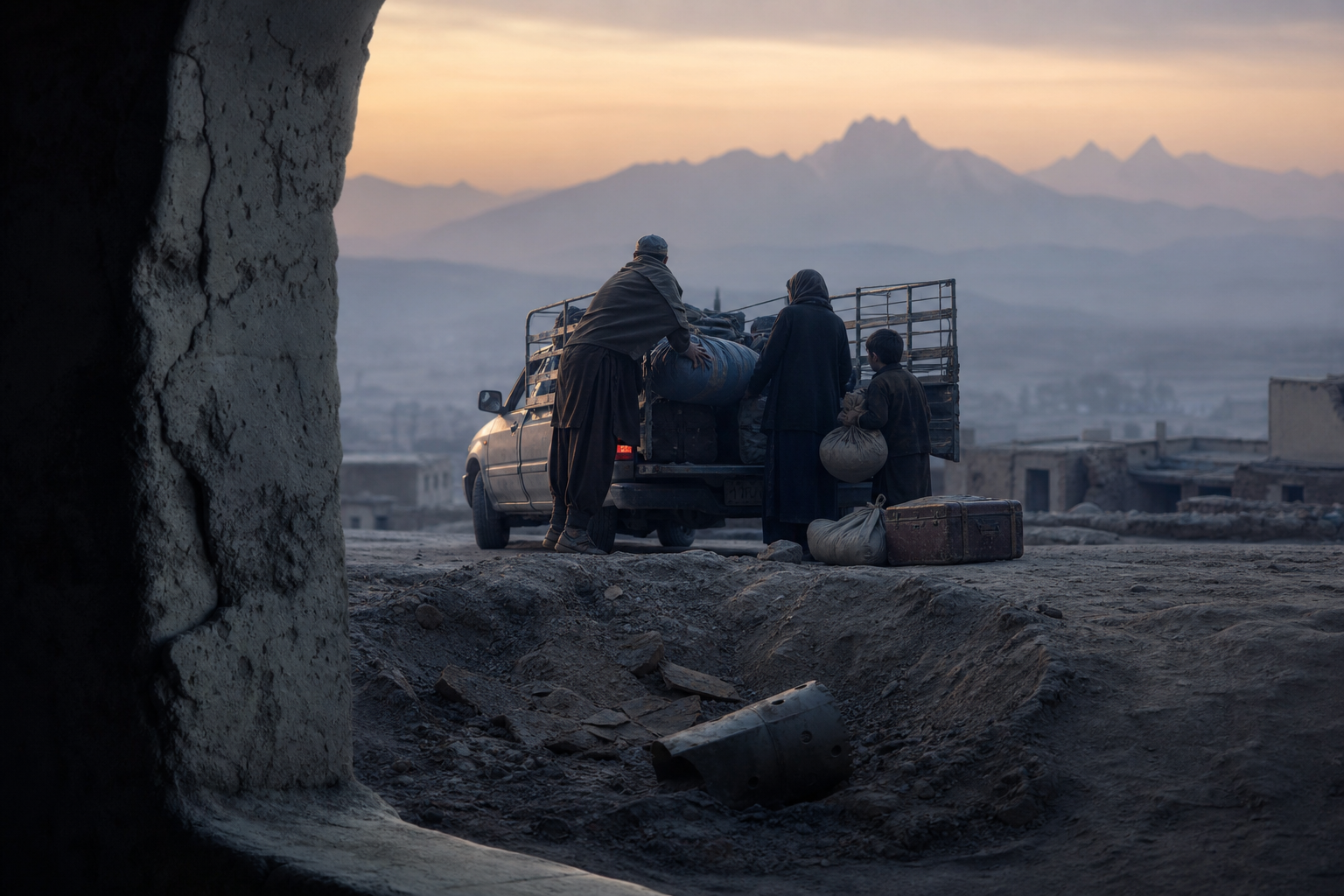
A family in Khost loads what they can carry into a pickup after a night of air raids. The UN's count for the first three months of 2026 lists 372 Afghan civilians killed and 397 injured along the border with Pakistan, most of them in February strikes that the Taliban and Islamabad now trade blame over. The names rarely make the English-language wires. The villages rarely get a second mention. If you have been half-following the headlines, you already know the rough shape: Pakistani forces and the Taliban, once something close to partners, are now bombing each other's claimed territory, and the people who happen to live there are the ones being counted in mortuary lists. What you may not have is the longer thread that explains why these two ended up here, pointing artillery at the same villages they once moved fighters through.
Most current coverage treats the Afghanistan-Pakistan border as a fresh crisis with a 2026 cast. That framing leaves out the inconvenient part. The relationship between Pakistani intelligence and the Taliban was built deliberately over decades, with American money flowing through it for long stretches, and the civilians being hit in air raids this winter live on terrain those choices shaped. The blind spot is not about who fired which missile in February. It is about how a state that spent years insisting it was a counterterrorism partner could also be running, sheltering, and steering the very networks its partners were fighting. Without that backstory, the violence reads as a sudden falling-out between neighbors. With it, the falling-out looks like the predictable end of a long arrangement nobody wanted to name out loud.
Carlotta Gall covered Afghanistan for The New York Times for more than a decade, and The Wrong Enemy is the book she wrote when she finally said the quiet part. Her argument, built across years of on-the-ground reporting from Kandahar, Quetta, Kabul, and the tribal belt, is that the war the United States thought it was fighting in Afghanistan was being directed, in significant part, from inside Pakistan. The title is not subtle, and she does not intend it to be. What earns the book your time is the texture of how she got there.
She is in a village after a night raid. She is sitting across from a Taliban commander who is candid about where he rests between fighting seasons. She is tracking the careers of ISI handlers whose names rarely appear in print. The reporting accumulates rather than performs, which is part of why it lands. Gall is at her sharpest on the human cost of strategic ambiguity. When Pakistani intelligence shelters a network, and that network crosses the border to plant a bomb, and an Afghan family loses three children, there is a chain of decisions behind that morning.
She follows the chain. She refuses to let the abstraction of regional policy absorb the specific deaths. She is also hard on the American side. US special forces, in her account, often misread who they were fighting and who they were standing next to, treating Pakistan as a difficult ally rather than a participant in the war on the other side of the line. The misreading was not innocent. It was convenient. Admitting the truth would have required a different kind of war, or no war at all, and neither Washington nor Islamabad wanted to pay that price.
The book has real limits. Gall is heavier on Afghan and Western voices than on Pakistani ones, and the internal politics of the Pakistani state, the tug-of-war between the army, the civilian government, and the intelligence services, gets less room than it deserves. For a full account of why Islamabad made the choices it did, you will want to read her alongside someone writing from inside that system. There are also moments where her sourcing leans on a small circle of Afghan officials whose own agendas she could have pressured harder. As a record of consequences, of what those choices did to the people on the receiving end, the reporting holds.
Read in 2026, with the Taliban now in power in Kabul and trading fire with the patrons who once sheltered them, the book settles into a quietly grim coherence. The arrangement Gall described was never going to age well. It was a transaction between two parties who never fully trusted each other, conducted on land where other people lived.
The family loading the pickup in Khost is not waiting for a verdict on regional policy. They are deciding whether the road south is safer at dawn or after dark. Gall's book is useful because it keeps that scale in view while explaining the larger machinery that put the road in play. If the 2026 news cycle has left you feeling like you walked in during the third act, The Wrong Enemy is a fair way back to the first two. Read it slowly. The names are worth sitting with.