
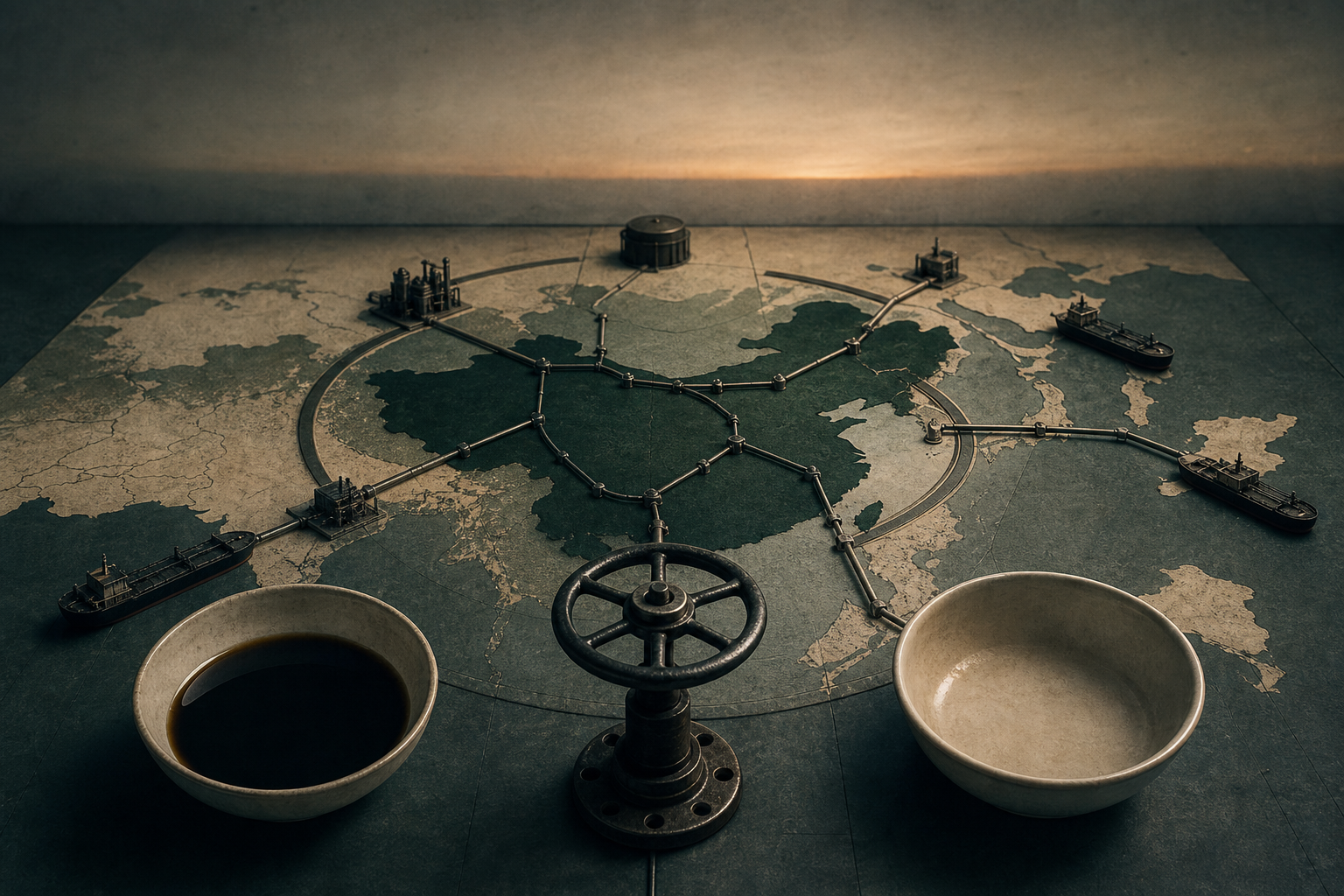
Why did China start stockpiling oil and building pipelines years before anyone was talking about a war with Iran? Because Beijing does not wait for the headline to arrive before it prepares for the crisis. While much of the coverage treats each oil-price spike as a fresh emergency, China's planners have spent the better part of a decade assuming exactly this kind of shock was coming. They filled strategic reserves, courted Russia, and spread their purchases across enough suppliers that no single chokepoint could squeeze them. When President Trump raised the stakes on Iran during his first term, China had already decided this was a durable feature of its future, not a passing storm. The question worth asking is not what China did last week. It is what China concluded about the world a long time ago, and why the rest of us are only now catching up to the logic.
Most of what you'll read frames China's energy moves as reactions: a response to sanctions, a response to conflict, a response to whoever occupies the White House. That framing misses the timeline. The scramble on your screen now is the visible edge of choices made when oil was cheap and the Middle East was quiet enough to ignore. Coverage tends to stop at the disruption and skip the design behind it, which leaves you with drama and no way to place it. The part rarely explained is why energy security became the organizing obsession of a state that imports most of what it burns, and how that obsession reshapes alliances far from any oil field. Understanding that means stepping back from the news cycle to the slower story of how power now moves through pipelines, tankers, and long-term contracts.
Daniel Yergin's The New Map is built for this gap between the shock and the strategy behind it. Yergin, who won a Pulitzer for his earlier work on oil, traces how energy, climate, and rival ambitions are redrawing global influence. NPR called it "a master class on how the world works," and the phrase fits a book that likes to follow a single barrel of oil into the middle of statecraft. The spine of the argument is that energy security now sits at the center of how great powers behave. Yergin walks through the American shale revolution, which ended the long assumption of scarcity and turned the United States into the world's leading energy producer.
That shift did more than lower prices at the pump. It rewrote the arithmetic for every country that had built its foreign policy around the fear of running short, China chief among them. Against that backdrop, the book sets out the rivalry between Washington and Beijing, sharpened by Russia's turn eastward and by the slow, competing push toward a low-carbon future. A Chinese pipeline deal with Moscow, Yergin shows, is less a headline about friendship than a hedge against the vulnerability of sea routes the U.S. Navy patrols. The strategy you're watching during the Iran tensions was drafted in these quieter negotiations.
I'll register one point of friction. Yergin is a careful, establishment-friendly writer, and his caution sometimes shades into reluctance to say plainly which bets will fail. The book maps the forces in play more confidently than it tells you who loses when they collide, and the low-carbon "second revolution" he describes gets an evenhandedness that can feel like fence-sitting. If you want a sharp prediction about the energy transition, you will find hedging where you hoped for a verdict. That restraint has a payoff. Because Yergin refuses to oversell any single outcome, the book holds up against events he never saw coming.
His account of why China hardened itself against disruption explains the current moment without having to name it, which is a rarer quality in geopolitics writing than it should be. You finish with the deeper logic in hand, not just the latest twist. The prose stays plainspoken even when the subject turns dense. Yergin can take a technical detail, the difference between a spot cargo and a long-term contract, and make it something you can picture and remember. That clarity is what lets the book serve as context for a news story it predates.
So why did China prepare for a crisis that hadn't happened yet? Because it decided, long before the rest of us, that scarcity and rivalry were the terrain rather than the exception. The New Map won't hand you a prediction, and if you came for one you'll leave a little unsatisfied. What it offers instead is the reasoning underneath the news, which tends to be worth more the longer you hold it. If the next oil-price lurch has you reaching for context rather than commentary, this is a good place to start.