
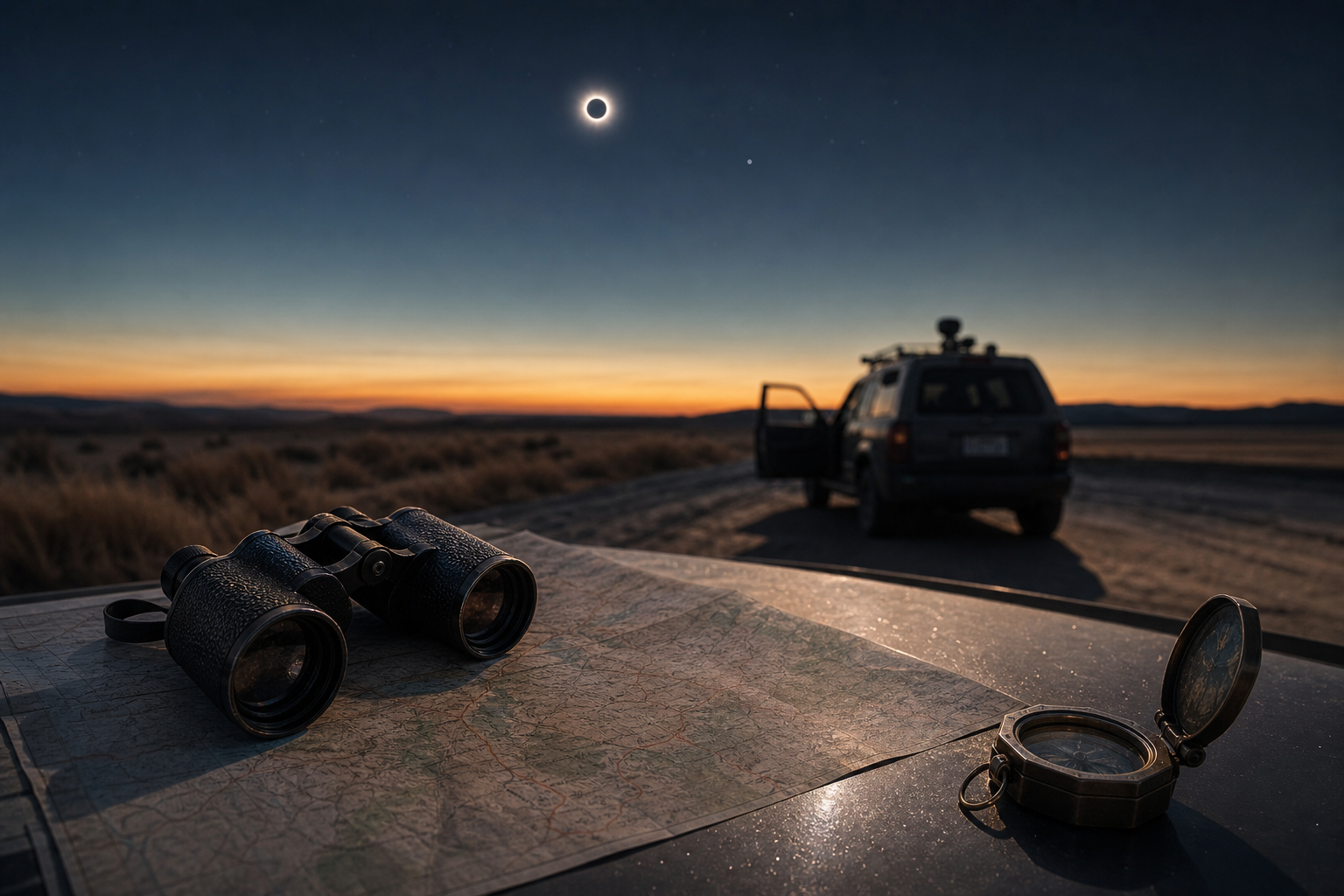
Picture an astronomer in 2017, someone who has spent a career cataloguing the sky's small miracles, pulled off the road because the world has just gone quiet. The shadow arrives. Cicadas stop. A horse in a nearby field lies down. For about two minutes she cannot speak, and later, writing about it, she says nothing in her training prepared her for that hush. The story keeps surfacing around every eclipse: a seasoned skywatcher undone by a few minutes of real dark in the middle of the day. The footage circulates, the explainer threads bloom, the maps of totality paths get reshared. Then the conversation moves on to the next celestial calendar item, as if awe were a scheduling problem. The quieter question is a little uncomfortable: why does that kind of silence feel so foreign to most of us now?
Most eclipse coverage treats the event as a logistics puzzle. Where to stand, which glasses to buy, how many minutes of totality the centerline gives you in Mazatlán versus Indianapolis. Useful information, and a strange way to talk about something people describe in the language of religious experience. The signal under the noise is harder to schedule. People keep reporting that totality felt unlike anything else in their lives, and they often can't say why a partial eclipse, or a lunar one, or a meteor shower did not land the same way. Some of the answer is astronomical. The rest is that, for three-quarters of Americans, the daily sky is already a dim and managed thing, and a real plunge into darkness has become rare. The eclipse shows you the sun and shows you what your nights are missing.
Paul Bogard's The End of Night makes that second job visible. Bogard travels from the Luxor Beam in Las Vegas, which he calls the brightest spot on Earth, out to dark-sky reserves where the Milky Way still looks like spilled snow. He is a good companion on the road: curious, a little stubborn, willing to stand in a parking lot at three in the morning with a sky-quality meter and report what the numbers say versus what his eyes can pick out. The central fact is blunt. Artificial light has erased the deep dark for most people alive today.
Bogard works through what that erasure costs in pieces you can feel. Sleep cycles thrown off by streetlight bleeding through curtains. Migrating birds pulled off course by lit towers. Sea turtle hatchlings crawling toward beachfront condos instead of surf. None of this arrives as catastrophe theater. Bogard prefers to show you a specific bird, a specific beach, a specific town that changed its lamps and got its stars back. The eclipse thread runs through the book without dominating it. He is interested in the broader category of celestial moments that depend on darkness to register, and he is honest that even a total eclipse is partly a contrast effect.
The corona looks the way it does because the sky around it is briefly allowed to go dark. The book sharpens when it turns to ethics. Bogard avoids scolding individuals for porch lights, but he is direct about the parties making the larger choices: municipal lighting contracts, big-box parking lot standards, advertising installations that throw light sideways and upward because nobody made them do otherwise. He treats light pollution as a design failure with known fixes. Shielded fixtures, warmer color temperatures, motion sensors, ordinances that have already worked in places like Flagstaff. The remedies are unglamorous, and that is part of his point.
The book occasionally overstates the spiritual stakes. Bogard sometimes writes about awe as if losing it were equivalent to losing a moral faculty, and that slide from aesthetic loss to ethical loss is a move worth questioning rather than nodding along to. Plenty of people live decent lives under sodium-orange skies. Even with that skepticism in mind, the reporting holds. The measurements are real, the wildlife data is real, and the gap between what a 2017 totality witness described and what a Tuesday night looks like from a suburban driveway is real.
If the eclipse stayed with you longer than you expected, Bogard's book is a useful place to put that feeling. It will not tell you that totality was a spiritual event. It will tell you, with measurements and specific towns and specific species, what kind of sky makes such moments possible, and what we are trading away to keep parking lots bright. Read it before the next path of totality crosses your map, or after, when the photos have stopped circulating and the question of what you actually saw is still sitting there.