
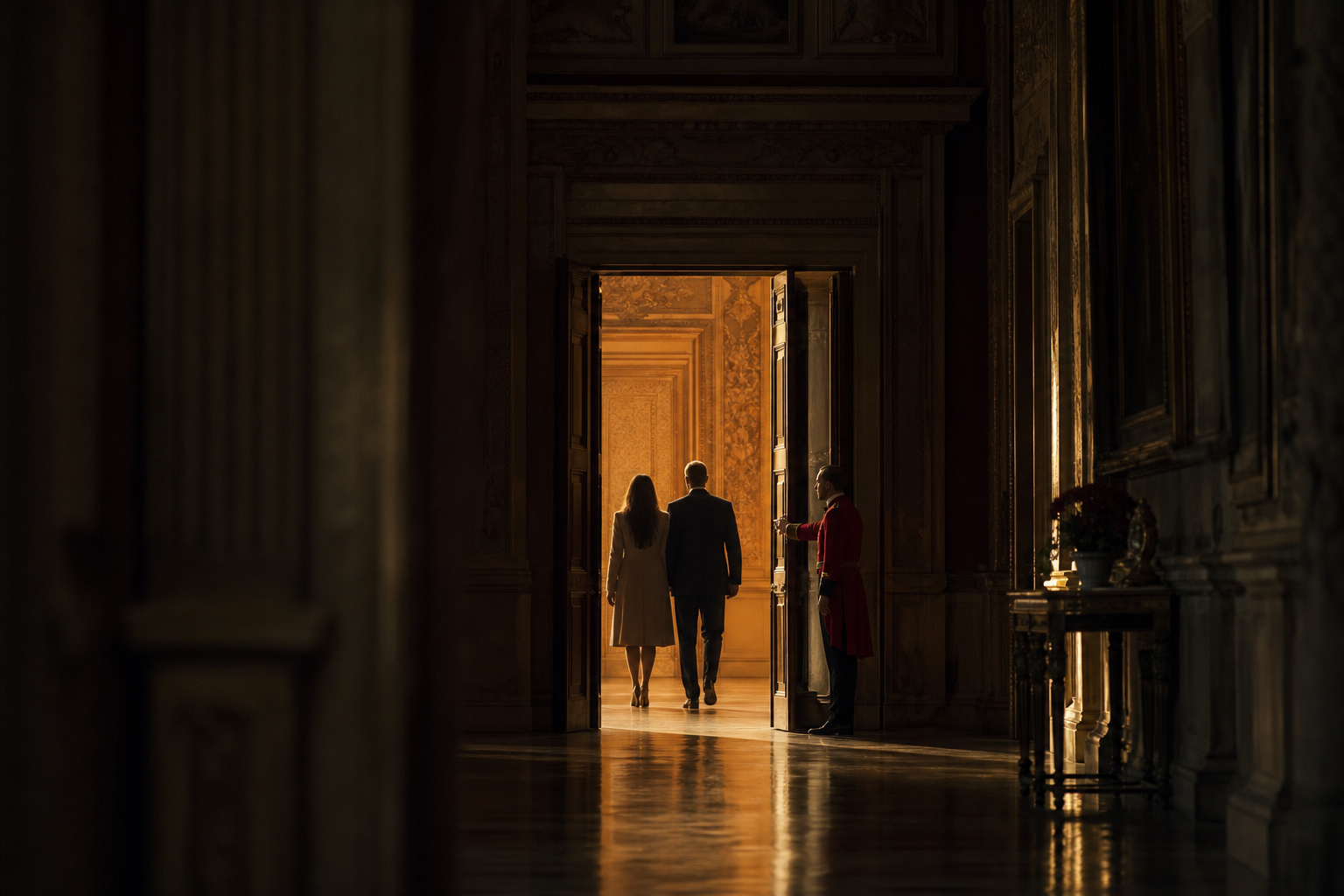
A staff member opens a door to a royal residence, and two people who have spent four years building a life an ocean away walk back inside. That is the image worth sitting with. Harry and Meghan have accepted the King's invitation to stay on a royal estate during their first family trip to Britain since 2022, and the word everyone keeps reaching for is rapprochement. The accommodation detail sounds like a matter of logistics. It is closer to choreography. Where a person sleeps inside the Windsor orbit has always signaled standing, favor, and the exact temperature of a relationship. So a headline that treats a guest room as the story is half right and half asleep at the wheel. The room means something because the history behind it does, and that history runs older and stranger than any single visit can hold.
The easy assumption is that this marks a thaw, a warm gesture, maybe the opening of a reconciliation arc with a tidy third act. The trouble is that reading treats the brothers as estranged friends who need one good weekend together. The rift never turned on a single quarrel. It grew out of roles assigned in childhood, hardened by two marriages, and litigated in public through books, interviews, and a Netflix series. An invitation to stay undoes none of that. The more likely truth is a managed concession, the kind of controlled proximity a family uses to look reconciled without being reconciled. To read this trip honestly you need the long version of how William and Harry stopped being a unit and became two competing definitions of what the monarchy is for.
Christopher Andersen's Brothers and Wives takes the slow road through that story, beginning with two boys who lost their mother in front of the world and were quietly shaped, afterward, into Windsors. Andersen keeps a close watch on Queen Elizabeth II's persistent hand in that shaping, the steady effort to mold her grandsons in the family image after Diana's death. He locates the brothers' divergence early, in the gap between being raised as the future and being raised as the contingency plan. That old vocabulary, the heir and the spare, earns its keep here. William carried the weight of inevitability, every choice measured against a throne he would one day occupy.
Harry was the backup, indulged and a little adrift, useful until he wasn't. Andersen traces how that imbalance soured as both men married, became fathers, and felt the press lean on each of them in different ways. The wives are not bit players in this account, and the title is honest about that. Andersen weighs how Catherine and Meghan shaped each other and the men they married, two women entering the same institution from opposite directions and drawing opposite treatment from the British tabloids. He does not pretend the press behaved evenly. The book confronts the uglier charges that have battered the family, including allegations of bullying and racism, and it is at its sharpest when it declines to file those as matching complaints.
The book wobbles on the question of sourcing. Andersen writes in the well-furnished style of a veteran royal chronicler, which means scenes arrive with a confidence the footnotes do not always earn. You get vivid private moments and overheard exchanges that read beautifully and prompt a fair question about who, exactly, was holding the notepad. Read it as a richly reported interpretation rather than a sworn deposition, and it holds. What it gives you, and what the guest-room headlines cannot, is the reason Harry's departure landed as a rupture on the scale of an abdication.
Andersen draws the comparison to Edward VIII on purpose, because a working royal walking away from duty is rare enough to bend the institution around the empty chair. Against that history, a King offering his son a place to stay stops looking like hospitality and starts looking like strategy, or hope, or both.
When the visit comes up over dinner, skip the recap and offer the part nobody tweeted, which is why the sleeping arrangements are the news. Brothers and Wives is the unhurried context for a moment everyone is reading too fast. You do not have to believe every overheard scene to come away with a firmer sense of how two grieving boys grew into rival ideas of the crown. Pick it up if you want the long memory behind a short headline.