
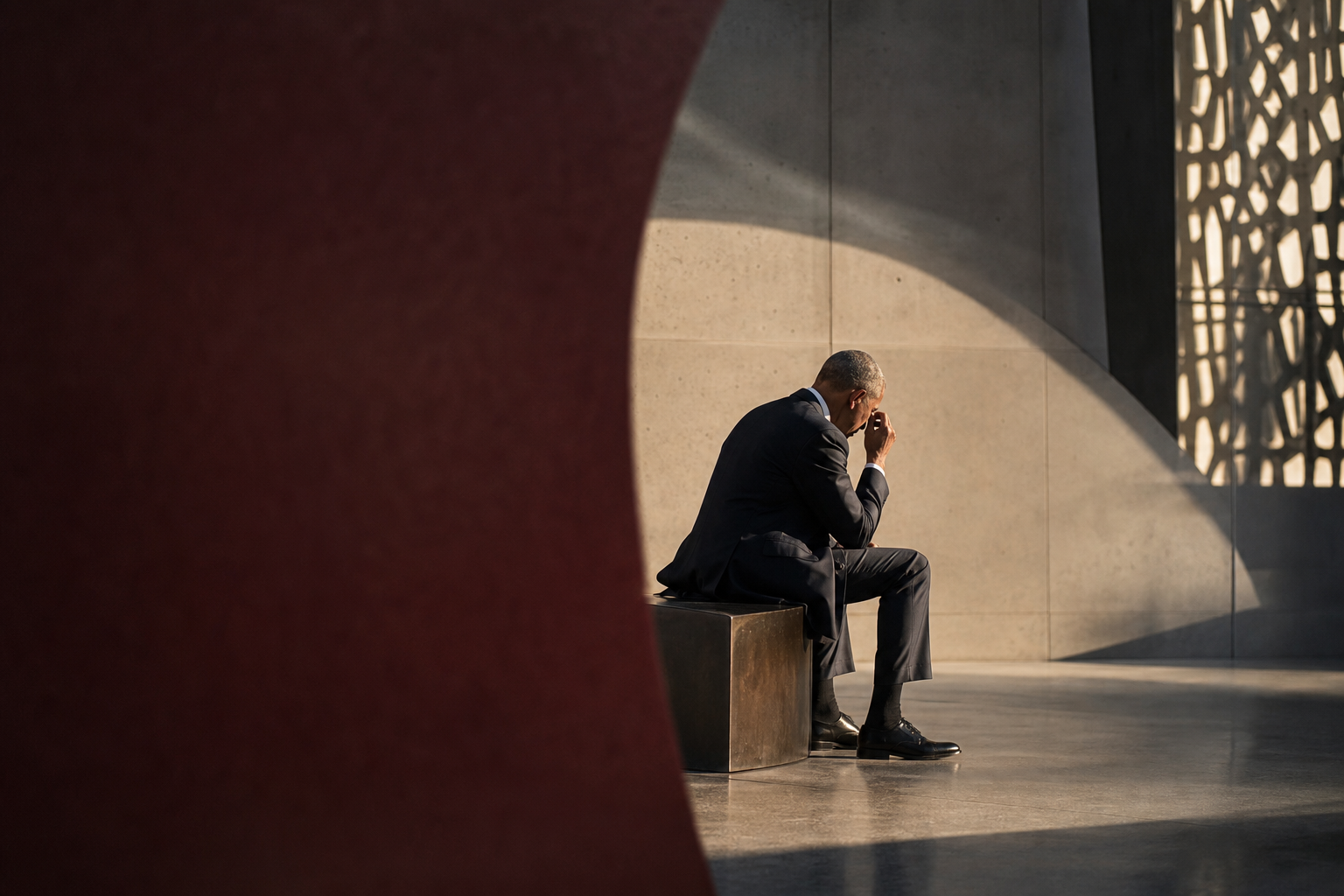
Picture Obama at the opening of his presidential center in Chicago, wiping away tears while Michelle salutes the work of his career. It is a fitting image for a man whose public life was built almost entirely on the spoken word. The center is a building now, glass and concrete on the South Side, but the thing it commemorates is harder to hold: a decade of speeches that millions could recite from memory before they could name a single piece of legislation he signed. That distance between the words and the policy is the whole puzzle of his career. A 704-page leather-bound collection of those speeches happens to be the most direct way into it, and it makes that moment in Chicago feel less like sentiment and more like an accounting.
Frederick Douglass understood the trap before Obama ever walked into it. A speaker who moves people gets praised for the moving and quietly excused from the rest, until the applause itself becomes the achievement. You can lose a decade of biography in the warm fog of remembered cadences, which is exactly what tends to happen here. People recall the 2004 convention keynote, the Grant Park night, the eulogy in Charleston where he sang. Harder to summon is what those speeches were arguing, and whether the arguments held up against eight years of governing. The tears in Chicago belong to that fog. They feel like a verdict on a legacy without telling you what the legacy was. For that you have to go back to the texts themselves, in sequence, and read them as a record of claims made and revised.
This collection gathers 85 speeches across more than a decade, from his Senate years to that 2017 farewell in the same city where he is now crying at a ribbon-cutting. Read in order, they stop being highlights and start being a paper trail. The young senator who tells the 2004 convention there is no red America or blue America is making a specific bet about how the country could be talked into cohesion. The retiring president in 2017 is addressing a nation that had just decisively contradicted that bet. The book lets you watch one man hold the same conviction across both moments, which beats any single quote.
The inaugural addresses reward this sequential reading. The first, in 2009, is a sober document, heavy with crisis and the language of responsibility instead of triumph. By the second, the optimism has acquired a defensive edge, an argument aimed at people who had stopped listening. Placing them a few pages apart shows you the cost of governing in a way no single address can. The volume earns its keep in the speeches nobody quotes. The State of the Union addresses are here in full, and they are built to plod, not to soar. They are lists of proposals, applause lines engineered by committee, the workmanlike prose of a man asking Congress for things.
Read them next to the Charleston eulogy or the Selma anniversary speech and the actual range comes into view, which complicates the orator label. The same person produced the transcendent and the dutiful, and the dutiful is where most of the presidency happened. I will register one complaint, and it is partly with the framing rather than the man. The publisher promises speeches that people of all political backgrounds can appreciate, which is a comforting fiction. Several of these texts were sharply partisan in their moment and read that way now. The 2008 race speech in Philadelphia, the remarks after Sandy Hook, the defenses of the health care law: these were fighting words, and pretending otherwise sands off what made them matter.
A speech that offends nobody usually accomplished nothing. The physical object leans into reverence in a way worth naming. Foil-stamped cover, gilded edges, the heft of a Bible. That packaging makes a quiet claim about permanence, and it sits a little awkwardly against the contested, unfinished quality of the contents. The editorial choice to print everything, the dull alongside the dazzling, works against the hagiography. You are left with the texts, and the texts are arguments, not relics.
The pattern is older than this presidency: the eloquent man remembered for the feeling and absolved of the argument. Obama's tears in Chicago fit it neatly. The book is the available counterweight, 704 pages that refuse the easy summary and make you sit with what was claimed, in what order, and at what cost. You do not have to admire him to find that worth reading. You only have to be curious about what persuasion can and cannot do over a decade. The leather binding suggests a closed case. The contents suggest otherwise.