The Diary, the Grants, and the Question That Outlasts Both
Picture the desk lamp and the notebook: a public health official writing down the sentences he kept away from the microphones.
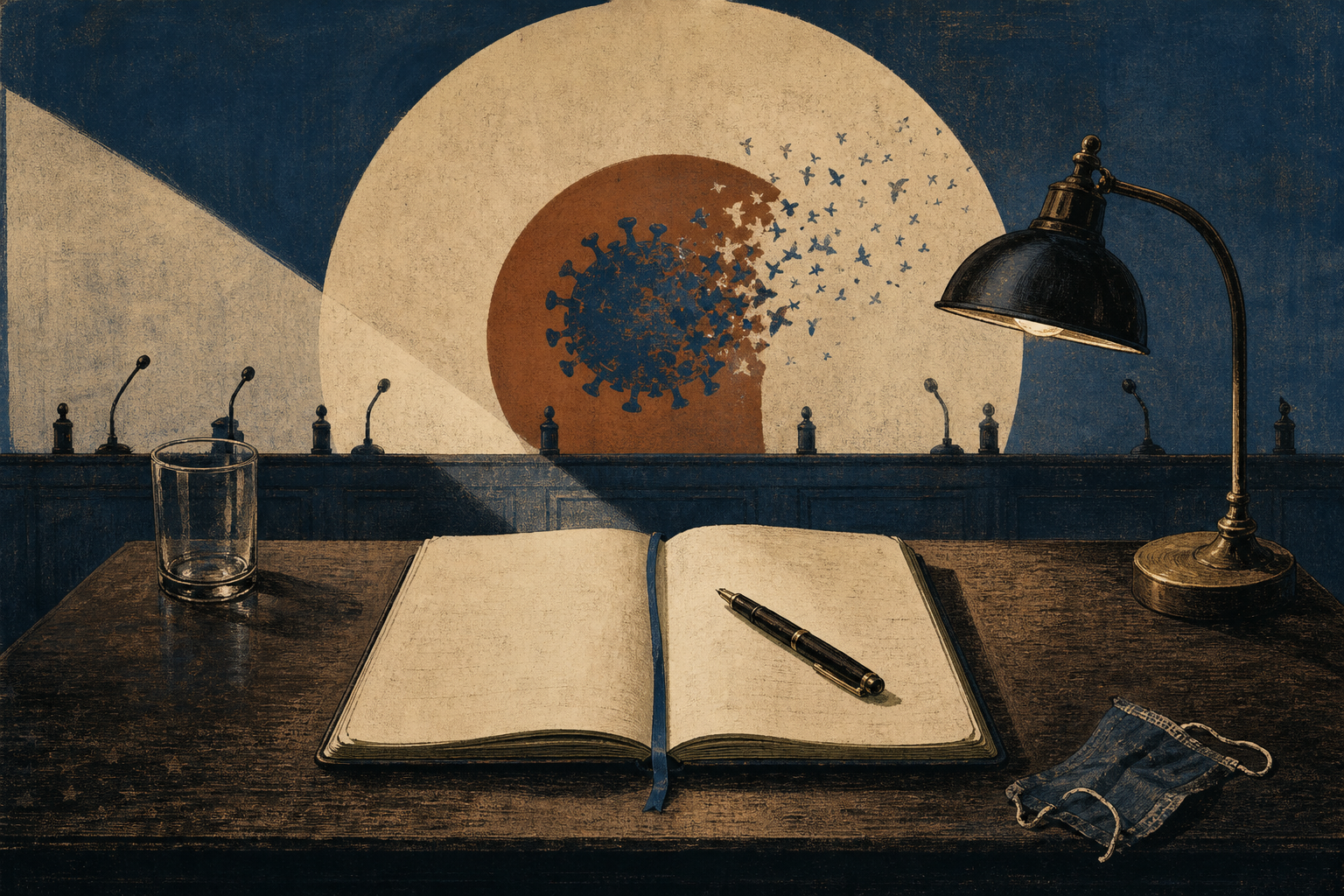
Picture the desk lamp and the notebook: a public health official at the end of another day of hearings, setting down on paper the sentences he kept away from the microphones. Some entries turn on where the virus came from. Others turn on his own fame, which by 2020 had climbed to the altitude that produces merchandise. Those private pages are public now, more than a thousand of them, released by Senator Rand Paul ahead of a Senate hearing he called, and they have restarted an argument that only ever went quiet. Sheryl Gay Stolberg, covering health policy from Washington, has the diary back at the middle of the lab-leak dispute, which means familiar claims are being relitigated with a fresh exhibit attached. The origin question will still be sitting there when attention drifts, with nothing underneath it.
Most of the coverage assumes this is a question of evidence, one decisive document short of settled. A private diary looks like that kind of document: contemporaneous, unguarded, written by the man in the middle of everything. What it holds is one person's mind on a given evening. The laboratory in Wuhan never appears in it. The durable disputes are administrative ones. Which grants traveled where, which review committees saw the applications, who decided in early 2020 that one hypothesis was irresponsible to say out loud. Those questions have answers, and the answers sit in grant files. They are boring in the way oversight is always boring, which is why a diary beats them in a news cycle and why they will still be here when the news cycle is not.
Rand Paul's Deception is the long-form version of those hearing-room exchanges, the ones where a senator trained as a physician and a career immunologist talked past each other over the phrase gain-of-function until the gavel came down. Paul's thesis arrives unhedged: Covid-19 most likely emerged from gain-of-function research at the Wuhan lab, work that American taxpayers helped pay for and that never went through the regulatory review such research is supposed to trigger. The paperwork is where the book is strongest. Paul traces how federal money, in his account, reached Wuhan through intermediary arrangements that kept the grants clear of the review process built for hazardous pathogen work.
That is a narrow, checkable claim about who signed what and who was supposed to be looking. It also holds up regardless of where the virus began, since a funding pathway can be badly supervised whether or not anything ever escaped a freezer. The suppression chapters are harder to sit with. Paul's central charge there is that researchers who considered a lab origin plausible were pressured into quiet. He also reads the early consensus statements as more coordinated than they appeared, and dates official awareness of the origin question well before the public acknowledgment. Pieces of this have circulated through years of document releases, and the diary lands on the same pile.
It is a prosecutor's brief and it argues like one, treating ambiguity as concealment and bureaucratic caution as strategy. The lockdown chapters are where that discipline slips. A specific oversight failure widens into a verdict on public health authority as such, and the verdict is a political preference wearing a finding's clothes. The keyword company the book keeps, Big Pharma and Big Tech, tells you which neighborhood the frame was built in. And there is something odd about a book that indicts officials for hiding their uncertainty while permitting itself almost none of its own.
Read as sworn advocacy from one side with the citations attached, it earns its shelf space. Paul names mechanisms and fixes dates, and he states plainly what he thinks the documents establish. He closes on a warning: paying for dangerous bioengineering abroad while accountability stays thin at home leaves the country open to a next pandemic worse than the last. As prophecy that is unfalsifiable. As an argument for tightening review, it needs no lab leak to be true. You can reject the verdict and still want the exhibits.
If you want the adversarial case in its most organized form, Deception is where it sits, sourced and dated and candid about its politics. No settled origin story is on offer here, from Paul or from anyone else. What the book gives you is specificity, which is what makes an argument checkable; a loud claim with no mechanism in it cannot be tested at all. Read it alongside the reporting that contests it, and keep the administrative question in view after the notebook stops trending. That question was never about Anthony Fauci's fame, which is probably the part of the diary he understood best.
Why this book
Set the book next to this week's release, which is easy enough to do, given that the senator who published the diary also wrote the case against its author and chairs the committee that subpoenaed him to testify. The diary arrives pre-framed, and the frame is available in book form with footnotes, which beats arguing with a summary of a summary. Three questions are knotted together in the coverage, and they come apart cleanly. The origin of the virus is a scientific matter that may stay open for a long time. Whether federal grant money bypassed a review process designed for dangerous work is administrative, and the answer exists in application paperwork and review records. The third, whether scientists were pressured out of saying what they suspected, is about how institutions behave when frightened, and a diary is the one kind of source that can speak to it directly. That is where the new pages actually matter, and it is a narrower place than the hearing coverage suggests. The next outbreak will arrive with most of the same machinery in place. If the oversight gaps Paul describes were real, they were fixable in 2020 and they are fixable in 2026, and the follow-up has drawn a fraction of the attention the accusation did. Grant review rules will shape the next decade with no cameras in the room.
Bridges by email
A news story and the book that goes with it, whenever we publish one.