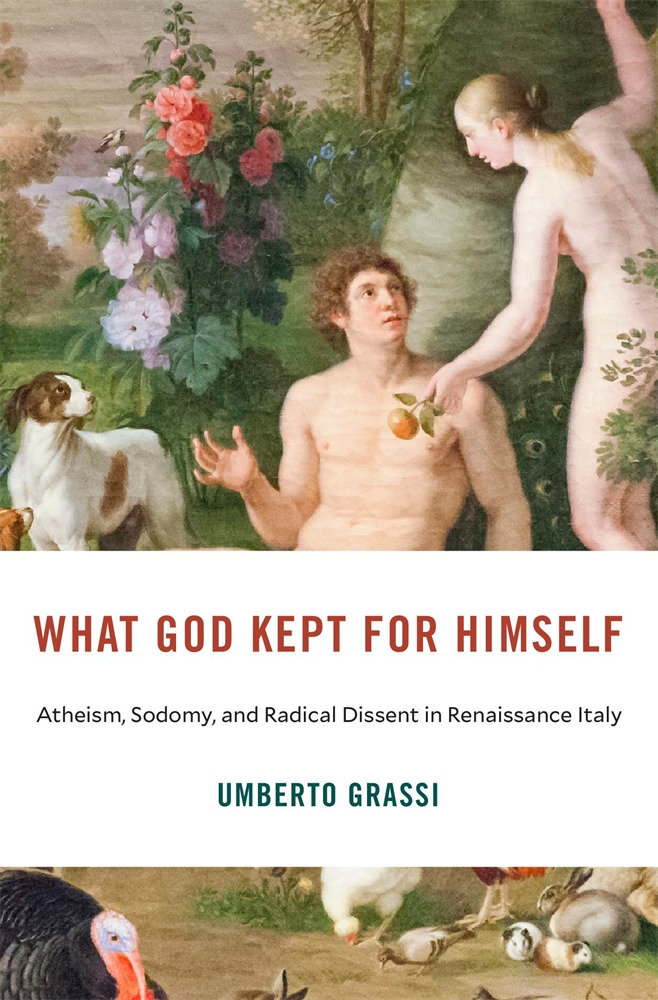
What God Kept for Himself
Atheism, Sodomy, and Radical Dissent in Renaissance Italy
Umberto Grassi traces how heresy trials connected sexual nonconformity with religious dissent in early modern Italy.
Heresy on Trial
Come here for
- Inquisition trials across the Italian peninsula
- Arguments linking sexual freedom, Church corruption, and elite power
Expect
- Accusations centered on Adam and Eve’s original sin
- Challenges to papal authority and Christian morality
Where it sits
How strongly BookFrontier reads the book as belonging to each subject.
Nearest books
Matched by our semantic model. Ordered by what its readers also loved.
 QLuther Blissett55% subject match
 The Cheese and the WormsCarlo Ginzburg53% subject matchShares Renaissance History
 A.d. 381Charles Freeman52% subject match
 Discerning SpiritsNancy Mandeville Caciola48% subject match
For younger readers: Heretics Anonymous
Start with three books, and this one can be the first.
Members get a new edition every morning: a route out from their books to essays, research and talks, with the reason for each.
Sign upAbout this book
A revelatory account of sexual nonconformity and radical religious dissent in Renaissance Italy, drawing on never-before-studied Inquisition trials.
Between the sixteenth and eighteenth centuries, a series of highly controversial Inquisition trials took place throughout the Italian peninsula. The defendants were all accused of the same heresy: claiming that Adam and Eve’s original sin had been committing sodomy, a “celestial” pleasure reserved for God alone.
Continue reading
Such claims were not merely subversive sexual innuendo. Rather, they were the most radical expressions of a much broader critique—one that not only targeted repressive sexual taboos but also denounced the corruption of the Church, questioned the authority of the pope, and suggested that organized religion itself was a hoax designed to maintain elite power.
As Umberto Grassi shows, these dissenters’ beliefs about sexual freedom came to play a crucial role in the development of skeptical and atheistic positions. Many of the accused argued that, by violating God’s exclusive right to engage in sodomy, Adam and Eve dared to make themselves like gods. This view, which led to charges of atheism, radicalized a more widely held belief that the ruling classes banned sodomy to prevent the masses from enjoying it. In turn, such heresies fueled indictments of Christian morality as an all-too-human invention, whose purpose was to reinforce a social order in which the ruling classes controlled both sexuality and religious truth.
Tracing a radical tradition of thought on trial, What God Kept for Himself establishes the firm relationship between sexual nonconformity and religious dissent in the early modern Mediterranean world.
Publisher details
Publisher categories
- Italian History
- Renaissance History
- 17th-Century History
- Authors
- Umberto Grassi
- Publisher
- WW Norton
- Published
- February 17, 2026
- Format
- Print & ebook
- Reading lane
- Italian History