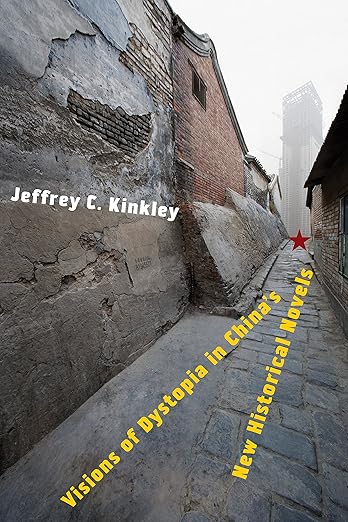
Visions of Dystopia in China’s New Historical Novels
Kindle Edition
An account of how late-century Chinese historical novels recast suffering, history, and dystopia.
Chinese Dystopian Novels
Come here for
- How novels unsettle standard Communist and historical narratives
- Chinese contributions to global dystopian fiction
Expect
- Magical realism in epic narratives
- Surrealism in epic narratives
Where it sits
How strongly BookFrontier reads the book as belonging to each subject.
Nearest books
Matched by our semantic model. Ordered by what its readers also loved. Most of these share its genre: Chinese Literary Criticism.
 Changing Stories in the Chinese WorldMark Elvin74% subject match
 To LiveYu Hua68% subject match
 The Stranger and the Chinese Moral ImaginationHaiyan Lee65% subject match
For younger readers: Revolution Is Not a Dinner Party, Along the River, Red Scarf Girl
Start with three books, and this one can be the first.
Members get a new edition every morning: a route out from their books to essays, research and talks, with the reason for each.
Sign upAbout this book
The depiction of personal and collective suffering in modern Chinese novels differs significantly from standard Communist accounts and many Eastern and Western historical narratives.
Continue reading
Writers such as Yu Hua, Su Tong, Wang Anyi, Mo Yan, Han Shaogong, Ge Fei, Li Rui, and Zhang Wei skew and scramble common conceptions of China's modern development, deploying avant-garde narrative techniques from Latin American and Euro-American modernism to project a surprisingly "un-Chinese" dystopian vision and critical view of human culture and ethics.
The epic narratives of modern Chinese fiction make rich use of magical realism, surrealism, and unusual treatments of historical time. Also featuring graphic depictions of sex and violence, as well as dark, raunchy comedy, these novels reflect China's recent history re-presenting the overthrow of the monarchy in the early twentieth century and the resulting chaos of revolution and war; the recurring miseries perpetrated by class warfare during the dictatorship of Mao Zedong; and the social dislocations caused by China's industrialization and rise as a global power. This book casts China's highbrow historical novels from the late 1980s to the first decade of the twenty-first century as a distinctively Chinese contribution to the form of the global dystopian novel and, consequently, to global thinking about the interrelations of utopia and dystopia.
Publisher details
Publisher categories
- Literary Theory
- Chinese Literary Criticism
- Authors
- Jeffrey C. Kinkley
- Publisher
- Columbia University Press
- Published
- November 18, 2014
- Format
- Ebook
- Reading lane
- Literary Theory