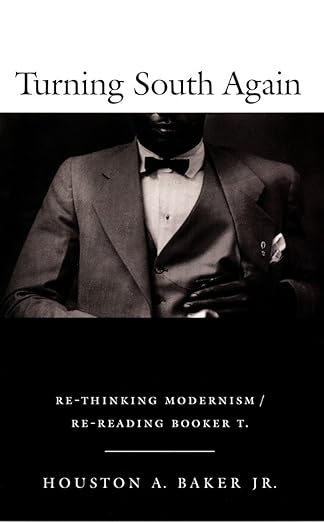
Turning South Again
Re-thinking Modernism/re-reading Booker T.
Houston A. Baker examines black modernism through incarceration, Tuskegee, personal memoir, and literary criticism.
- Themes
- African American modernism, Incarceration and Black life, The South in American cultural studies
- Pacing
- Reflective
Tuskegee and Black Modernism
Come here for
- A revisionist reading of Booker T. Washington and Tuskegee
- The South’s place in African American cultural studies
Expect
- Historical considerations alongside psychoanalysis and whiteness studies
- Autobiographical prose, literary criticism, blues lyrics, and poetry
Where it sits
How strongly BookFrontier reads the book as belonging to each subject.
Nearest books
Matched by our semantic model. Ordered by what its readers also loved. Most of these share its genres: Black Lit Crit and African American Studies.
 Up from SlaveryBooker T. Washington59% subject match
 Monstrous IntimaciesChristina Sharpe59% subject match
 The Black BoxHenry Louis Gates, Jr.58% subject match
 Black Marxism, Revised and Updated Third EditionCedric J. Robinson58% subject match
 The Ideological Origins of African American LiteraturePhillip M. Richards57% subject matchAlso shares Race & Culture in Literature
 Playing in the DarkToni Morrison57% subject match
 Stony the RoadHenry Louis Gates, Jr.57% subject match
For younger readers: Now Is Your Time!, A Long Time Coming, The Color of a Lie
Start with three books, and this one can be the first.
Members get a new edition every morning: a route out from their books to essays, research and talks, with the reason for each.
Sign upAbout this book
In Turning South Again the distinguished and award-winning essayist, poet, and scholar of African American literature Houston A. Baker, Jr. offers a revisionist account of the struggle for black modernism in the United States.
Continue reading
With a take on the work of Booker T. Washington and the Tuskegee Institute surprisingly different from that in his earlier book Modernism and the Harlem Renaissance, Baker combines historical considerations with psychoanalysis, personal memoir, and whiteness studies to argue that the American South and its regulating institutions—particularly that of incarceration—have always been at the center of the African American experience.
From the holds of slave ships to the peonage of Reconstruction to the contemporary prison system, incarceration has largely defined black life in the United States. Even Washington’s school at Tuskegee, Baker explains, housed and regulated black bodies no longer directly controlled by slave owners. He further implicates Washington by claiming that in enacting his ideas about racial “uplift,” Washington engaged in “mulatto modernism,” a compromised attempt at full citizenship. Combining autobiographical prose, literary criticism, psychoanalytic writing, and, occasionally, blues lyrics and poetry, Baker meditates on the consequences of mulatto modernism for the project of black modernism, which he defines as the achievement of mobile, life-enhancing participation in the public sphere and economic solvency for the majority of African Americans. By including a section about growing up in the South, as well as his recent return to assume a professorship at Duke, Baker contributes further to one of the book’s central concerns: a call to centralize the South in American cultural studies.
Publisher details
Publisher categories
- Cultural Heritage Lives
- U.S. State & Local History
- African American Studies
- Authors
- Houston A. Baker
- Publisher
- Duke University Press
- Published
- June 6, 2001
- Format
- Print & ebook
- Reading lane
- Cultural Heritage Lives