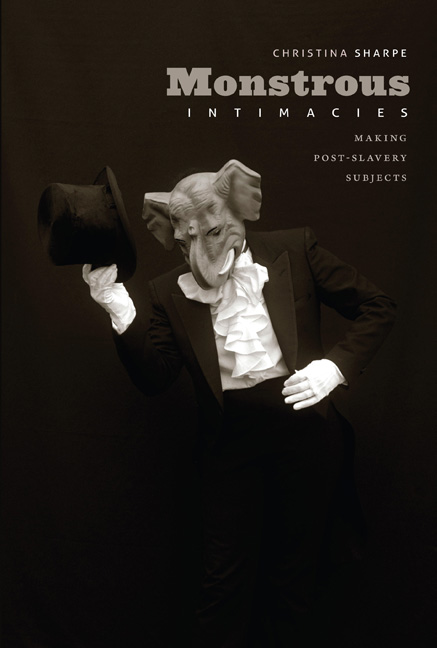
Monstrous Intimacies
Making Post-slavery Subjects
Series: Perverse Modernities: A Series Edited by Jack Halberstam and Lisa Lowe
Christina Sharpe reads Black Atlantic texts and art through slavery’s continuing effects.
- Themes
- Slavery’s ongoing effects, Post-slavery subjectivity, Representation in art
- Pacing
- Reflective
Post-slavery Intimacies
Come here for
- Readings of Douglass and Essie Mae Washington-Williams
- Analysis of Kara Walker’s silhouettes
Expect
- Readings of Gayl Jones’s Corregidora
- Discussion of Isaac Julien’s The Attendant
Where it sits
How strongly BookFrontier reads the book as belonging to each subject.
Nearest books
Matched by our semantic model. Ordered by what its readers also loved.
 The Black Feminist ReaderJoy James, T. Denean Sharpley-Whiting57% subject matchShares African American Studies and Black Lit Crit
 The Apocalypse of Settler ColonialismGerald Horne54% subject matchShares Slavery Studies
 The Black BookMiddleton A. Harris, Ernest Smith57% subject matchShares African American Studies and Slavery Studies
 Captive GendersEric A. Stanley, Nat Smith55% subject match
 Black Skin, White MasksFrantz Fanon50% subject match
 The Delectable NegroVincent Woodard, Dwight McBride61% subject matchShares Black Lit Crit and Slavery Studies
 Tales from the Haunted SouthTiya Miles61% subject match
For younger readers: A Sitting in St. James, Now Is Your Time!, The Middle Passage
Start with three books, and this one can be the first.
Members get a new edition every morning: a route out from their books to essays, research and talks, with the reason for each.
Sign upAbout this book
Arguing that the fundamental, familiar, sexual violence of slavery and racialized subjugation have continued to shape black and white subjectivities into the present, Christina Sharpe interprets African diasporic and Black Atlantic visual and literary texts that address those “monstrous intimacies” and their repetition as constitutive of post-slavery subjectivity.
Continue reading
Her illuminating readings juxtapose Frederick Douglass’s narrative of witnessing the brutal beating of his Aunt Hester with Essie Mae Washington-Williams’s declaration of freedom in Dear Senator: A Memoir by the Daughter of Strom Thurmond, as well as the “generational genital fantasies” depicted in Gayl Jones’s novel Corregidora with a firsthand account of such “monstrous intimacies” in the journals of an antebellum South Carolina senator, slaveholder, and vocal critic of miscegenation. Sharpe explores the South African–born writer Bessie Head’s novel Maru—about race, power, and liberation in Botswana—in light of the history of the KhoiSan woman Saartje Baartman, who was displayed in Europe as the “Hottentot Venus” in the nineteenth century. Reading Isaac Julien’s film The Attendant, Sharpe takes up issues of representation, slavery, and the sadomasochism of everyday black life. Her powerful meditation on intimacy, subjection, and subjectivity culminates in an analysis of Kara Walker’s black silhouettes, and the critiques leveled against both the silhouettes and the artist.
Publisher details
Publisher categories
- Asian American Lit Crit
- Literary Theory
- Women's Studies
- Authors
- Christina Sharpe
- Publisher
- Duke University Press
- Published
- September 7, 2010
- Format
- Print & ebook
- Reading lane
- Asian American Lit Crit