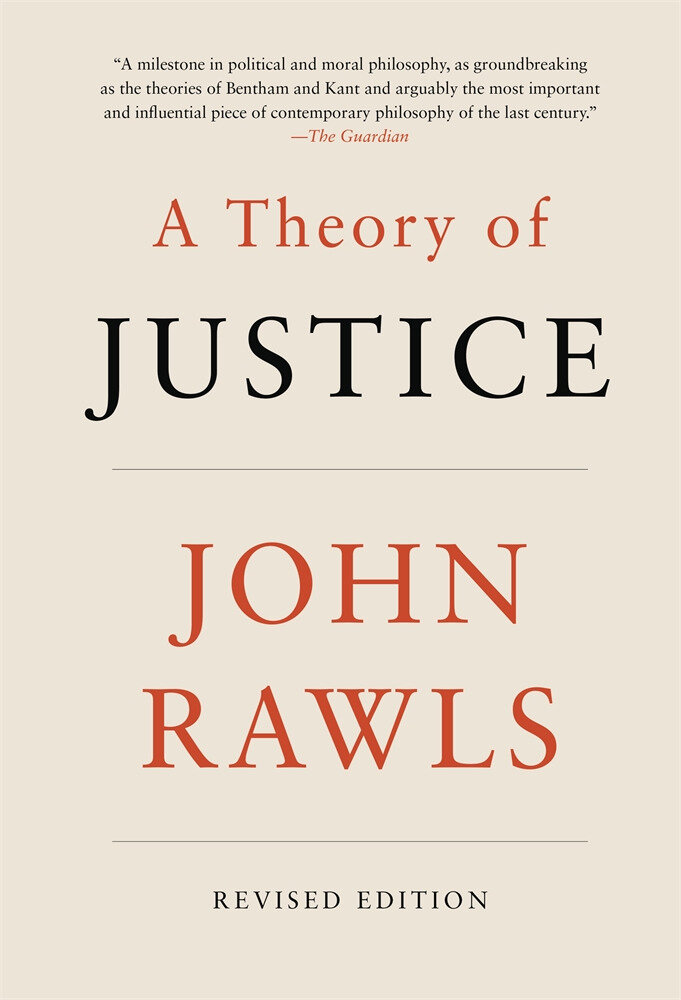
Theory of Justice
Revised Edition
Rawls asks what principles we would choose if we didn’t know where we’d land in society.
- Themes
- Political and moral philosophy, Justice and equality, Social contract theory
Justice Under Scrutiny
Come here for
- A thought experiment that puts fairness before self-interest
- A layered argument about rights, duties, and social goods
Expect
- Careful philosophical reasoning, not a quick political fix
- Questions that keep justice in view beyond the page
Where it sits
How strongly BookFrontier reads the book as belonging to each subject.
Nearest books
Matched by our semantic model. Ordered by what its readers also loved.
 The Origins of Political OrderFrancis Fukuyama52% subject matchShares Political History & Ideas
 The Marx-Engels ReaderKarl Marx55% subject matchShares Political Philosophy
 One-Dimensional ManHerbert Marcuse56% subject match
 The Power EliteC. Wright Mills, Alan Wolfe49% subject matchShares Political History & Ideas
 Development as FreedomAmartya Sen51% subject match
For younger readers: Anarchy Explained to Children
Start with three books, and this one can be the first.
Members get a new edition every morning: a route out from their books to essays, research and talks, with the reason for each.
Sign upAbout this book
“A milestone in political and moral philosophy, as groundbreaking as the theories of Bentham and Kant and arguably the most important and influential piece of contemporary philosophy of the last century.” —The Guardian
The principles of justice that Rawls set forth in this book are those that free and rational people would accept in an “original position” of equality.
Continue reading
In this hypothetical situation, which corresponds to the state of nature in social contract theory, no one knows their place in society; their class or social status; their fortune in the distribution of natural assets and abilities—their intelligence, strength, and the like—or even their conception of the good. Deliberating behind this “veil of ignorance,” people naturally determine their proper rights and duties. Thus, as Rawls writes, “each person possesses an inviolability founded on justice that even the welfare of society as a whole cannot override.”
Incorporating the ideas of Rousseau, Kant, Emerson, and Lincoln, Rawls’s theory is as powerful today as it was when first published in 1971. For more than half a century, A Theory of Justice has been taught and debated, celebrated and translated into more than thirty languages. This revised edition includes changes, discussed in the preface, that Rawls considered to be significant, especially to the discussions of liberty and primary social goods.
Publisher details
Publisher categories
- Political Philosophy
- Civil Rights
- Political History & Ideas
- Authors
- John Rawls
- Publisher
- WW Norton
- Published
- October 5, 1999
- Format
- Print & ebook
- Reading lane
- Political Philosophy