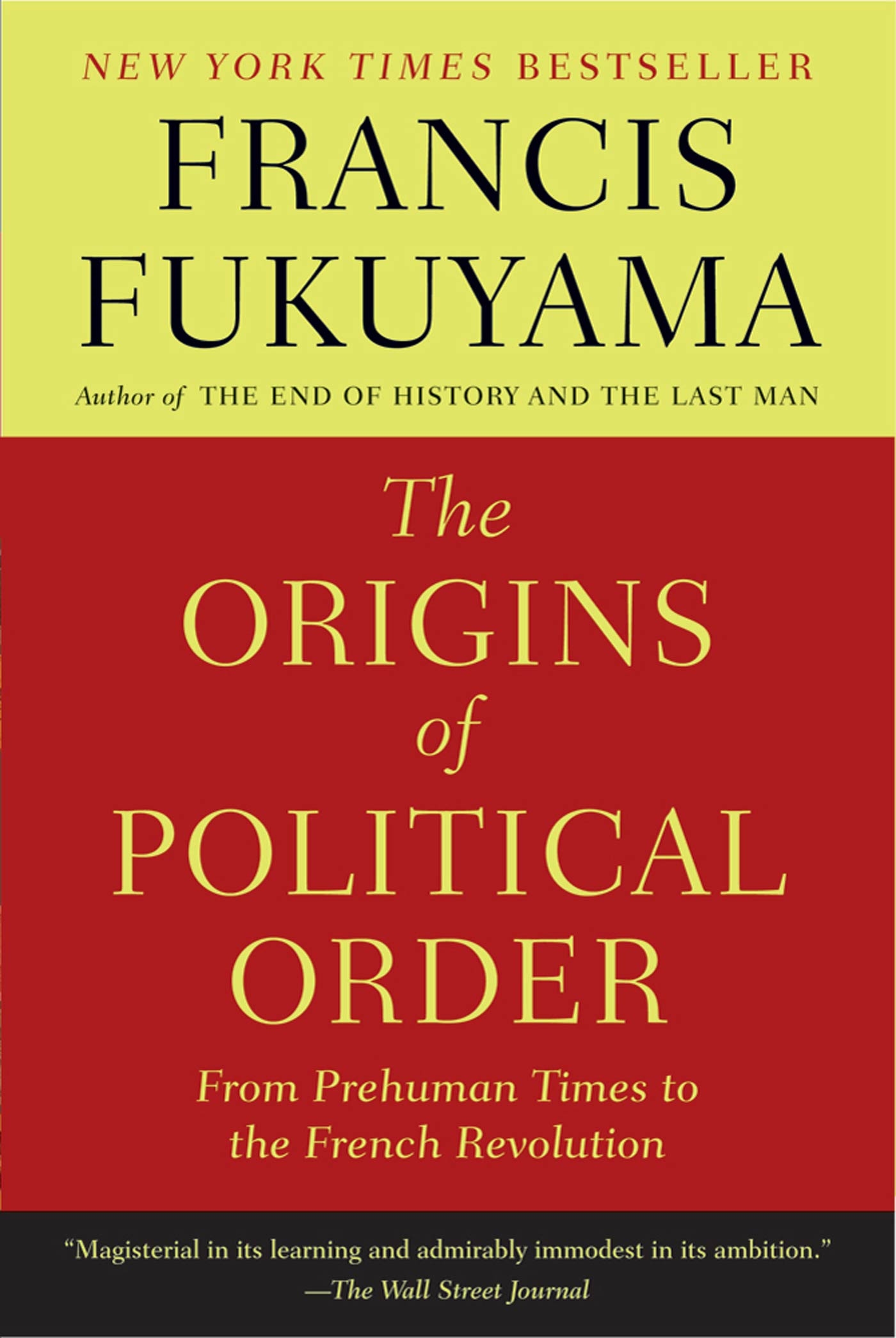
The Origins of Political Order
From Prehuman Times to the French Revolution
- Themes
- Political institution formation, Rule of law, Political accountability
Who it’s for
- Readers interested in how political institutions developed across societies
- Readers interested in the history of democratic institutions
Where it sits
How strongly BookFrontier reads the book as belonging to each subject.
Nearest books
Matched by our semantic model. Ordered by what its readers also loved. Most of these share its genre: World History.
 The Silk RoadsPeter Frankopan54% subject match
 The Anatomy of FascismRobert O. Paxton52% subject match
 CivilizationNiall Ferguson54% subject match
For younger readers: Strongman, Unstoppable Us, Volume 2: Why the World Isn't Fair
Start with three books, and this one can be the first.
Members get a new edition every morning: a route out from their books to essays, research and talks, with the reason for each.
Sign upAbout this book
A landmark history of the origins of modern democratic societies by one of our most important political thinkers.
A New York Times Notable Book for 2011
A Globe and Mail Best Books of the Year 2011 Title
A Kirkus Reviews Best Nonfiction of 2011 title
Virtually all human societies were once organized tribally, yet over time most developed new political institutions which included a central state that could keep the peace and uniform laws that applied to all citizens.
Continue reading
Some went on to create governments that were accountable to their constituents. We take these institutions for granted, but they are absent or are unable to perform in many of today's developing countries—with often disastrous consequences for the rest of the world.
Francis Fukuyama, author of the bestselling The End of History and the Last Man and one of our most important political thinkers, provides a sweeping account of how today's basic political institutions developed. The first of a major two-volume work, The Origins of Political Order begins with politics among our primate ancestors and follows the story through the emergence of tribal societies, the growth of the first modern state in China, the beginning of the rule of law in India and the Middle East, and the development of political accountability in Europe up until the eve of the French Revolution.
Drawing on a vast body of knowledge—history, evolutionary biology, archaeology, and economics—Fukuyama has produced a brilliant, provocative work that offers fresh insights on the origins of democratic societies and raises essential questions about the nature of politics and its discontents.
Publisher details
Publisher categories
- World History
- Political History & Ideas
- Authors
- Francis Fukuyama
- Publisher
- Farrar Straus & Giroux
- Published
- March 27, 2012
- Format
- Print & ebook
- Reading lane
- World History