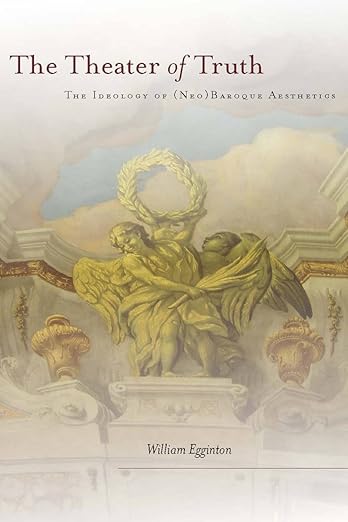
The Theater of Truth
The Ideology of (neo)baroque Aesthetics
William Egginton links two Baroques through a shared problem of appearance, representation, and cultural politics.
Hispanic Baroques
Come here for
- The paradox between appearances and what they represent
- Art and literature of the Hispanic Baroques, old and new
Expect
- The Spanish Empire’s political and social world
- A theory relating the Baroques and vocabulary for their ideological differences
Where it sits
How strongly BookFrontier reads the book as belonging to each subject.
Nearest books
Matched by our semantic model. Ordered by what its readers also loved.
 The Cornucopian Mind and the Baroque Unity of the ArtsGiancarlo Maiorino62% subject matchShares Baroque & Rococo Art History and Aesthetics
 Tilting CervantesBruce R. Burningham56% subject matchShares Iberian Lit Crit
 Neoclassicism and Romanticism: Architecture, Sculpture, Painting, DrawingROLF TOMAN50% subject match
 Kafka's ClothesMark M. Anderson49% subject match
 Aesthetic DilemmasMarlo Alexandra Burks48% subject matchShares Aesthetics
 Affecting GraceKenneth S. Calhoon47% subject match
 Erotic MysticismNancy LaGreca47% subject match
 The Politics of AestheticsJacques Ranci, Gabriel Rockhill47% subject matchShares Aesthetics
Start with three books, and this one can be the first.
Members get a new edition every morning: a route out from their books to essays, research and talks, with the reason for each.
Sign upAbout this book
The Theater of Truth argues that seventeenth-century baroque and twentieth-century neobaroque aesthetics have to be understood as part of the same complex. The Neobaroque, rather than being a return to the stylistic practices of a particular time and place, should be described as the continuation of a cultural strategy produced as a response to a specific problem of thought that has beset Europe and the colonial world since early modernity.
Continue reading
This problem, in its simplest philosophical form, concerns the paradoxical relation between appearances and what they represent. Egginton explores expressions of this problem in the art and literature of the Hispanic Baroques, new and old. He shows how the strategies of these two Baroques emerged in the political and social world of the Spanish Empire, and how they continue to be deployed in the cultural politics of the present. Further, he offers a unified theory for the relation between the two Baroques and a new vocabulary for distinguishing between their ideological values.
Publisher details
Publisher categories
- Iberian Lit Crit
- Authors
- William Egginton
- Publisher
- Stanford University Press
- Published
- December 17, 2009
- Format
- Print & ebook
- Reading lane
- Iberian Lit Crit