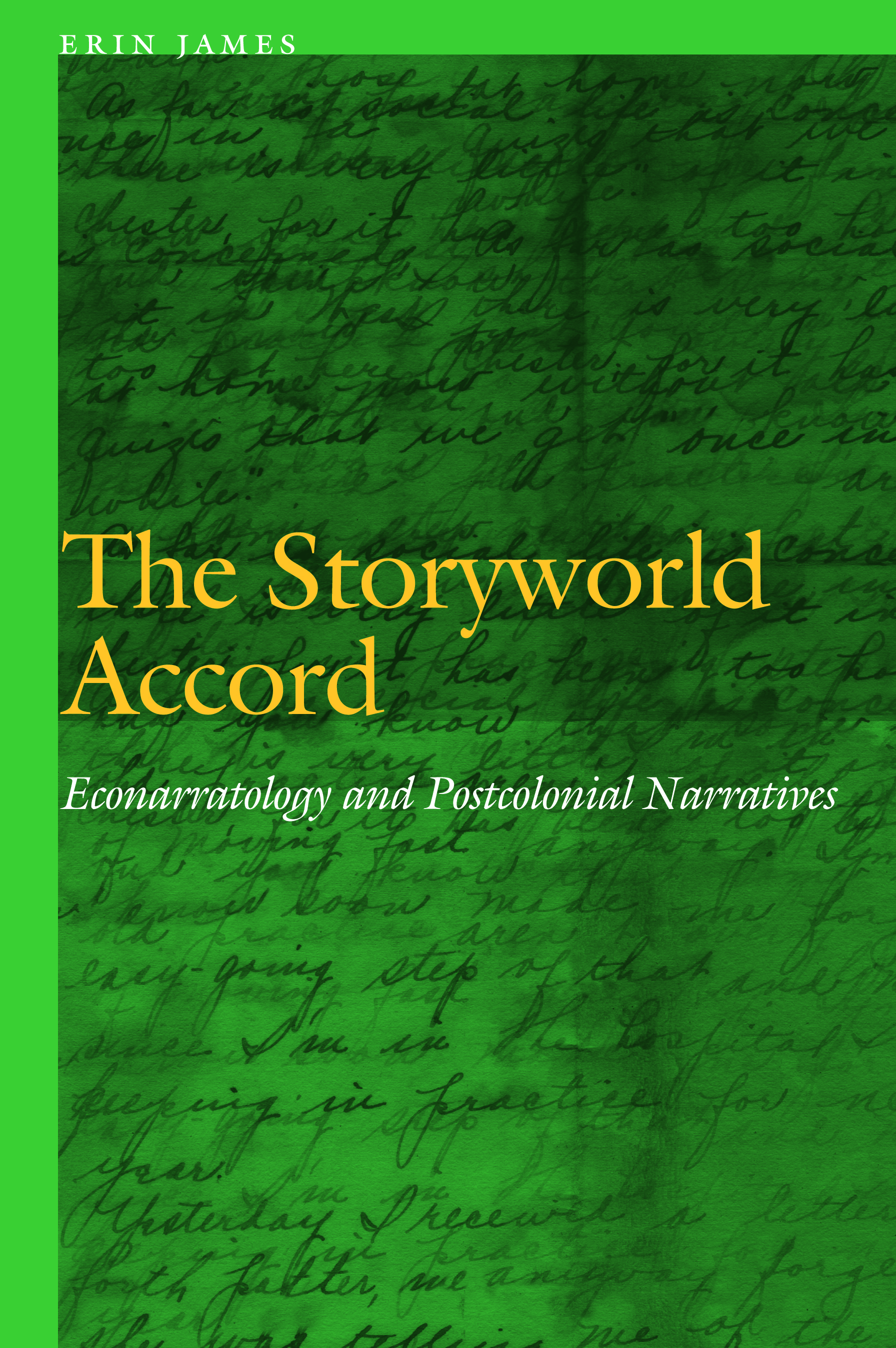
Erin James examines how postcolonial narratives connect imagined environments, subjectivity, and political sovereignty.
Postcolonial Storyworlds
Come here for
- Storyworlds as frameworks for reading narrative space and time
- Comparisons of nonrealist and postmodern postcolonial texts
Expect
- Econarratology brings narratological and ecocritical concerns together
- Attention to representation and environment in narrative form
Where it sits
How strongly BookFrontier reads the book as belonging to each subject.
Nearest books
Matched by our semantic model. Ordered by what its readers also loved. Most of these share its genre: Nature in Literature.
 Postcolonial EcologiesElizabeth DeLoughrey, George H. Handley64% subject match
 African Fiction and Joseph ConradByron Caminero-Santangelo59% subject matchAlso shares African Lit Crit
 Climate and CrisesBen Holgate58% subject match
 The Ecological PlotJohn MacNeill Miller56% subject match
 Premodern Ecologies in the Modern Literary ImaginationVin Nardizzi, Tiffany Jo Werth55% subject match
 Questioning BordersRobin Visser55% subject match
 Prose of the WorldSaikat Majumdar53% subject match
 Allegories of the AnthropoceneElizabeth M. DeLoughrey53% subject matchAlso shares Caribbean & Latin American Criticism
For younger readers: The Barefoot Book of Earth Tales, A Pride of African Tales
Start with three books, and this one can be the first.
Members get a new edition every morning: a route out from their books to essays, research and talks, with the reason for each.
Sign upAbout this book
“Storyworlds,” mental models of context and environment within which characters function, is a concept used to describe what happens in narrative.
Continue reading
Narratologists agree that the concept of storyworlds best captures the ecology of narrative interpretation by allowing a fuller appreciation of the organization of both space and time, by recognizing reading as a process that encourages readers to compare the world of a text to other possible worlds, and by highlighting the power of narrative to immerse readers in new and unfamiliar environments.
Focusing on the work of writers from Trinidad and Nigeria, such as Sam Selvon and Ben Okri, The Storyworld Accord investigates and compares the storyworlds of nonrealist and postmodern postcolonial texts to show how such narratives grapple with the often-collapsed concerns of subjectivity, representation, and environment, bringing together these narratological and ecocritical concerns via a mode that Erin James calls econarratology. Arguing that postcolonial ecocriticism, like ecocritical studies, has tended to neglect imaginative representations of the environment in postcolonial literatures, James suggests that readings of storyworlds in postcolonial texts helps narrative theorists and ecocritics better consider the ways in which culture, ideologies, and social and environmental issues are articulated in narrative forms and structures, while also helping postcolonial scholars more fully consider the environment alongside issues of political subjectivity and sovereignty.
Publisher details
Publisher categories
- African Lit Crit
- Caribbean & Latin American Criticism
- Authors
- Erin James
- Publisher
- Nebraska
- Published
- July 1, 2015
- Format
- Print & ebook
- Reading lane
- African Lit Crit