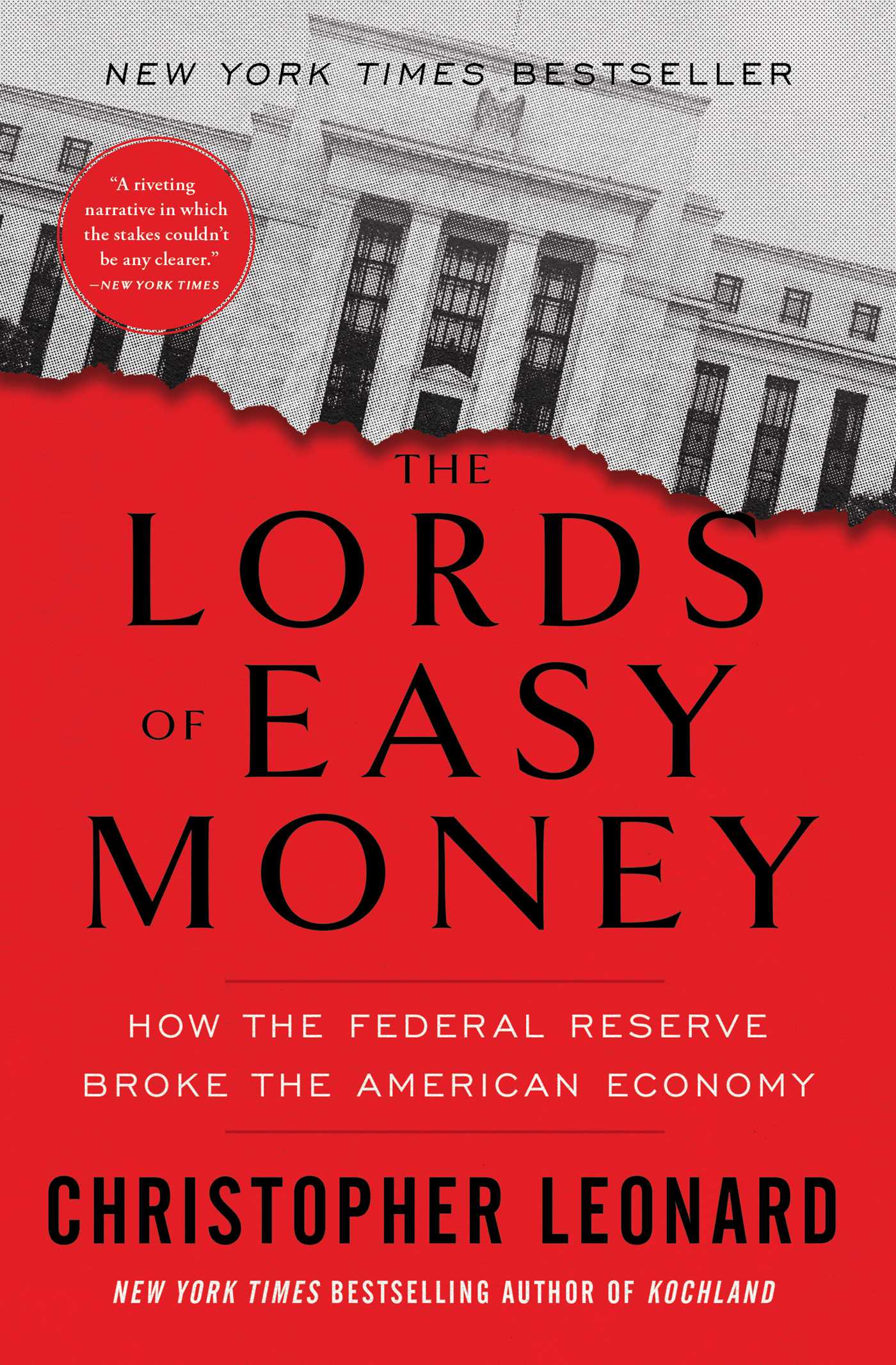
The Lords of Easy Money
How the Federal Reserve Broke the American Economy
Christopher Leonard makes monetary policy legible through a pointed account of the Federal Reserve’s interventions.
Money’s Ripple Effects
Come here for
- A sharp look at quantitative easing and its economic aftershocks
- The Fed’s influence on inequality, markets, and financial stability
Expect
- A critical inside account of the Fed’s choices
- Big economic consequences, told in clear, direct prose
Where it sits
How strongly BookFrontier reads the book as belonging to each subject.
Nearest books
Matched by our semantic model. Ordered by what its readers also loved.
 America's BankRoger Lowenstein74% subject matchShares Money & Monetary Policy
 Lords of FinanceLiaquat Ahamed63% subject matchShares Money & Monetary Policy
 The Triumph of Economic FreedomPhil Gramm, Donald J. Boudreaux60% subject matchShares Economic Policy
 Against the GodsPeter L. Bernstein54% subject match
 These Are the PlunderersGretchen Morgenson, Joshua Rosner63% subject match
 Exorbitant PrivilegeBarry Eichengreen64% subject matchShares Money & Monetary Policy
 Life after CapitalismGeorge Gilder57% subject match
 The Undercover Economist Strikes BackTim Harford63% subject matchShares Money & Monetary Policy and Macroeconomics
Start with three books, and this one can be the first.
Members get a new edition every morning: a route out from their books to essays, research and talks, with the reason for each.
Sign upAbout this book
The New York Times bestseller from business journalist Christopher Leonard infiltrates one of America’s most mysterious institutions—the Federal Reserve—to show how its policies spearheaded by Chairman Jerome Powell over the past ten years have accelerated income inequality and put our country’s economic stability at risk.
If you asked most people what forces led to today’s unprecedented income inequality and financial crashes, no one would say the Federal Reserve.
Continue reading
For most of its history, the Fed has enjoyed the fawning adoration of the press. When the economy grew, it was credited to the Fed. When the economy imploded in 2008, the Fed got credit for rescuing us.
But here, for the first time, is the inside story of how the Fed has reshaped the American economy for the worse. It all started on November 3, 2010, when the Fed began a radical intervention called quantitative easing. In just a few short years, the Fed more than quadrupled the money supply with one goal: to encourage banks and other investors to extend more risky debt. Leaders at the Fed knew that they were undertaking a bold experiment that would produce few real jobs, with long-term risks that were hard to measure. But the Fed proceeded anyway…and then found itself trapped. Once it printed all that money, there was no way to withdraw it from circulation. The Fed tried several times, only to see the market start to crash, at which point the Fed turned the money spigot back on. That’s what it did when COVID hit, printing 300 years’ worth of money in a few short months.
Which brings us to now: Ten years on, the gap between the rich and poor has grown dramatically, inflation is raging, and the stock market is driven by boom, busts, and bailouts. Middle-class Americans seem stuck in a stage of permanent stagnation, with wage gains wiped out by high prices even as they remain buried under credit card debt, car loan debt, and student debt. Meanwhile, the “too big to fail” banks remain bigger and more powerful than ever while the richest Americans enjoy the gains of a hyper-charged financial system.
The Lords of Easy Money “skillfully” (The Wall Street Journal) tells the “fascinating” (The New York Times) tale of how quantitative easing is imperiling the American economy through the story of the one man who tried to warn us. This is the first inside story of how we really got here—and why our economy rests on such unstable ground.
Publisher details
Publisher categories
- Banks & Banking
- Economic History
- Money & Monetary Policy
- Authors
- Christopher Leonard
- Publisher
- Simon & Schuster
- Published
- January 10, 2023
- Format
- Print & ebook
- Reading lane
- Banks & Banking