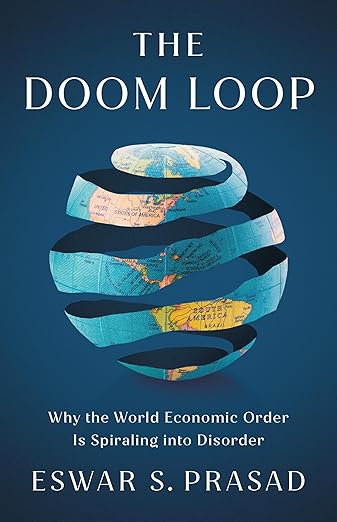
The Doom Loop
Why the World Economic Order Is Spiraling Into Disorder
Eswar Prasad traces how economic integration, domestic politics, and geopolitics feed a destabilizing global loop.
Global Economic Loop
Come here for
- How globalization deepened inequality and stoked political backlash
- The IMF and WTO’s struggle to adapt to current realities
Expect
- Discussion of rising trade wars and shifting economic power
- A critique of old solutions to global problems
Where it sits
How strongly BookFrontier reads the book as belonging to each subject.
Nearest books
Matched by our semantic model. Ordered by what its readers also loved.
 Principles for Dealing with the Changing World OrderRay Dalio65% subject match
 The End of the World Is Just the BeginningPeter Zeihan64% subject matchShares Globalization
 Exorbitant PrivilegeBarry Eichengreen64% subject match
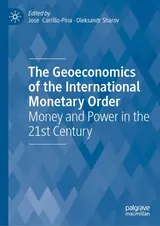 The Geoeconomics of the International Monetary OrderJose Carrillo-Pina, Oleksandr Sharov62% subject match
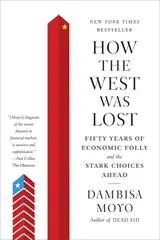 How the West Was LostDambisa Moyo62% subject matchShares Globalization
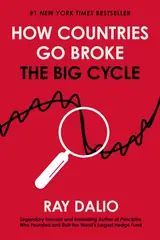 How Countries Go BrokeRay Dalio61% subject match
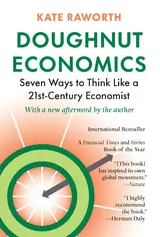 Doughnut EconomicsKate Raworth60% subject match
 The Undercover Economist Strikes BackTim Harford60% subject match
Start with three books, and this one can be the first.
Members get a new edition every morning: a route out from their books to essays, research and talks, with the reason for each.
Sign upAbout this book
The acclaimed economist and author of The Future of Money argues that the forces meant to stabilize the world’s economy are in fact driving global instability
“An excellent survey of some of the most important issues in international affairs today.” —Financial Times
Global economic power is shifting, liberal market-oriented democracies face growing domestic turmoil, and international trade and financial integration is crumbling. How did we get here?
Continue reading
In The Doom Loop, economist Eswar Prasad argues that the very forces that we long believed could stabilize the world order are fueling its destabilization. Rather than promoting shared prosperity, globalization has instead deepened economic inequality, stoked political backlash, and prompted escalating trade wars. Institutions like the International Monetary Fund and World Trade Organization, founded to foster international cooperation, have failed to adapt to twenty-first-century realities. The rise of “middle power” countries like India, Brazil, and Indonesia once suggested a stable multipolar future, but today, such nations are increasingly forced to pick sides as the United States and China fight for global dominance.
Prasad argues that we are caught in a destructive feedback loop between economics, domestic politics, and geopolitics. The Doom Loop offers a clear-eyed and bracing account of a world spiraling into disorder, and makes it clear that old solutions cannot pull us out—we need radically new solutions to solve the world’s problems.
Publisher details
Publisher categories
- International Economics
- Globalization
- Democracy
- Political Economy
- Authors
- Eswar S. Prasad
- Publisher
- PublicAffairs
- Published
- February 3, 2026
- Format
- Print & ebook
- Reading lane
- International Economics