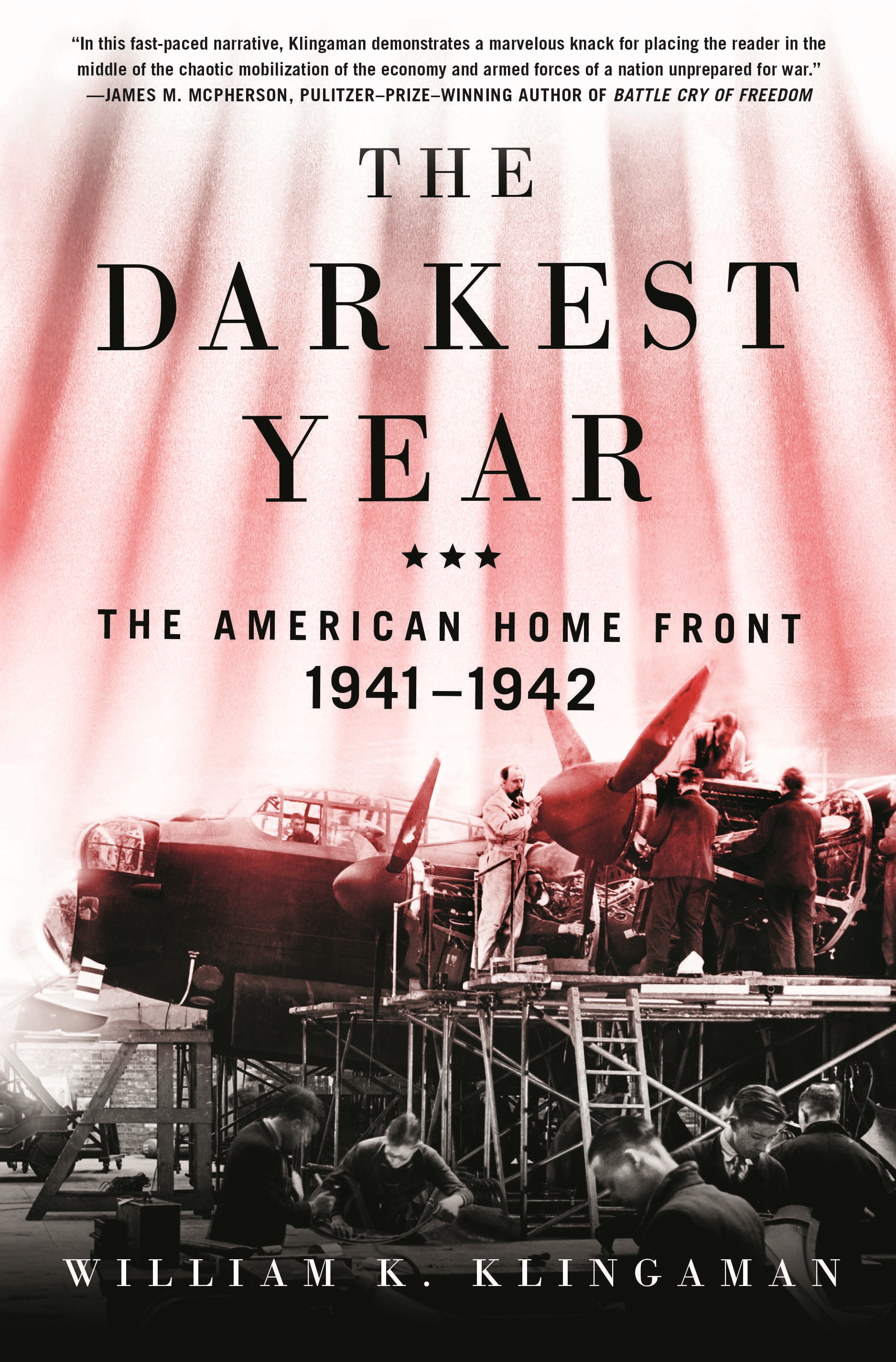
The Darkest Year
The American Home Front 1941-1942
A psychological history of a divided nation facing military setbacks and the pressures of total war.
- Themes
- Anxiety under total war, Wartime social divisions, Changes in family and cultural life
Anxious Home Front
Come here for
- The American home front beyond battlefield accounts
- War’s effects on family roles, race relations, work, and culture
Expect
- A focus on public words and everyday behavior
- A portrait of anxiety, uncertainty, and deepening divisions
Where it sits
How strongly BookFrontier reads the book as belonging to each subject.
Nearest books
Matched by our semantic model. Ordered by what its readers also loved. Most of these share its genre: World War II History.
 The Wounded GenerationDavid Nasaw60% subject match
 The Accidental PresidentA. J. Baime55% subject match
 Allies at WarTim Bouverie54% subject match
 Twilight of the GodsIan W Toll56% subject matchAlso shares WWII Pacific Theater
 The War BelowJames Scott55% subject matchAlso shares WWII Pacific Theater
 Last Call at the Hotel ImperialDeborah Cohen51% subject match
 World War II at SeaCraig L. Symonds52% subject matchAlso shares WWII Pacific Theater
 The Devil Reached Toward the SkyGarrett M. Graff55% subject matchAlso shares WWII Pacific Theater
For younger readers: Air Raid--Pearl Harbor!, When Can We Go Back to America?, What Was Pearl Harbor?
Start with three books, and this one can be the first.
Members get a new edition every morning: a route out from their books to essays, research and talks, with the reason for each.
Sign upAbout this book
The Darkest Year is acclaimed author William K. Klingaman’s narrative history of the American home front from December 7, 1941 through the end of 1942, a psychological study of the nation under the pressure of total war.
For Americans on the home front, the twelve months following the Japanese attack on Pearl Harbor comprised the darkest year of World War Two.
Continue reading
Despite government attempts to disguise the magnitude of American losses, it was clear that the nation had suffered a nearly unbroken string of military setbacks in the Pacific; by the autumn of 1942, government officials were openly acknowledging the possibility that the United States might lose the war.
Appeals for unity and declarations of support for the war effort in the aftermath of Pearl Harbor made it appear as though the class hostilities and partisan animosities that had beset the United States for decades — and grown sharper during the Depression — suddenly disappeared. They did not, and a deeply divided American society splintered further during 1942 as numerous interest groups sought to turn the wartime emergency to their own advantage.
Blunders and repeated displays of incompetence by the Roosevelt administration added to the sense of anxiety and uncertainty that hung over the nation.
The Darkest Year focuses on Americans’ state of mind not only through what they said, but in the day-to-day details of their behavior. Klingaman blends these psychological effects with the changes the war wrought in American society and culture, including shifts in family roles, race relations, economic pursuits, popular entertainment, education, and the arts.
Publisher details
Publisher categories
- World War II History
- Authors
- William K. Klingaman
- Publisher
- St. Martin's Press
- Published
- February 19, 2019
- Format
- Print & ebook
- Reading lane
- World War II History