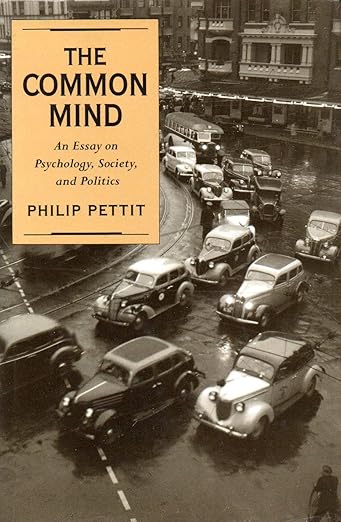
The Common Mind: An Essay on Psychology, Society, and Politics with a new postscript
Pettit links human thought’s communal resources to individual autonomy and political evaluation.
The Common Mind
Come here for
- How communal resources figure in human thought
- A framework for social and political theory
Expect
- An account of human beings as thinking subjects
- A republican rethinking of liberal commitments
Where it sits
How strongly BookFrontier reads the book as belonging to each subject.
Nearest books
Matched by our semantic model. Ordered by what its readers also loved.
 On Thinking the HumanRobert W. Jenson58% subject match
 Philosophy of Social ScienceMichael Root57% subject matchShares Political Philosophy and Social Theory
 The Philosophy of Social EcologyMurray Bookchin56% subject match
 Society Of MindMarvin Minsky55% subject match
 When Everyone Knows That Everyone Knows . . .Steven Pinker55% subject matchShares Social Psychology
 The Conscious Mind: In Search of a Fundamental TheoryDavid J. Chalmers55% subject match
 A Conflict of VisionsThomas Sowell54% subject matchShares Political Philosophy
 God, Human, Animal, MachineMeghan O'Gieblyn54% subject match
Start with three books, and this one can be the first.
Members get a new edition every morning: a route out from their books to essays, research and talks, with the reason for each.
Sign upAbout this book
What makes human beings intentional and thinking subjects? How does their intentionality and thought connect with their social nature and their communal experience? How do the answers to these questions shape the assumptions which it is legitimate to make in social explanation and political evaluation? These are the broad-ranging issues which Pettit addresses in this novel study.
Continue reading
The Common Mind argues for an original way of marking off thinking subjects, in particular human beings, from other intentional systems, natural and artificial. It holds by the holistic view that human thought requires communal resources while denying that this social connection compromises the autonomy of individuals. And, in developing the significance of this view of social subjects--this holistic individualism--it outlines a novel framework for social and political theory. Within this framework, social theory is allowed to follow any of a number of paths: space is found for intentional interpretation and decision-theoretic reconstruction, for structural explanation and rational choice derivation. But political theory is treated less ecumenically. The framework raises serious questions about contractarian and atomistic modes of thought and it points the way to a republican rethinking of liberal commitments.
Publisher details
Publisher categories
- What We Can Know
- Authors
- Philip Pettit
- Publisher
- Oxford University Press
- Published
- March 1, 1986
- Format
- Print & ebook
- Reading lane
- What We Can Know