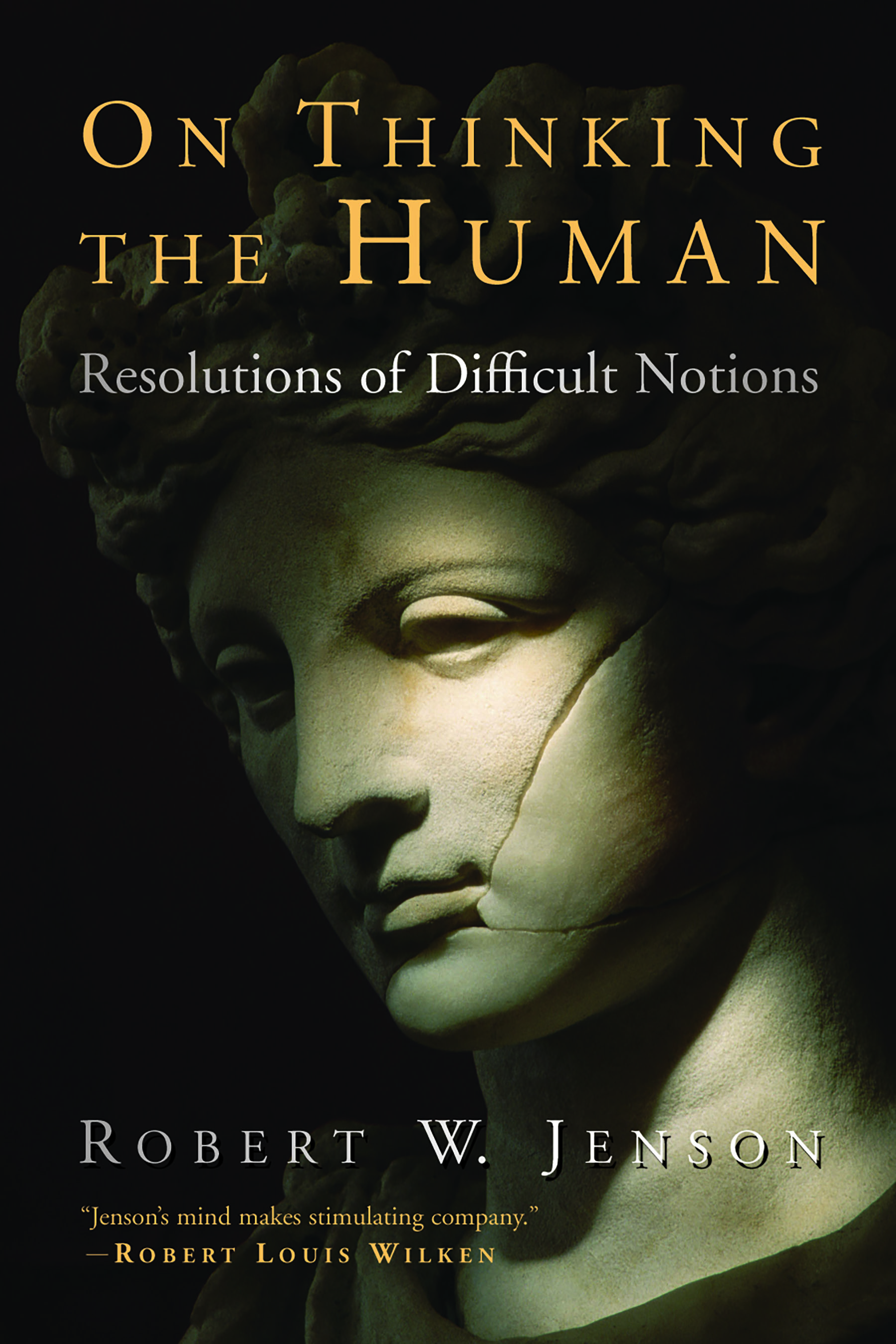
On Thinking the Human
Jenson examines human self-understanding through theology and six difficult concepts.
Theological Self-Understanding
Come here for
- The claim that humanity cannot be understood apart from God
- Engagement with Hegel, Nietzsche, and Heidegger
Expect
- Reflections on death; consciousness; freedom
- Reflections on reality; wickedness; love
Where it sits
How strongly BookFrontier reads the book as belonging to each subject.
Nearest books
Matched by our semantic model. Ordered by what its readers also loved. Most of these share its genre: The Christian Soul.
 The Basic Writings of C. G. JungCarl G. Jung, Violet S. De Laszlo48% subject match
 Theological AnthropologyMarc Cortez66% subject match
 Desperately WickedPatrick Downey64% subject matchAlso shares Religion & Philosophy
 Person, Grace, and GodPhilip A. Rolnick61% subject match
 God's Many-Splendored ImageHarrison, Nonna Verna60% subject match
 Created in God's ImageAnthony A. Hoekema59% subject match
 The Common Mind: An Essay on Psychology, Society, and Politics with a new postscriptPhilip Pettit58% subject match
 Dignity and DestinyJohn F. Kilner57% subject match
Start with three books, and this one can be the first.
Members get a new edition every morning: a route out from their books to essays, research and talks, with the reason for each.
Sign upAbout this book
Since Socrates, the effort to understand ourselves precisely as human has been the central occupation of Western thought. In this short, profound book Robert W. Jenson argues that not only are all philosophical attempts to accurately think the self doomed to failure, but also that the category "human" is unthinkable without reference to God.
Continue reading
As Jenson says at the outset of the book, "our anthropological endeavors are at once impelled and checked by an epistemic quirk or set of quirks: notions we need to use and do use when we talk about ourselves as human resist being thought." On Thinking the Human, which tackles this problem theologically while also giving a nod to philosophic heavyweights like Hegel, Nietzsche, and Heidegger, is a concise attempt to explain why this is so.
Under chapter titles that reflect the problem's different facets — "Thinking Death," "Thinking Consciousness," "Thinking Freedom," "Thinking Reality," "Thinking Wickedness," and "Thinking Love" — Jenson limns the difficulty inherent in each concept and then shows how the unthinkable becomes thinkable in light of the triune God of Scripture.
Publisher details
Publisher categories
- Philosophy
- The Christian Soul
- Cultural Anthropology
- Authors
- Robert W. Jenson
- Publisher
- Wm. B. Eerdmans Publishing
- Published
- July 2, 2003
- Format
- Paperback
- Reading lane
- Philosophy