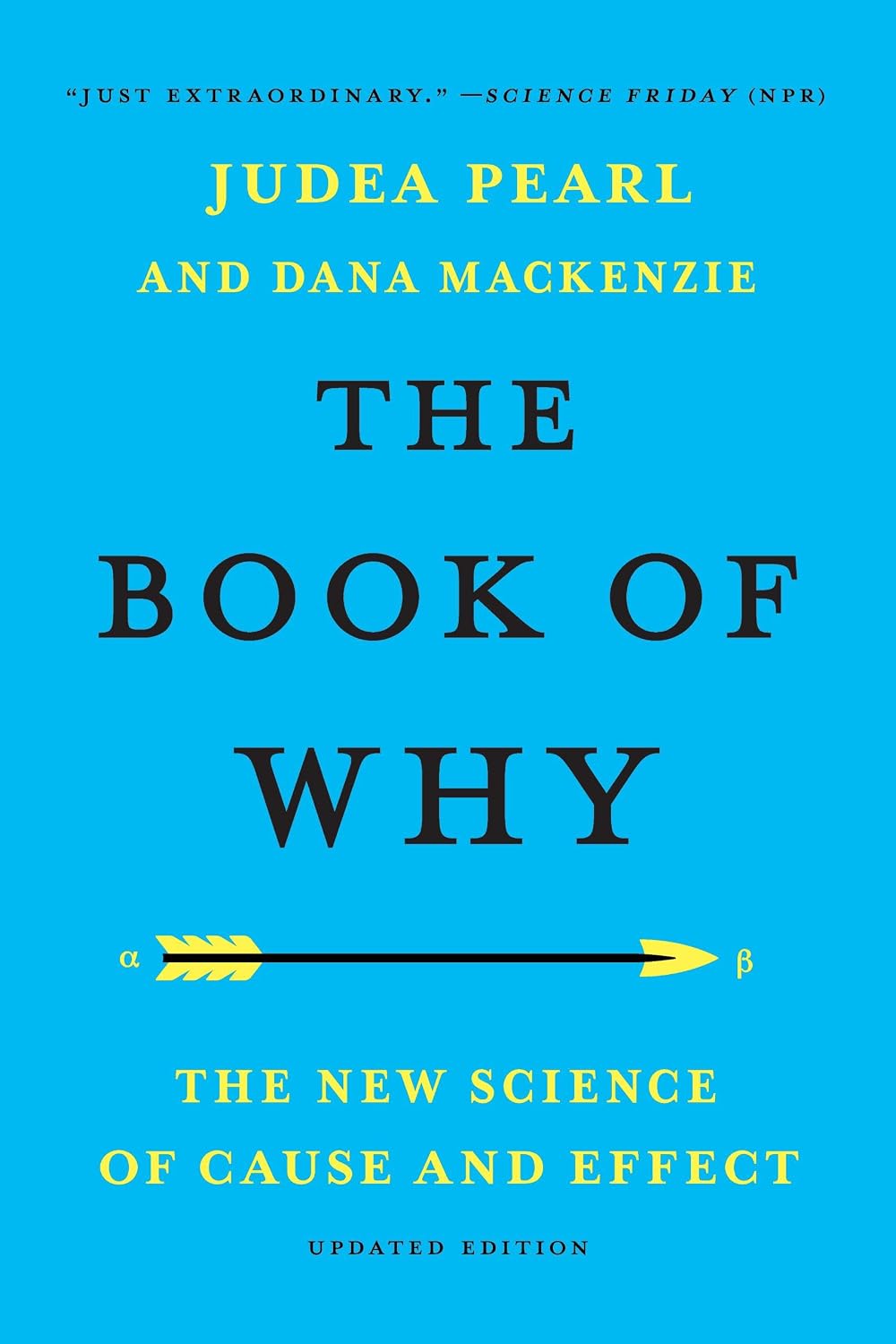
The Book of Why
The New Science of Cause and Effect
Basic Books · Print & ebook · October 20, 2026
An argument for how understanding causality has revolutionized science and will revolutionize artificial intelligence.
- Themes
- Cause and effect, Causal reasoning in AI, Counterfactual questions
- Genres
- AI & Machine Learning, Science & Society, Probability & Statistics
- Published
- Basic Books, October 20, 2026
Beyond Correlation
Explore how causal reasoning connects data to questions about what changes—and what might have been.
Come here for
- A clear-eyed look at why correlation alone cannot explain cause and effect
- Counterfactual questions and the role of causality in AI
Expect
- An introduction to cause and effect for lay readers and scientists
- Tools for thinking about the observable world and alternatives
Nearest books
Matched by what the books are about, then ordered by what their readers also loved.
 More Everything ForeverAdam Becker, Greg Tremblay50% matchShares AI & Machine Learning
 Calling BullshitCarl T. Bergstrom, Jevin D. West46% match
 LifespanDavid Sinclair, Matthew D. LaPlante47% match
For younger readers: Future Tense, Basher Science Mini: Artificial Intelligence, What Is Artificial Intelligence?
Start with three books, and this one can be the first.
Members get a new edition every morning: a route out from their books to essays, research and talks, with the reason for each.
Join the waitlistAbout this book
An argument for how understanding causality has revolutionized science and will revolutionize artificial intelligence. "Illuminating." —New York Times "Extraordinary." —Science Friday “Correlation is not causation.” This mantra, chanted by scientists for more than a century, once led to a virtual prohibition on causal talk. Today, with causal analysis taking center stage in AI and other applications, the old taboos are a thing of the past.
Continue reading
The causal revolution, instigated by Judea Pearl and others, established causality on a firm scientific basis. Pearl showed how intuitive models can interface with data to help answer causal questions, such as whether a drug will cure an illness or, counterfactually, whether an illness would have persisted absent the drug. These models provide a blueprint for causal AI to learn and take responsibility for its mistakes. Updated with a new preface and summary of recent advances, The Book of Why outlines the basics of cause and effect for lay readers and scientists alike, providing tools to explore the observable world and worlds that might have been.
Where it sits
| AI & Machine Learning | 72% |
|---|---|
| Science & Society | 39% |
| Probability & Statistics | 38% |
Percentages are BookFrontier’s reading of the book.
Publisher categories
- Business Statistics
- AI & Machine Learning
- Computer Science
- Probability & Statistics
Show all 5 publisher categories
- Applied Science
- Authors
- Judea Pearl, Dana Mackenzie
- Publisher
- Basic Books
- Published
- October 20, 2026
- Format
- Print & ebook
- Theme
- Cause and effect · Causal reasoning in AI · Counterfactual questions
- Reading lane
- Business Statistics