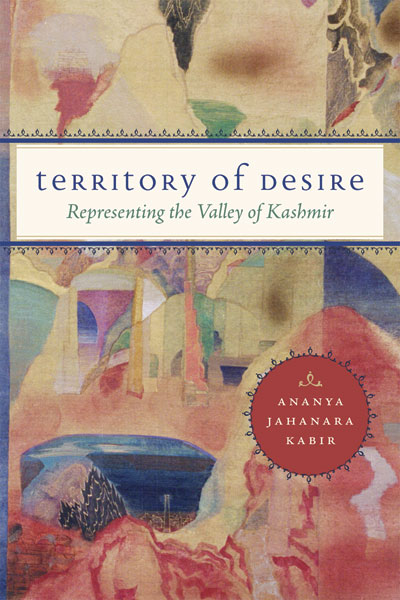
Territory of Desire
Representing the Valley of Kashmir
Ananya Jahanara Kabir traces how Kashmir’s beauty became bound to national desire and conflict.
- Themes
- Kashmir and national imagination, Colonialism and modernity, Representation and conflict
Kashmir in Representation
Come here for
- Kashmir’s portrayals in photography, literature, cinema, art, and souvenirs
- Colonial travelogues and Kashmiri handicrafts
Expect
- Links between colonialism, modernity, and conflict
- Discussion of Pandit and Muslim religious revivalisms
Where it sits
How strongly BookFrontier reads the book as belonging to each subject.
Nearest books
Matched by our semantic model. Ordered by what its readers also loved.
 Nine LivesWilliam Dalrymple49% subject match
 Cracking IndiaBapsi Sidhwa48% subject match
 The Palace of IllusionsChitra Banerjee Divakaruni48% subject match
For younger readers: Lion of the Sky, A Moment Comes, If I Tell You the Truth
Start with three books, and this one can be the first.
Members get a new edition every morning: a route out from their books to essays, research and talks, with the reason for each.
Sign upAbout this book
Moves beyond traditional analysis to understand the conflict over Kashmir
A result of territorial disputes between India and Pakistan since 1947, exacerbated by armed freedom movements since 1989, the ongoing conflict over Kashmir is consistently in the news. Taking a unique multidisciplinary approach, Territory of Desire asks how, and why, Kashmir came to be so intensely desired within Indian, Pakistani, and Kashmiri nationalistic imaginations.
Continue reading
Literary historian Ananya Jahanara Kabir finds an answer to this question in the Valley of Kashmir’s repeated portrayal as a “special” place and the missing piece of Pakistan and India.
Analyzing the conversion of natural beauty into collective desire—through photography, literature, cinema, art, and souvenir production—Kabir exposes the links between colonialism, modernity, and conflict within the postcolonial nation. Representations of Kashmir as a space of desire emerge in contemporary film, colonial “taming” of the valley through nineteenth-century colonialist travelogues, the fetishization of traditional Kashmiri handicrafts like papier maché, and Pandit and Muslim religious revivalisms in the region.
Linking a violent modernity to the fantasies of nationhood, Kabir proposes nonmilitaristic ways in which such desire may be overcome. In doing so she offers an innovative approach to complex and protracted conflict and, ultimately, its resolution.
Publisher details
Publisher categories
- Indian & South Asian History
- Indic Literary Criticism
- Authors
- Ananya Jahanara Kabir
- Publisher
- University of Minnesota Press
- Published
- March 12, 2009
- Format
- Print & ebook
- Reading lane
- Indian & South Asian History