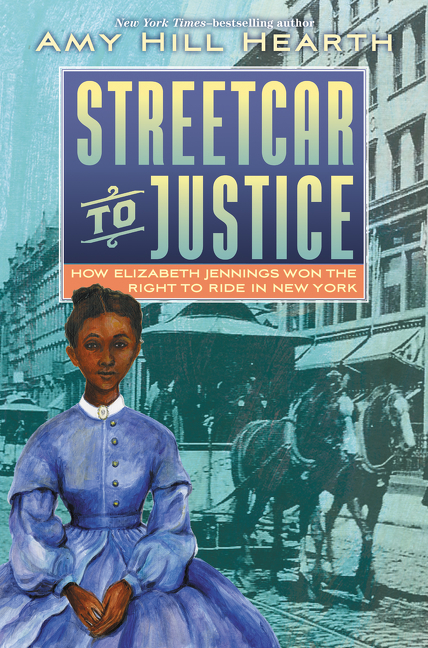
Streetcar to Justice
How Elizabeth Jennings Won the Right to Ride in New York
A vivid, accessible biography brings an overlooked victory in the fight for equal rights into focus.
- Themes
- Desegregation of public transportation, The struggle for equal rights, African American history
History in Motion
Come here for
- A lesser-known civil rights story rooted in New York history
- Photographs and archival material that deepen the historical picture
Expect
- A narrative biography of Elizabeth Jennings
- A focused look at an early fight to desegregate public transportation
Where it sits
How strongly BookFrontier reads the book as belonging to each subject.
Nearest books
Matched by our semantic model. Ordered by what its readers also loved.
 Meet ClaudieBrit Bennett52% subject match
 Celeste's Harlem RenaissanceEleanora E. Tate51% subject match
 Escape on the Underground RailroadNancy LeSourd49% subject match
For older readers: Riding into History, Claudette Colvin, Spell Freedom
Start with three books, and this one can be the first.
Members get a new edition every morning: a route out from their books to essays, research and talks, with the reason for each.
Sign upAbout this book
Starred reviews hail Streetcar to Justice as "a book that belongs in any civil rights library collection" (Publishers Weekly) and "completely fascinating and unique” (Kirkus). An ALA Notable Book and winner of a Septima Clark Book Award from the National Council for the Social Studies.
Bestselling author and journalist Amy Hill Hearth uncovers the story of a little-known figure in U.S. history in this fascinating biography.
Continue reading
In 1854, a young African American woman named Elizabeth Jennings won a major victory against a New York City streetcar company, a first step in the process of desegregating public transportation in Manhattan.
This illuminating and important piece of the history of the fight for equal rights, illustrated with photographs and archival material from the period, will engage fans of Phillip Hoose’s Claudette Colvin and Steve Sheinkin’s Most Dangerous.
One hundred years before Rosa Parks refused to give up her seat on a bus in Montgomery, Alabama, Elizabeth Jennings’s refusal to leave a segregated streetcar in the Five Points neighborhood of Manhattan set into motion a major court case in New York City.
On her way to church one day in July 1854, Elizabeth Jennings was refused a seat on a streetcar. When she took her seat anyway, she was bodily removed by the conductor and a nearby police officer and returned home bruised and injured. With the support of her family, the African American abolitionist community of New York, and Frederick Douglass, Elizabeth Jennings took her case to court. Represented by a young lawyer named Chester A. Arthur (a future president of the United States) she was victorious, marking a major victory in the fight to desegregate New York City’s public transportation.
Amy Hill Hearth, bestselling author of Having Our Say: The Delany Sisters’ First 100 Years, illuminates a lesser-known benchmark in the struggle for equality in the United States, while painting a vivid picture of the diverse Five Points neighborhood of Manhattan in the mid-1800s.
Includes sidebars, extensive illustrative material, notes, and an index.
Publisher details
Publisher categories
- Historical Biographies for Kids
- Social Activist Biographies for Kids
- Biographies of Women for Kids
- LGBTQ+ Lives & Stories
Show all 8 publisher categories
- Alphabet Books
- African American Life (U.S.)
- New Baby
- Girls & Young Women
- Authors
- Amy Hill Hearth
- Publisher
- HarperCollins
- Published
- January 2, 2018
- Format
- Print & ebook
- Reading lane
- Historical Biographies for Kids