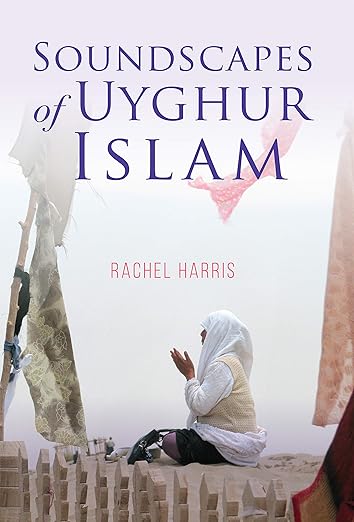
Soundscapes of Uyghur Islam
Series: Framing the Global
Rachel Harris traces how sound, travel, and internet connections shape Uyghur women’s religious practice.
Uyghur Religious Soundscapes
Come here for
- Uyghur women’s religious practice in a village in Xinjiang
- Connections reaching Mecca, Istanbul, Bishkek, and Beijing
Expect
- Attention to spiritual and political geographies
- Discussion of sound, embodiment, and territoriality
Where it sits
How strongly BookFrontier reads the book as belonging to each subject.
Nearest books
Matched by our semantic model. Ordered by what its readers also loved.
 Questioning BordersRobin Visser45% subject match
 One Islam, Many Muslim WorldsRaymond William Baker45% subject matchShares Islam - General
 Cruel and Usual PunishmentNonie Darwish44% subject matchShares Islam - General
 The Good Women of ChinaXinran44% subject matchShares Chinese History
 Aspects of IslamRon Geaves44% subject matchShares Islam - General
 Islam in PracticeReinhold Loeffler43% subject match
For younger readers: A Thousand Nights, We Gather at an Islamic Mosque, Love, Hate and Other Filters
Start with three books, and this one can be the first.
Members get a new edition every morning: a route out from their books to essays, research and talks, with the reason for each.
Sign upAbout this book
China's Xinjiang Uyghur Autonomous Region is experiencing a crisis of securitization and mass incarceration. In Soundscapes of Uyghur Islam, author Rachel Harris examines the religious practice of a group of Uyghur women in a small village now engulfed in this chaos. Despite their remote location, these village women are mobile and connected, and their religious soundscapes flow out across transnational networks.
Continue reading
Harris explores the spiritual and political geographies they inhabit, moving outward from the village to trace connections with Mecca, Istanbul, Bishkek, and Beijing. Sound, embodiment, and territoriality illuminate both the patterns of religious change among Uyghurs and the policies of cultural erasure used by the Chinese state to reassert its control over the land the Uyghurs occupy. By drawing on contemporary approaches to the circulation of popular music, Harris considers how various forms of Islam that arrive via travel and the internet come into dialogue with local embodied practices. Synthesized together, these practicies create new forms that facilitate powerful, affective experiences of faith.
Publisher details
Publisher categories
- Ethnomusicology
- Islam - General
- Islamic Rituals & Practice
- Authors
- Rachel Harris
- Publisher
- Indiana University Press
- Published
- November 3, 2020
- Format
- Print & ebook
- Reading lane
- Ethnomusicology