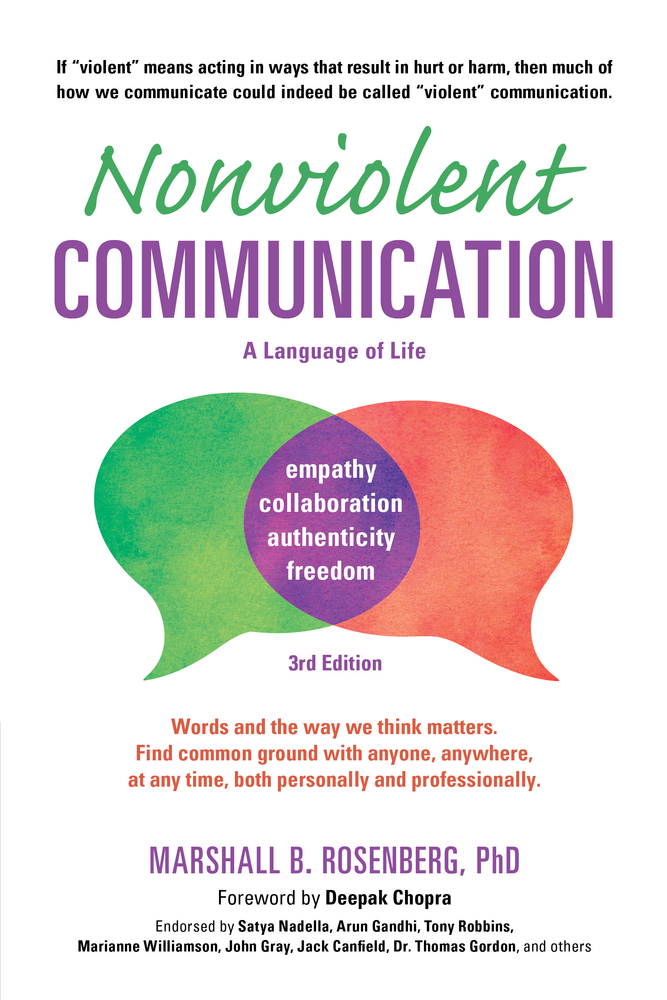
Nonviolent Communication: a Language of Life
Life-changing Tools for Healthy Relationships
PuddleDancer Press · Print & ebook · September 1, 2015
5,000,000 COPIES SOLD WORLDWIDE • TRANSLATED IN MORE THAN 35 LANGUAGES What is Violent Communication?
- Themes
- Empathic communication, Healthy relationships, Collaborative problem-solving
- Genres
- Better Communication, Relationships, Family Conflict Resolution
- Published
- PuddleDancer Press, September 1, 2015
Words That Connect
Rosenberg links everyday language with the possibility of connection, collaboration, and solutions that work for all.
Come here for
- A closer look at blame, judgment, and words that create distance
- Communication rooted in empathy, even when people disagree
Expect
- Principles for compassionate, authentic communication
- A focus on asking clearly, listening, and sharing power
Nearest books
Matched by what the books are about, then ordered by what their readers also loved.
 Eight DatesJohn Gottman Ph.D., Julie Schwartz Gottman PhD57% matchShares Better Communication
 USTerrence Real, Bruce Springsteen48% matchShares Family Conflict Resolution
 The New Rules of MarriageTerrence Real50% matchShares Family Conflict Resolution
 The Dance of AngerHarriet Lerner50% matchShares Family Conflict Resolution
 The Gifts of ImperfectionBrené Brown47% match
 The Gift of FearGavin de Becker48% match
 Accessing the Healing Power of the Vagus NerveStanley Rosenberg, Stephen W. Porges49% match
For younger readers: What Can I Say?, Words Are Not for Hurting Board Book, Listen and Learn
Start with three books, and this one can be the first.
Members get a new edition every morning: a route out from their books to essays, research and talks, with the reason for each.
Join the waitlistAbout this book
5,000,000 COPIES SOLD WORLDWIDE • TRANSLATED IN MORE THAN 35 LANGUAGES What is Violent Communication?
Continue reading
If “violent” means acting in ways that result in hurt or harm, then much of how we communicate—judging others, bullying, having racial bias, blaming, finger pointing, discriminating, speaking without listening, criticizing others or ourselves, name-calling, reacting when angry, using political rhetoric, being defensive or judging who’s “good/bad” or what’s “right/wrong” with people—could indeed be called “violent communication.” What is Nonviolent Communication? Nonviolent Communication is the integration of four things: • Consciousness: a set of principles that support living a life of compassion, collaboration, courage, and authenticity • Language: understanding how words contribute to connection or distance • Communication: knowing how to ask for what we want, how to hear others even in disagreement, and how to move toward solutions that work for all • Means of influence: sharing “power with others” rather than using “power over others” Nonviolent Communication serves our desire to do three things: • Increase our ability to live with choice, meaning, and connection • Connect empathically with self and others to have more satisfying relationships • Sharing of resources so everyone is able to benefit
Where it sits
| Better Communication | 88% |
|---|---|
| Family Conflict Resolution | 74% |
| Relationships | 46% |
Percentages are BookFrontier’s reading of the book.
Publisher categories
- Relationships
- Personal Growth
- Authors
- Marshall B. Rosenberg
- Publisher
- PuddleDancer Press
- Published
- September 1, 2015
- Format
- Print & ebook
- Theme
- Empathic communication · Healthy relationships · Collaborative problem-solving
- Reading lane
- Relationships