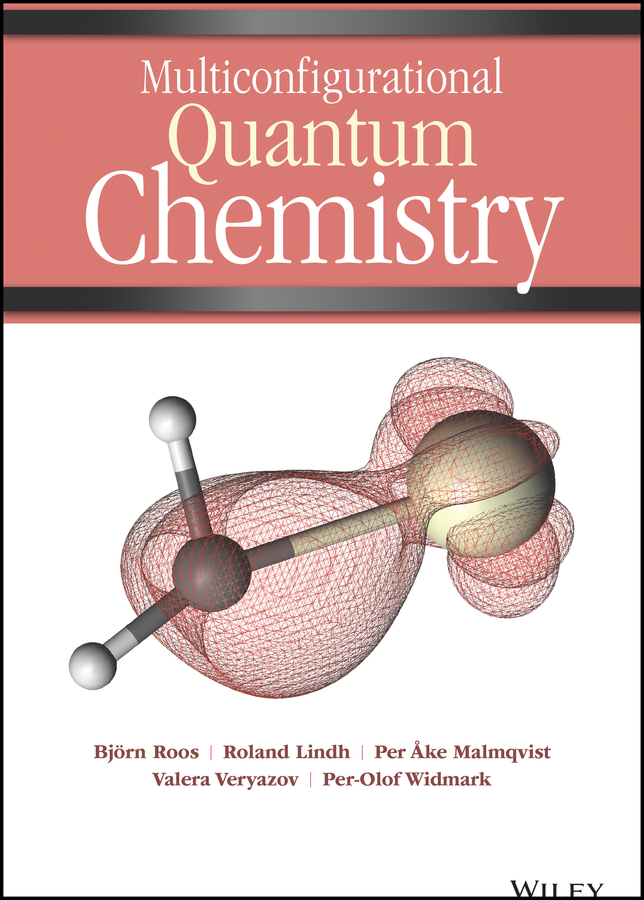
Multiconfigurational Quantum Chemistry
1st Edition, Kindle Edition
Wiley · Ebook · August 3, 2016
The first book to aid in the understanding of multiconfigurational quantum chemistry, Multiconfigurational Quantum Chemistry demystifies a subject that has historically been considered difficult to learn.
We earn from qualifying purchases.
- Who it’s for
- Explore wavefunction-based methods, their limits, and applications across chemical systems.
- Genres
- Molecular Modeling, Physical Chemistry, Atomic & Molecular Physics
- Published
- Wiley, August 3, 2016
Nearest books
Matched by what the books are about, then ordered by what their readers also loved. Most of these share its genre: Physical Chemistry.
 Handbook of Computational Quantum ChemistryDavid B. Cook65% matchAlso shares Molecular Modeling and Atomic & Molecular Physics
 Quantum ChemistryDonald A. McQuarrie63% matchAlso shares Molecular Modeling
 Molecular Symmetry and Group TheoryRobert L. Carter60% match
 Quantum ChemistryIra Levine, Ira N. Levine59% matchAlso shares Molecular Modeling
 Problems and Solutions to Accompany Mcquarrie and Simon's Physical ChemistryHeather Cox, Donald A. McQuarrie58% match
 Kinetics and Catalysis in Microheterogeneous SystemsMichael Gratzel, M. Gratzel58% match
 Physical ChemistryDonald A. McQuarrie, John D. Simon58% matchAlso shares Atomic & Molecular Physics
 Quantum ChemistryMichael Springborg, Meijuan Zhou58% matchAlso shares Molecular Modeling and Atomic & Molecular Physics
For younger readers: CHEM MAT & CHG SE
Start with three books, and this one can be the first.
Members get a new edition every morning: a route out from their books to essays, research and talks, with the reason for each.
Join the waitlistAbout this book
The first book to aid in the understanding of multiconfigurational quantum chemistry, Multiconfigurational Quantum Chemistry demystifies a subject that has historically been considered difficult to learn.
Continue reading
Accessible to any reader with a background in quantum mechanics and quantum chemistry, the book contains illustrative examples showing how these methods can be used in various areas of chemistry, such as chemical reactions in ground and excited states, transition metal and other heavy element systems. The authors detail the drawbacks and limitations of DFT and coupled-cluster based methods and offer alternative, wavefunction-based methods more suitable for smaller molecules.
Quantum Chemistry Methods
Explore wavefunction-based methods, their limits, and applications across chemical systems.
Come here for
- Illustrative examples in ground- and excited-state reactions
- Coverage of transition metals and other heavy-element systems
Expect
- Drawbacks and limits of DFT and coupled-cluster methods
- Wavefunction-based alternatives for smaller molecules
Where it sits
| Molecular Modeling | 78% |
|---|---|
| Physical Chemistry | 68% |
| Atomic & Molecular Physics | 48% |
Percentages are BookFrontier’s reading of the book.
Publisher categories
- Physical Chemistry
- Authors
- Björn O. Roos, Roland Lindh, Per ke Malmqvist
- Publisher
- Wiley
- Published
- August 3, 2016
- Format
- Ebook
- Reading lane
- Physical Chemistry