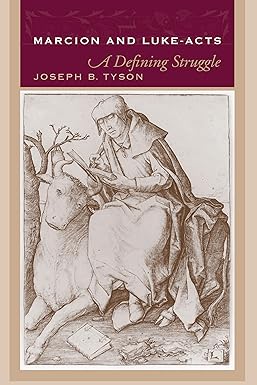
Marcion and Luke-acts
A Defining Struggle
Joseph B. Tyson examines how Marcionite controversy may have shaped canonical Luke and Acts.
Luke-Acts and Marcion
Come here for
- A proposed 120–125 c.e. context for canonical Luke and Acts
- Tyson’s reading of Paul’s portrayal as a devoted Pharisaic Jew
Expect
- Attention to Peter and the Jerusalem apostles in Acts
- An argument about the author’s use of an earlier Luke
Where it sits
How strongly BookFrontier reads the book as belonging to each subject.
Nearest books
Matched by our semantic model. Ordered by what its readers also loved.
 The First Edition of the New TestamentDavid Trobisch49% subject matchShares New Testament Interpretation
 An Introduction to the Study of Luke-ActsV. George Shillington63% subject matchShares New Testament Interpretation
 Paul and JesusJames D. Tabor61% subject matchShares Jesus, Gospels & Acts and Paul's Letters
 ActsN.T. Wright, Dale Larsen60% subject match
 The Ministry and Message of PaulRichard N. Longenecker59% subject matchShares Paul's Letters
 LukeDarrell L. Bock58% subject match
 The Lost Letters of PergamumLongenecker, Bruce W.58% subject matchShares Jesus, Gospels & Acts
 ActsJohn F. MacArthur56% subject match
For younger readers: The Fire, the Revelation and the Fall, The Wind, the Road and the Way, Who Was Jesus?
Start with three books, and this one can be the first.
Members get a new edition every morning: a route out from their books to essays, research and talks, with the reason for each.
Sign upAbout this book
An investigation into the motives behind writing the canonical versions of Luke and Acts
Building on recent scholarship that argues for a second-century date for the book of Acts, Marcion and Luke–Acts explores the probable context for the authorship not only of Acts but also of the canonical Gospel of Luke.
Continue reading
Noted New Testament scholar Joseph B. Tyson proposes that both Acts and the final version of the Gospel of Luke were published at the time when Marcion of Pontus was beginning to proclaim his version of the Christian gospel, in the years 120–125 c.e. He suggests that although the author was subject to various influences, a prominent motivation was the need to provide the church with writings that would serve in its fight against Marcionite Christianity. Tyson positions the controversy with Marcion as a defining struggle over the very meaning of the Christian message and the author of Luke-Acts as a major participant in that contest.
Suggesting that the primary emphases in Acts are best understood as responses to the Marcionite challenge, Tyson looks particularly at the portrait of Paul as a devoted Pharisaic Jew. He contends that this portrayal appears to have been formed by the author to counter the Marcionite understanding of Paul as rejecting both the Torah and the God of Israel. Tyson also points to stories that involve Peter and the Jerusalem apostles in Acts as arguments against the Marcionite claim that Paul was the only true apostle.
Tyson concludes that the author of Acts made use of an earlier version of the Gospel of Luke and produced canonical Luke by adding, among other things, birth accounts and postresurrection narratives of Jesus.
Publisher details
Publisher categories
- Christian History
- Authors
- Joseph B. Tyson
- Publisher
- University of South Carolina Press
- Published
- August 29, 2006
- Format
- Print & ebook
- Reading lane
- Christian History