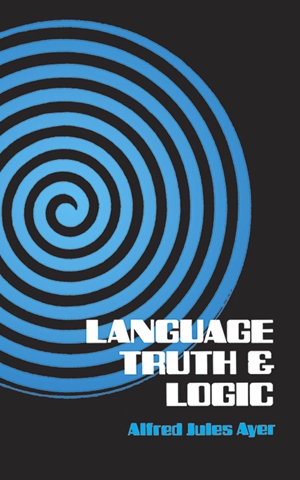
Language, Truth and Logic
A sharp, early account of logical positivism asks what language can—and cannot—tell us.
- Themes
- Logical positivism, Language and meaning, Philosophical analysis
Clearer Thinking
Come here for
- Tests for evaluating claims about ideas
- A close look at language, verification, and philosophical confusion
Expect
- Argument-led philosophy with a critical edge
- Attention to religious, moral, aesthetic, and metaphysical claims
Where it sits
- 81%Logic
- 71%Philosophy of Language
- 51%Semantics
How strongly BookFrontier reads the book as belonging to each subject.
Nearest books
Matched by our semantic model. Ordered by what its readers also loved.
 Prolegomena to Any Future Metaphysics: And the Letter to Marcus Herz, February 1772Immanuel Kant, James W. Ellington51% subject match
 The Conscious Mind: In Search of a Fundamental TheoryDavid J. Chalmers48% subject match
 The Sovereignty of GoodIris Murdoch48% subject match
 Either/OrSøren Kierkegaard, Victor Eremita47% subject match
 Tractatus Logico-PhilosophicusLudwig Wittgenstein64% subject matchShares Philosophy of Language, Logic and Semantics
 A Treatise of Human NatureDavid Hume55% subject match
 The Temptation to ExistE. M. Cioran50% subject match
 Phenomenology of SpiritG. W. F. Hegel55% subject match
For younger readers: Maybe Yes, Maybe No
Start with three books, and this one can be the first.
Members get a new edition every morning: a route out from their books to essays, research and talks, with the reason for each.
Sign upAbout this book
"A delightful book … I should like to have written it myself." — Bertrand Russell
First published in 1936, this first full-length presentation in English of the Logical Positivism of Carnap, Neurath, and others has gone through many printings to become a classic of thought and communication. It not only surveys one of the most important areas of modern thought; it also shows the confusion that arises from imperfect understanding of the uses of language.
Continue reading
A first-rate antidote for fuzzy thought and muddled writing, this remarkable book has helped philosophers, writers, speakers, teachers, students, and general readers alike.
Mr. Ayers sets up specific tests by which you can easily evaluate statements of ideas. You will also learn how to distinguish ideas that cannot be verified by experience — those expressing religious, moral, or aesthetic experience, those expounding theological or metaphysical doctrine, and those dealing with a priori truth. The basic thesis of this work is that philosophy should not squander its energies upon the unknowable, but should perform its proper function in criticism and analysis.
Publisher details
Publisher categories
- Logic
- Authors
- Alfred Jules Ayer
- Publisher
- Dover Publications
- Published
- June 1, 1952
- Format
- Print & ebook
- Reading lane
- Logic