
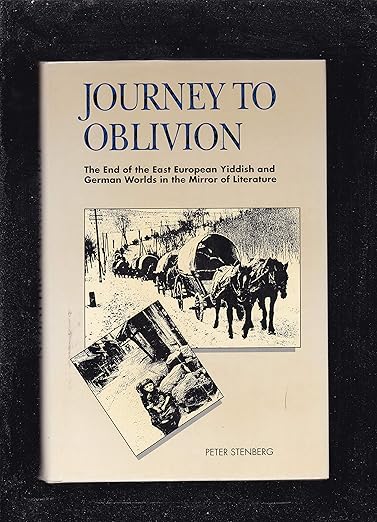
Book
Journey to Oblivion
The End of the East European Yiddish and German Worlds in the Mirror of Literature
Peter Stenberg, Peter A Stenberg
University of Toronto Press · Print & ebook · December 15, 1991
Reading lane: East European Literary Criticism
Before the Second World War, some 25 million people in Eastern Europe spoke Yiddish or German.
Disclosure: Some outbound links are affiliate links. If you buy through them, we may earn a commission. It doesn't affect which books we include. Learn more in our disclosure policy.
At a Glance
Who It's For
Book Details
- Authors
- Peter Stenberg, Peter A Stenberg
- Publisher
- University of Toronto Press
- Published
- December 15, 1991
- Format
- Print & ebook
- Theme
- East European Literary Criticism · Jewish Literary Criticism
- Reading lane
- East European Literary Criticism
Affinity
Publisher Categories
East European Literary Criticism
German Literary Criticism
LITERARY CRITICISM / Modern / 20th Century
About This Book
Before the Second World War, some 25 million people in Eastern Europe spoke Yiddish or German. Their numbers had grown over 750 years. The two language groups spread and developed in relative isolation from each other, though they occupied much the same territory and experienced similar fates during the Russian Revolution. In this book, Peter Stenberg uses literature to trace the destinies of these two separate but related language groups. He analyses works by well-known wri...
Read full description
Similar Books

German-jewish Thought and Its Afterlife
Vivian Liska · Indiana University Press
Shared affinity
East European Literary Criticism
Jewish Literary Criticism
German Literary Criticism

Imre Kertesz and Holocaust Literature
Louise O. Vasvári, Steven Tötösy de Zepetnek · Purdue University Press
Shared affinity
East European Literary Criticism
Jewish Literary Criticism
German Literary Criticism

Kafka's Jewish Languages
David Suchoff · University of Pennsylvania Press, Inc.
Shared affinity
East European Literary Criticism
Jewish Literary Criticism
German Literary Criticism

East, West, and Others
Arlene A. Teraoka · Nebraska
Shared affinity
Affinity match is still building for this title.
Representations of Flight and Expulsion in East German Prose Works
William Niven · Boydell & Brewer Inc.
Shared affinity
Affinity match is still building for this title.

Australian Literature in the German Democratic Republic
Nicole Moore, Christina Spittel · Anthem Press
Shared affinity
Affinity match is still building for this title.
Writing Weimar
David Midgley, David R. Midgley · Oxford University Press
Shared affinity
Affinity match is still building for this title.

Stranger in Our Midst
Harold B. Segel · Cornell University Press
Shared affinity
Affinity match is still building for this title.