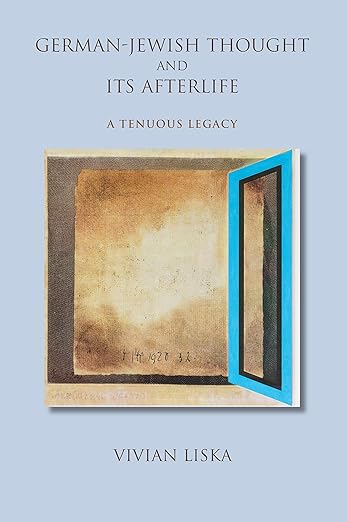
German-jewish Thought and Its Afterlife
A Tenuous Legacy
Indiana University Press · Print & ebook · December 19, 2016
In German-Jewish Thought and Its Afterlife, Vivian Liska innovatively focuses on the changing form, fate and function of messianism, law, exile, election, remembrance, and the transmission of tradition itself in three different temporal and intellectual frameworks: German-Jewish modernism, postmodernism, and the current period.
We earn from qualifying purchases.
- Who it’s for
- Vivian Liska traces Jewish traditions through German-Jewish writing and their transformations in later theory.
- Genres
- Jewish Literary Criticism, German Literary Criticism, Literary Theory
- Published
- Indiana University Press, December 19, 2016
Nearest books
Matched by what the books are about, then ordered by what their readers also loved.
 Kafka's Jewish LanguagesDavid Suchoff70% matchShares Jewish Literary Criticism and German Literary Criticism
 Recovering JewishnessFrederick S. Roden62% match
 Memory MattersCaroline Schaumann, Caroline Jones Mckay61% matchShares Jewish Literary Criticism and German Literary Criticism
 The Blessing and the CurseAdam Kirsch60% matchShares Jewish Literary Criticism
 Women of the WordJudith R. Baskin, Sara Horowitz60% matchShares Jewish Literary Criticism
 Walter BenjaminDavid S. Ferris, David Ferris60% matchShares German Literary Criticism and Literary Theory
 Modern Orthodox JudaismMenachem-Martin Gordon58% match
 Kafka's ClothesMark M. Anderson58% matchShares German Literary Criticism
For younger readers: What Jewish Looks Like, I Have Lived a Thousand Years, Man's Search for Meaning: Young Adult Edition
Start with three books, and this one can be the first.
Members get a new edition every morning: a route out from their books to essays, research and talks, with the reason for each.
Join the waitlistAbout this book
In German-Jewish Thought and Its Afterlife, Vivian Liska innovatively focuses on the changing form, fate and function of messianism, law, exile, election, remembrance, and the transmission of tradition itself in three different temporal and intellectual frameworks: German-Jewish modernism, postmodernism, and the current period.
Continue reading
Highlighting these elements of the Jewish tradition in the works of Franz Kafka, Walter Benjamin, Gershom Scholem, Hannah Arendt, and Paul Celan, Liska reflects on dialogues and conversations between them and on the reception of their work. She shows how this Jewish dimension of their writings is transformed, but remains significant in the theories of Maurice Blanchot and Jacques Derrida and how it is appropriated, dismissed or denied by some of the most acclaimed thinkers at the turn of the twenty-first century such as Giorgio Agamben, Slavoj ?i?ek, and Alain Badiou.
Jewish Traditions
Vivian Liska traces Jewish traditions through German-Jewish writing and their transformations in later theory.
Come here for
- Messianism, law, exile, election, and remembrance across three intellectual periods
- Kafka, Benjamin, Scholem, Arendt, and Celan in dialogue and reception
Expect
- Attention to tradition’s changing form, fate, and function
- Discussion of Blanchot, Derrida, Agamben, Žižek, and Badiou
Where it sits
| Jewish Literary Criticism | 82% |
|---|---|
| German Literary Criticism | 47% |
| Literary Theory | 23% |
Percentages are BookFrontier’s reading of the book.
Publisher categories
- German Literary Criticism
- Religion & Philosophy
- Authors
- Vivian Liska
- Publisher
- Indiana University Press
- Published
- December 19, 2016
- Format
- Print & ebook
- Reading lane
- German Literary Criticism