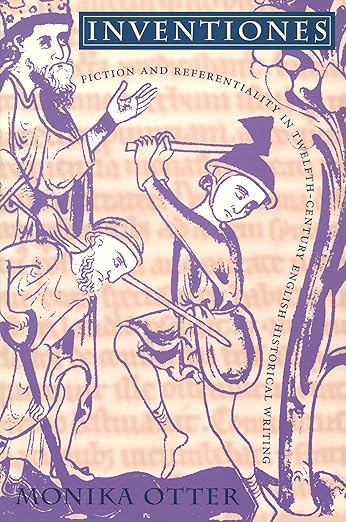
Inventiones
Fiction and Referentiality in Twelfth-century English Historical Writing
How twelfth-century Latin writers made fictionality visible within historical narratives.
Latin Historical Writing
Come here for
- Inventiones and the discovery of saints’ relics
- Conquests as metaphors for accessing the past
Expect
- Questions about truth and historical representation
- The textuality of accounts by five named writers
Where it sits
How strongly BookFrontier reads the book as belonging to each subject.
Nearest books
Matched by our semantic model. Ordered by what its readers also loved.
 The History of the Kings of BritainGeoffrey of Monmouth54% subject match
 The Romance of Italy and the English ImaginationMaura O'Connor49% subject matchShares British & Irish Literary Criticism
 The Greatest KnightElizabeth Chadwick49% subject match
 Anglo-Saxon ChronicleMichael Swanton49% subject match
For younger readers: Stories of King Arthur and His Knights, The Story of the Middle Ages, Good Masters! Sweet Ladies!
Start with three books, and this one can be the first.
Members get a new edition every morning: a route out from their books to essays, research and talks, with the reason for each.
Sign upAbout this book
Combining literary theory and historiography, Monika Otter explores the relationship between history and fiction in the Latin literature of twelfth-century England. The beginnings of fiction have commonly been associated with vernacular romance, but Otter demonstrates that writers of Latin historical narratives also employed the self-referential techniques characteristic of fiction.
Continue reading
Beginning with inventiones, a genre dealing with the discovery of saints' relics, Otter reveals how exploring the fundamental problems of writing history and the nature of truth itself leads monastic or clerical Latin writers to a budding awareness of fictionality. According to Otter, accounts of conquests, treasure hunts, descents into underground worlds, and efforts (usually unsuccessful) to retrieve subterranean objects serve as self-referential metaphors for the problems of accessing and retrieving the past; they are thus designed to shake the reader’s faith in historical representation and highlight the textuality of the historical account. Otter traces this self-conscious use of fictional elements within historical narrative through the works of William of Malmesbury, Geoffrey of Monmouth, Gerald of Wales, Walter Map, and William of Newburgh.
Originally published in 1996.
A UNC Press Enduring Edition — UNC Press Enduring Editions use the latest in digital technology to make available again books from our distinguished backlist that were previously out of print. These editions are published unaltered from the original, and are presented in affordable paperback formats, bringing readers both historical and cultural value.
Publisher details
Publisher categories
- British & Irish Literary Criticism
- Authors
- Monika Otter
- Publisher
- The University of North Carolina Press
- Published
- November 14, 1996
- Format
- Print & ebook
- Reading lane
- British & Irish Literary Criticism