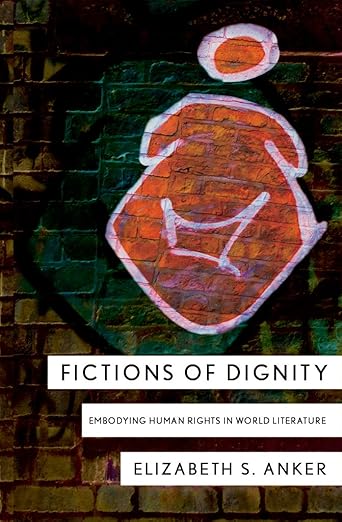
Fictions of Dignity
Embodying Human Rights in World Literature
Anker reads four postcolonial novels through the tensions between dignity, embodiment, and human rights.
Dignity and the Body
Come here for
- A reading of Midnight’s Children and postcolonial legal culture
- Analysis of Woman at Point Zero and women’s freedoms
Expect
- How bodily integrity shapes debates over who receives human rights protections
- Embodied reading as a challenge to abstract liberal rights
Where it sits
How strongly BookFrontier reads the book as belonging to each subject.
Nearest books
Matched by our semantic model. Ordered by what its readers also loved. Most of these share its genre: Race & Culture in Literature.
 Inventing Human RightsLynn Hunt57% subject matchAlso shares Human Rights
 Contemporary Arab-American LiteratureCarol Fadda-Conrey56% subject match
 Against NormalizationAnthony O'Brien55% subject match
 Standing by the RuinsKen Seigneurie54% subject match
 Things with a HistoryHéctor Hoyos53% subject match
 Trials of Arab ModernityTarek El-Ariss52% subject match
 Inhuman CitizenshipJuliana Chang52% subject match
 The World, the Text, and the IndianScott Richard Lyons52% subject match
Start with three books, and this one can be the first.
Members get a new edition every morning: a route out from their books to essays, research and talks, with the reason for each.
Sign upAbout this book
Over the past fifty years, debates about human rights have assumed an increasingly prominent place in postcolonial literature and theory. Writers from Salman Rushdie to Nawal El Saadawi have used the novel to explore both the possibilities and challenges of enacting and protecting human rights, particularly in the Global South.
Continue reading
In Fictions of Dignity, Elizabeth S. Anker shows how the dual enabling fictions of human dignity and bodily integrity contribute to an anxiety about the body that helps to explain many of the contemporary and historical failures of human rights, revealing why and how lives are excluded from human rights protections along the lines of race, gender, class, disability, and species membership. In the process, Anker examines the vital work performed by a particular kind of narrative imagination in fostering respect for human rights. Drawing on phenomenology, Anker suggests how an embodied politics of reading might restore a vital fleshiness to the overly abstract, decorporealized subject of liberal rights.
Each of the novels Anker examines approaches human rights in terms of limits and paradoxes. Rushdie's Midnight's Children addresses the obstacles to incorporating rights into a formerly colonized nation's legal culture. El Saadawi's Woman at Point Zero takes up controversies over women's freedoms in Islamic society. In Disgrace, J. M. Coetzee considers the disappointments of post-apartheid reconciliation in South Africa. And in The God of Small Things, Arundhati Roy confronts an array of human rights abuses widespread in contemporary India. Each of these literary case studies further demonstrates the relevance of embodiment to both comprehending and redressing the failures of human rights, even while those narratives refuse simplistic ideals or solutions.
Publisher details
Publisher categories
- 20th-Century Literary Criticism
- Politics in Literature
- Human Rights
- Authors
- Elizabeth S. Anker
- Publisher
- Cornell University Press
- Published
- January 15, 2017
- Format
- Print & ebook
- Reading lane
- 20th-Century Literary Criticism