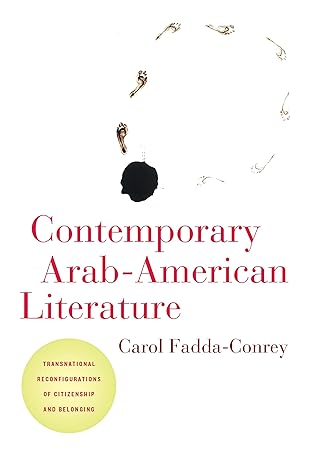
Contemporary Arab-American Literature
Transnational Reconfigurations of Citizenship and Belonging
Carol Fadda-Conrey traces how Arab-American writers connect homeland, citizenship, and belonging from the 1990s onward.
Homeland and Belonging
Come here for
- Arab homelands, actual and imagined, in literary and cultural texts
- How immigrant parents and later generations negotiate the idea of home
Expect
- A historical sweep from Gibran Kahlil Gibran to contemporary writers
- Analysis of Arab and Muslim identities amid post-9/11 anti-Arab sentiment
Where it sits
How strongly BookFrontier reads the book as belonging to each subject.
Nearest books
Matched by our semantic model. Ordered by what its readers also loved.
 Modern Arabic FictionSalma Khadra Jayyusi59% subject match
 Dancing into the LightKathryn Abdul-Baki57% subject match
 Our ArabZaina Arafat57% subject match
 Politics and Aesthetics in Contemporary Native American LiteratureMatthew Herman56% subject match
For younger readers: 19 Varieties of Gazelle, Arab Arab All Year Long!, A Thousand Nights
Start with three books, and this one can be the first.
Members get a new edition every morning: a route out from their books to essays, research and talks, with the reason for each.
Sign upAbout this book
The last couple of decades have witnessed a flourishing of Arab-American literature across multiple genres. Yet, increased interest in this literature is ironically paralleled by a prevalent bias against Arabs and Muslims that portrays their long presence in the US as a recent and unwelcome phenomenon.
Continue reading
Spanning the 1990s to the present, Carol Fadda-Conrey takes in the sweep of literary and cultural texts by Arab-American writers in order to understand the ways in which their depictions of Arab homelands, whether actual or imagined, play a crucial role in shaping cultural articulations of US citizenship and belonging. By asserting themselves within a US framework while maintaining connections to their homelands, Arab-Americans contest the blanket representations of themselves as dictated by the US nation-state.
Deploying a multidisciplinary framework at the intersection of Middle-Eastern studies, US ethnic studies, and diaspora studies, Fadda-Conrey argues for a transnational discourse that overturns the often rigid affiliations embedded in ethnic labels. Tracing the shifts in transnational perspectives, from the founders of Arab-American literature, like Gibran Kahlil Gibran and Ameen Rihani, to modern writers such as Naomi Shihab Nye, Joseph Geha, Randa Jarrar, and Suheir Hammad, Fadda-Conrey finds that contemporary Arab-American writers depict strong yet complex attachments to the US landscape. She explores how the idea of home is negotiated between immigrant parents and subsequent generations, alongside analyses of texts that work toward fostering more nuanced understandings of Arab and Muslim identities in the wake of post-9/11 anti-Arab sentiments.
Publisher details
Publisher categories
- American Lit Crit
- How Cultures Work
- Authors
- Carol Fadda-Conrey
- Publisher
- NYU Press
- Published
- May 30, 2014
- Format
- Print & ebook
- Reading lane
- American Lit Crit