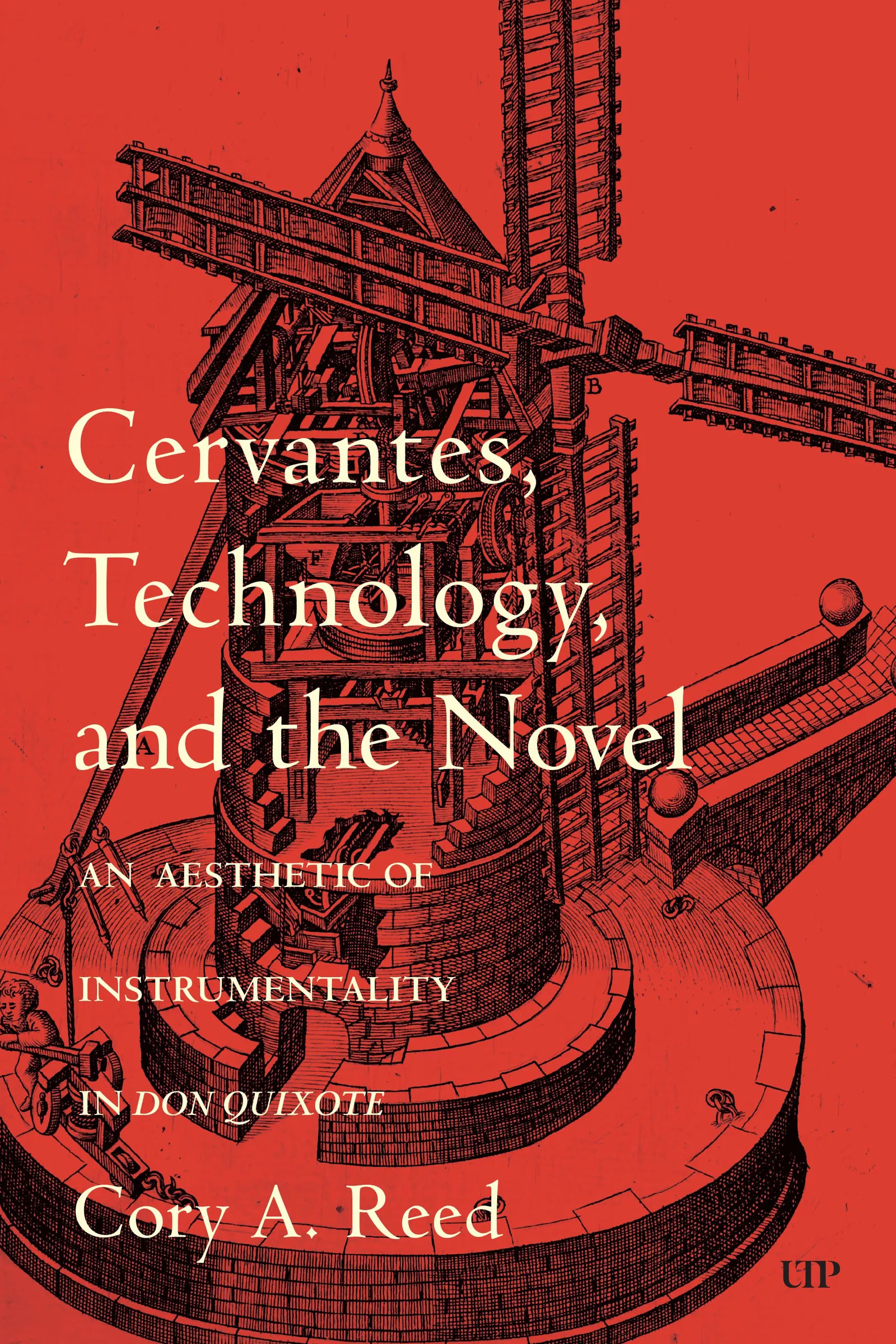
Cervantes, Technology, and the Novel
An Aesthetic of Instrumentality in Don Quixote
Series: Toronto Iberic
Cervantes’s novel becomes a lens on technology, human agency, and cultural change in early modern Spain.
Machines in Don Quixote
Come here for
- Technology and scientific imagery in Don Quixote
- Machines as obstacles and ingenious devices
Expect
- An analysis of machines between magic and engineering
- Attention to the Scientific Revolution’s role in Cervantes’s cultural critique
Where it sits
How strongly BookFrontier reads the book as belonging to each subject.
Nearest books
Matched by our semantic model. Ordered by what its readers also loved. Most of these share its genres: Iberian Lit Crit and Renaissance Literary Criticism.
 The Man Who Invented FictionWilliam Egginton64% subject match
 Adventures in ParadoxCharles D. Presberg63% subject matchAlso shares Hispanic American Lit Crit
 Contradictory SubjectsGeorge Mariscal59% subject match
 Cervantes, the Novel, and the New WorldDiana de Armas Wilson59% subject matchAlso shares Hispanic American Lit Crit
 Don QuixoteMiguel de Cervantes58% subject match
 Tilting CervantesBruce R. Burningham56% subject matchAlso shares Hispanic American Lit Crit
 The Gallant SpaniardMiguel de Cervantes54% subject match
 Cervantes' ArchitecturesFrederick A. de Armas53% subject match
For younger readers: The Way Things Work: Newly Revised Edition, Woven in Moonlight
Start with three books, and this one can be the first.
Members get a new edition every morning: a route out from their books to essays, research and talks, with the reason for each.
Sign upAbout this book
This book examines the technological and scientific imagery in Cervantes’s novel, Don Quixote, and the ways in which the Scientific Revolution participated in the author’s examination of early modern European culture during a time of crisis and change.
Continue reading
Cervantes’s representation of technology not only documents the cultural dynamics of the transition between medieval scholasticism and early modern empiricism in Spain but also celebrates the agency of the individual to effect change in the world. Machines in Don Quixote often function as the would-be knight’s nemesis, playing a role in foiling his quest to revive a mythical, pre-technological Golden Age. They also appear as ingenious devices that straddle the border between magic and engineering in a modern expression of human creativity and ingenuity. For Cervantes and his characters, technology is not just about machines, but about the human desire to reverse power structures and exercise agency.
Cory A. Reed, a specialist in early modern Spanish literature, analyzes how Cervantes’s aesthetic of instrumentality encourages his reader to engage critically with the world in a time of cultural transformation. Cervantes, Technology, and the Novel thus demonstrates how Don Quixote becomes an instrument of enlightenment achieved through imagination.
Publisher details
Publisher categories
- Iberian Lit Crit
- Renaissance Literary Criticism
- 17th-Century Literary Criticism
- History of Science
- Authors
- Cory A. Reed
- Publisher
- University of Toronto Press
- Published
- December 15, 2025
- Format
- Print & ebook
- Reading lane
- Iberian Lit Crit