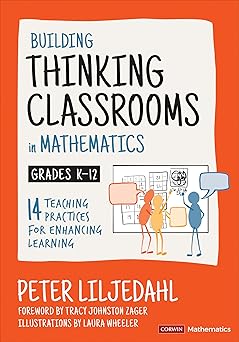
Building Thinking Classrooms in Mathematics, Grades K-12
14 Teaching Practices for Enhancing Learning
Corwin Press Inc · Print & ebook · October 30, 2020
A thinking student is an engaged student Teachers often find it difficult to implement lessons that help students go beyond rote memorization and repetitive calculations.
We earn from qualifying purchases.
- Who it’s for
- Mathematics teachers seeking practical strategies to foster deep thinking in K-12 students
- Themes
- Mathematics education, Student-centered learning, Teaching strategies
- Pacing
- Reflective
Nearest books
Matched by what the books are about, then ordered by what their readers also loved. Most of these share its genre: Teaching Math.
 Limitless MindJo Boaler57% match
 Mathematics Tasks for the Thinking Classroom, Grades 6-12Peter Liljedahl, Kyle Webb77% matchAlso shares Professional Development and Teaching Mathematics
 Know Better, Do Better: ComprehensionDavid Liben, Meredith Liben50% matchAlso shares Professional Development
 The Writing Revolution 2.0Judith C. Hochman, Natalie Wexler52% match
 The Math Pact, ElementaryKaren S. Karp, Barbara J. Dougherty62% matchAlso shares Teaching Mathematics
 Teaching the Common Core Math Standards With Hands-on Activities, Grades 6-8Judith A. Muschla, Gary R. Muschla61% match
 Advancing DifferentiationRichard M. Cash61% matchAlso shares Professional Development
 What's Math Got to Do With It?Jo Boaler61% matchAlso shares Professional Development and Teaching Mathematics
For younger readers: Third Grade Math With Confidence Complete Bundle, Addition and Subtraction Kindergarten Math Workbook, The Big Fat Middle School Math Workbook
Start with three books, and this one can be the first.
Members get a new edition every morning: a route out from their books to essays, research and talks, with the reason for each.
Join the waitlistAbout this book
A thinking student is an engaged student Teachers often find it difficult to implement lessons that help students go beyond rote memorization and repetitive calculations. In fact, institutional norms and habits that permeate all classrooms can actually be enabling "non-thinking" student behavior.
Continue reading
Sparked by observing teachers struggle to implement rich mathematics tasks to engage students in deep thinking, Peter Liljedahl has translated his 15 years of research into this practical guide on how to move toward a thinking classroom. Building Thinking Classrooms in Mathematics, Grades K–12 helps teachers implement 14 optimal practices for thinking that create an ideal setting for deep mathematics learning to occur. This guide Provides the what, why, and how of each practice and answers teachers’ most frequently asked questions Includes firsthand accounts of how these practices foster thinking through teacher and student interviews and student work samples Offers a plethora of macro moves, micro moves, and rich tasks to get started Organizes the 14 practices into four toolkits that can be implemented in order and built on throughout the year When combined, these unique research-based practices create the optimal conditions for learner-centered, student-owned deep mathematical thinking and learning, and have the power to transform mathematics classrooms like never before.
Who it’s for
- Mathematics teachers seeking practical strategies to foster deep thinking in K-12 students
- Educators interested in implementing research-based classroom practices for student engagement
Where it sits
| Teaching Math | 88% |
|---|---|
| Teaching Mathematics | 59% |
| Professional Development | 38% |
Percentages are BookFrontier’s reading of the book.
Publisher categories
- General Reference
- Authors
- Peter Liljedahl
- Publisher
- Corwin Press Inc
- Published
- October 30, 2020
- Format
- Print & ebook
- Theme
- Mathematics education · Student-centered learning · Teaching strategies
- Reading lane
- General Reference