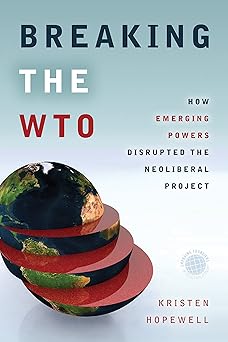
Breaking the WTO
How Emerging Powers Disrupted the Neoliberal Project
The book traces how China, India, and Brazil challenged U.S. power at the WTO.
Doha at the WTO
Come here for
- The Doha Round’s collapse in 2008
- Tensions between WTO principles and power politics
Expect
- U.S. pressure for open markets alongside its protectionist policies
- How emerging powers invoked free-trade principles
Where it sits
How strongly BookFrontier reads the book as belonging to each subject.
Nearest books
Matched by our semantic model. Ordered by what its readers also loved. Most of these share its genre: Trade & Tariffs.
 The Doom LoopEswar S. Prasad59% subject match
 Reconstructing the World Trade Organization for the 21st CenturyKent Jones58% subject match
 Trade Multilateralism in the Twenty-First CenturyAlexei Kireyev, Chiedu Osakwe57% subject match
 China's Weaponization of TradeVictor D. Cha, Ellen Kim57% subject matchAlso shares Political Economy
 World Trade and Investment Law ReimaginedAlvaro Santos, Chantal Thomas57% subject match
 U.S. Trade PolicyWilliam A. Lovett, Alfred E. Eckes, Jr55% subject match
 Confessions of an OutsourcerTimothy Brantingham55% subject match
 No Trade Is FreeRobert Lighthizer52% subject match
Start with three books, and this one can be the first.
Members get a new edition every morning: a route out from their books to essays, research and talks, with the reason for each.
Sign upAbout this book
The world economic order has been upended by the rise of the BRIC nations and the attendant decline of the United States' international influence. In Breaking the WTO, Kristen Hopewell provides a groundbreaking analysis of how these power shifts have played out in one of the most important theaters of global governance: the World Trade Organization.
Continue reading
Hopewell argues that the collapse of the Doha Round negotiations in 2008 signals a crisis in the American-led project of neoliberal globalization. Historically, the U.S. has pressured other countries to open their markets while maintaining its own protectionist policies. Over the course of the Doha negotiations, however, China, India, and Brazil challenged America's hypocrisy. They did so not because they rejected the multilateral trading system, but because they embraced neoliberal rhetoric and sought to lay claim to its benefits. By demanding that all members of the WTO live up to the principles of "free trade," these developing states caused the negotiations to collapse under their own contradictions. Breaking the WTO probes the tensions between the WTO's liberal principles and the underlying reality of power politics, exploring what the Doha conflict tells us about the current and coming balance of power in the global economy.
Publisher details
Publisher categories
- Sociology
- Authors
- Kristen Hopewell
- Publisher
- Stanford University Press
- Published
- August 3, 2016
- Format
- Print & ebook
- Reading lane
- Sociology