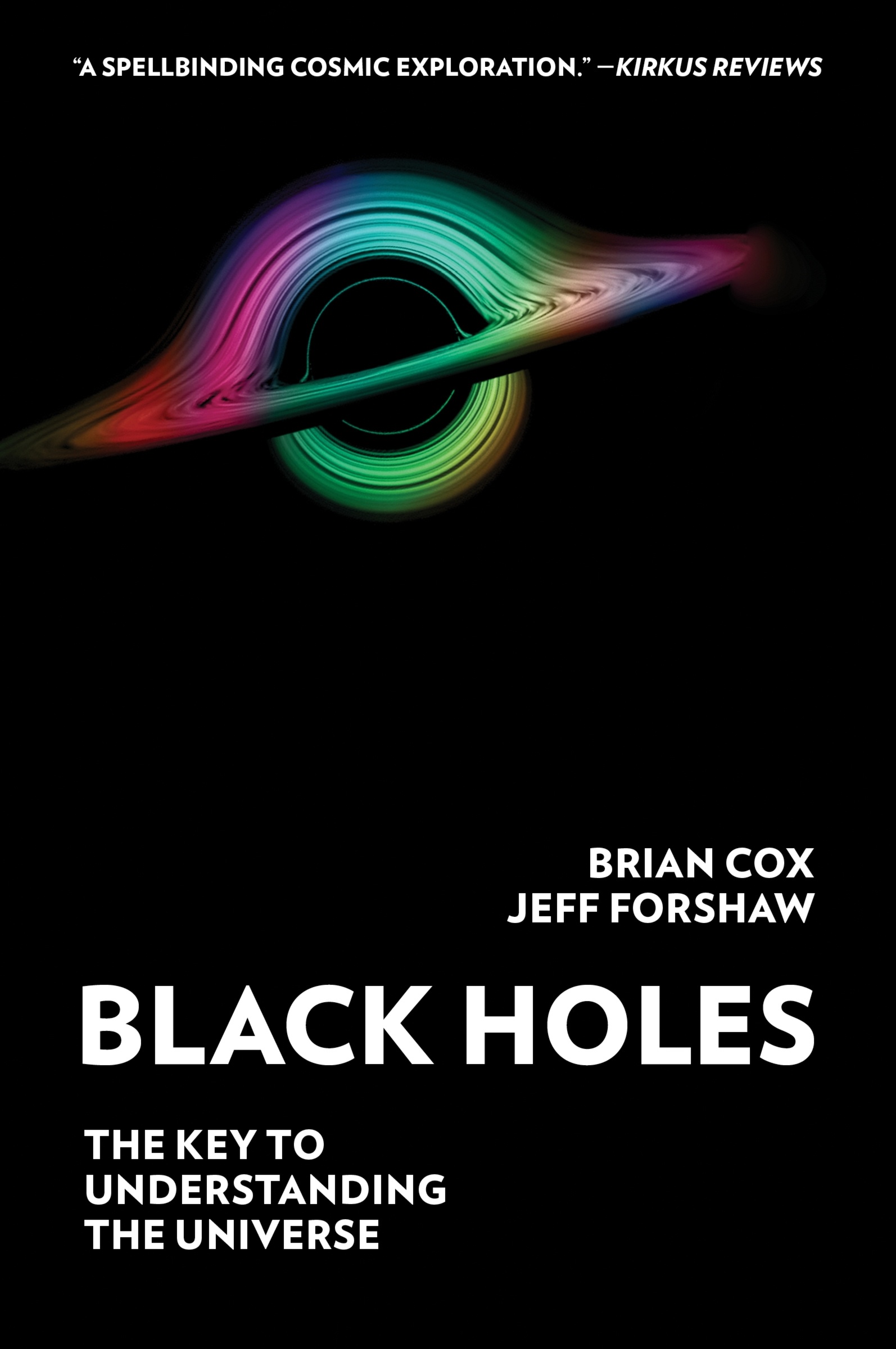
Black Holes
The Key to Understanding the Universe
Black holes offer a vivid route into some of physics’ biggest questions about the universe.
- Themes
- Black holes and galaxy formation, General relativity, Cosmology and other universes
Where Black Holes Lead
Come here for
- The strange physics of objects that bend space and challenge our intuitions
- Cosmic mysteries, from stellar destruction to gravitational waves
Expect
- A sweeping exploration of black holes and their place in galaxies
- Big questions about relativity, wormholes and what may lie beyond our universe
Where it sits
- 80%Astrophysics
- 49%Relativity
- 46%Cosmology
How strongly BookFrontier reads the book as belonging to each subject.
Nearest books
Matched by our semantic model. Ordered by what its readers also loved. Most of these share its genre: Cosmology.
 We Have No IdeaJorge Cham, Daniel Whiteson67% subject matchAlso shares Astrophysics
 To Infinity and BeyondNeil deGrasse Tyson, Lindsey Nyx Walker67% subject matchAlso shares Astrophysics
 Destroyer of WorldsFrank Close50% subject match
 Fantastic Numbers and Where to Find ThemAntonio Padilla63% subject matchAlso shares Relativity
 The Big PictureSean Carroll63% subject match
 Seven Brief Lessons on PhysicsCarlo Rovelli61% subject matchAlso shares Relativity
 Why Does E=mc2?Brian Cox, Jeff Forshaw59% subject matchAlso shares Relativity
For younger readers: Unstoppable Us, Volume 1: How Humans Took Over the World, I am the Universe, The Mysteries of the Universe
Start with three books, and this one can be the first.
Members get a new edition every morning: a route out from their books to essays, research and talks, with the reason for each.
Sign upAbout this book
By the star physicist and author of multiple #1 Sunday Times bestsellers, a major and definitive narrative work on black holes and how they can help us understand the universe.
At the heart of our galaxy lies a monster so deadly it can bend space, throwing vast jets of radiation millions of light years out into the cosmos. Its kind were the very first inhabitants of the universe, the black holes.
Continue reading
Today, across the universe, at the heart of every galaxy, and dotted throughout, mature black holes are creating chaos. And in a quiet part of the universe, the Swift satellite has picked up evidence of a gruesome death caused by one of these dark powers. High energy X-ray flares shooting out from deep within the Draco constellation are thought to be the dying cries of a white dwarf star being ripped apart by the intense tides of a supermassive black hole – heating it to millions of degrees as it is shredded at the event horizon.
They have the power to wipe out any of the universe’s other inhabitants, but no one has ever seen a black hole itself die. But 1.8 billion light years away, the LIGO instruments have recently detected something that could be the closest a black hole gets to death. Gravitational waves given off as two enormous black holes merge together. And now scientists think that these gravitational waves could be evidence of two black holes connecting to form a wormhole – a link through space and time. It seems outlandish, but today’s physicists are daring to think the unthinkable – that black holes could connect us to another universe.
At their very heart, black holes are also where Einstein’s Theory of General Relativity is stretched in almost unimaginable ways, revealing black holes as the key to our understanding of the fundamentals of our universe and perhaps all other universes.
Join Professors Brian Cox and Jeff Forshaw in exploring our universe’s most mysterious inhabitants, how they are formed, why they are essential components of every galaxy, including our own, and what secrets they still hold, waiting to be discovered.
Publisher details
Publisher categories
- Computer Science
- Astronomy
- Astrophysics
- Chemistry
Show all 8 publisher categories
- Physical Chemistry
- Cosmology
- Gravity
- History of Science
- Authors
- Brian Cox, Jeff Forshaw
- Publisher
- HarperCollins
- Published
- March 12, 2024
- Format
- Print & ebook
- Reading lane
- Computer Science