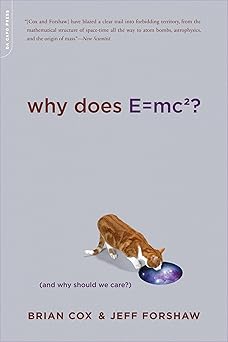
Why Does E=mc2?
(and Why Should We Care?)
- Themes
- physics, relativity, science education
- Pacing
- Steady
Who it’s for
- Readers interested in popular science and physics
- Those curious about Einstein's theory of relativity and its implications
Where it sits
- 98%Relativity
- 29%Particle Physics
- 22%Cosmology
How strongly BookFrontier reads the book as belonging to each subject.
Nearest books
Matched by our semantic model. Ordered by what its readers also loved. Most of these share its genre: Cosmology.
 From Eternity to HereSean Carroll62% subject match
 Quantum SupremacyMichio Kaku51% subject match
 We Have No IdeaJorge Cham, Daniel Whiteson53% subject matchAlso shares Particle Physics
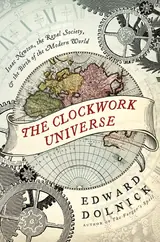 The Clockwork UniverseEdward Dolnick52% subject match
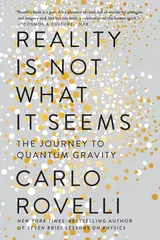 Reality Is Not What It SeemsCarlo Rovelli62% subject matchAlso shares Relativity
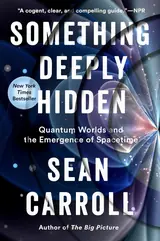 Something Deeply Hidden: Quantum Worlds and the Emergence of SpacetimeSean Carroll62% subject matchAlso shares Relativity
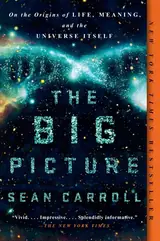 The Big PictureSean Carroll62% subject match
 Fantastic Numbers and Where to Find ThemAntonio Padilla60% subject matchAlso shares Relativity
For younger readers: Astrophysics for Young People in a Hurry, The Story of Science: Newton at the Center, The Way Things Work: Newly Revised Edition
Start with three books, and this one can be the first.
Members get a new edition every morning: a route out from their books to essays, research and talks, with the reason for each.
Sign upAbout this book
The international bestseller: an introduction to the theory of relativity by the eminent physicists Brian Cox and Jeff Forshaw
What does E=mc2 actually mean? Dr. Brian Cox and Professor Jeff Forshaw go on a journey to the frontier of twenty-first century science to unpack Einstein's famous equation.
Continue reading
Explaining and simplifying notions of energy, mass, and light-while exploding commonly held misconceptions-they demonstrate how the structure of nature itself is contained within this equation. Along the way, we visit the site of one of the largest scientific experiments ever conducted: the now-famous Large Hadron Collider, a gigantic particle accelerator capable of re-creating conditions that existed fractions of a second after the Big Bang. A collaboration between one of the youngest professors in the United Kingdom and a distinguished popular physicist, Why Does E=mc2? is one of the most exciting and accessible explanations of the theory of relativity.
Publisher details
Publisher categories
- Physics
- Quantum Theory
- Relativity
- Atomic & Molecular Physics
- Authors
- Brian Cox, Jeff Forshaw
- Publisher
- Grand Central Publishing
- Published
- July 13, 2010
- Format
- Print & ebook
- Reading lane
- Physics