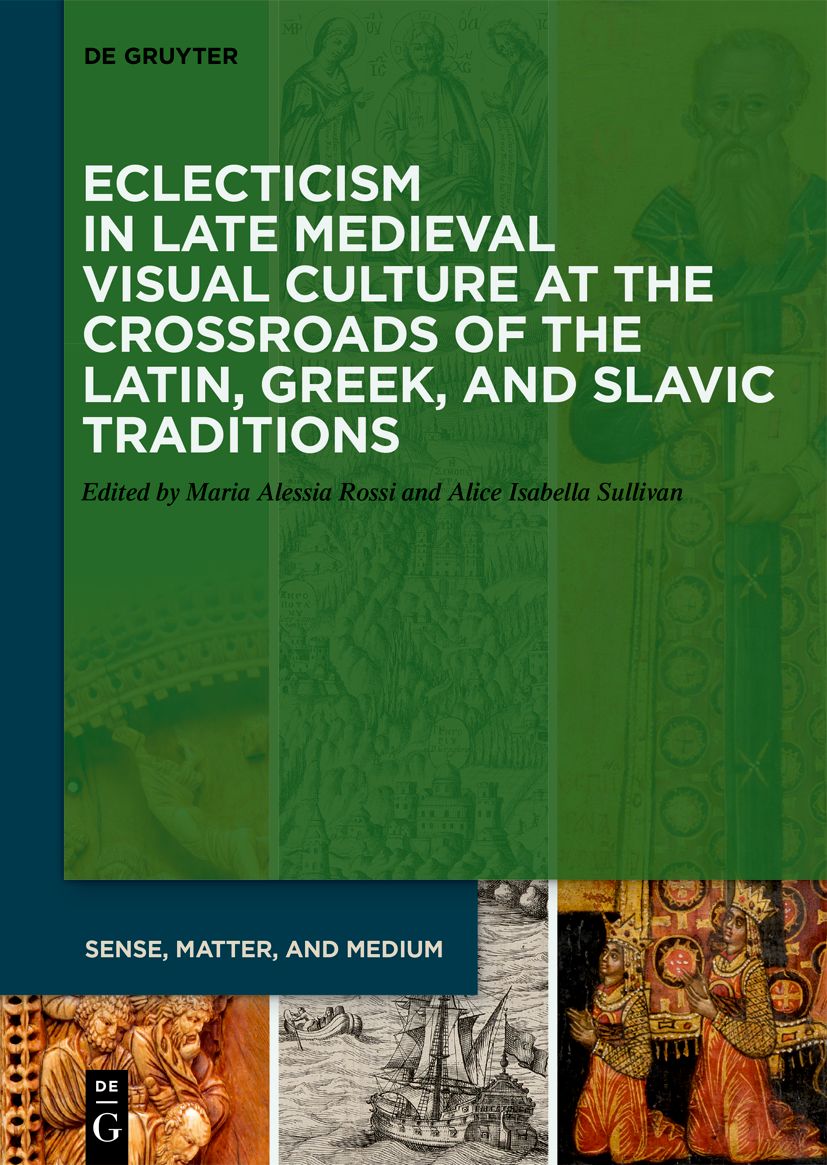
Eclecticism in Late Medieval Visual Culture at the Crossroads of the Latin, Greek, and Slavic Traditions
Kindle Edition
De Gruyter · Ebook · November 22, 2021
This volume builds upon the new worldwide interest in the global Middle Ages.
We earn from qualifying purchases.
- Who it’s for
- A comparative study of Eastern European visual culture from the fourteenth through seventeenth centuries.
- Genres
- Medieval Art History, European Art, Medieval History
- Published
- De Gruyter, November 22, 2021
Nearest books
Matched by what the books are about, then ordered by what their readers also loved.
 A Short History of the Middle Ages, Fifth EditionBarbara H. Rosenwein63% matchShares Medieval History
 The Middle KingdomsJohn Curless, Martyn Rady60% matchShares Medieval History
 Medieval ArtMarilyn Stokstad58% matchShares Medieval Art History and Medieval History
 Renaissance Art ReconsideredCarol M. Richardson, Kim W. Woods54% matchShares European Art
 The Renaissance: a Very Short IntroductionJerry Brotton53% match
 A History of Greek ArtMark D. Stansbury-O'Donnell53% match
For younger readers: Renaissance Fashions Coloring Book, Medieval World, The Renaissance in Europe
Start with three books, and this one can be the first.
Members get a new edition every morning: a route out from their books to essays, research and talks, with the reason for each.
Join the waitlistAbout this book
This volume builds upon the new worldwide interest in the global Middle Ages. It investigates the prismatic heritage and eclectic artistic production of Eastern Europe between the fourteenth and seventeenth centuries, while challenging the temporal and geographical parameters of the study of medieval, Byzantine, post-Byzantine, and early-modern art.
Continue reading
Contact and interchange between primarily the Latin, Greek, and Slavic cultural spheres resulted in local assimilations of select elements that reshaped the artistic landscapes of regions of the Balkan Peninsula, the Carpathian Mountains, and further north. The specificities of each region, and, in modern times, politics and nationalistic approaches, have reinforced the tendency to treat them separately, preventing scholars from questioning whether the visual output could be considered as an expression of a shared history. The comparative and interdisciplinary framework of this volume provides a holistic view of the visual culture of these regions by addressing issues of transmission and appropriation, as well as notions of cross-cultural contact, while putting on the global map of art history the eclectic artistic production of Eastern Europe.
Eastern European Art
A comparative study of Eastern European visual culture from the fourteenth through seventeenth centuries.
Come here for
- Artistic exchange among Latin, Greek, and Slavic cultural spheres
- The Balkans, Carpathians, and regions farther north
Expect
- Discussion of transmission, appropriation, and cross-cultural contact
- A challenge to medieval art’s usual temporal and geographical boundaries
Where it sits
| Medieval Art History | 66% |
|---|---|
| European Art | 42% |
| Medieval History | 39% |
Percentages are BookFrontier’s reading of the book.
Publisher categories
- Medieval Architecture
- Medieval Art History
- Literary Criticism
- Authors
- Maria Alessia Rossi, Alice Isabella Sullivan
- Publisher
- De Gruyter
- Published
- November 22, 2021
- Format
- Ebook
- Reading lane
- Medieval Architecture