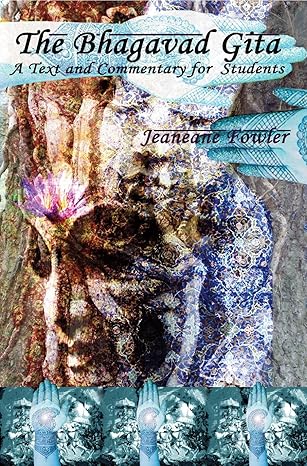
Bhagavad Gita
A Text and Commentary for Students
Liverpool University Press · Print & ebook · November 23, 2011
Jeaneane Fowler provides a text and detailed commentary on this important Hindu scripture, which is a dialogue between Arjuna the man and Krishna the God.
We earn from qualifying purchases.
- Who it’s for
- Explore the Gita’s interpretations of yoga through Fowler’s text, commentary, and notes.
- Genres
- Hindu Sacred Writings, Hindu Thought, Hindu Theology
- Published
- Liverpool University Press, November 23, 2011
Nearest books
Matched by what the books are about, then ordered by what their readers also loved. Most of these share its genres: Hindu Sacred Writings and Hindu Thought.
 The Bhagavad Gita for Daily Living, Volume 1Eknath Easwaran74% match
 The Bhagavad Gita for Daily Living, Volume 2Eknath Easwaran73% match
 The Bhagavad Gita for Daily Living, Volume 3Eknath Easwaran72% match
For younger readers: Ramayana, Seasons of Splendour
Start with three books, and this one can be the first.
Members get a new edition every morning: a route out from their books to essays, research and talks, with the reason for each.
Join the waitlistAbout this book
Jeaneane Fowler provides a text and detailed commentary on this important Hindu scripture, which is a dialogue between Arjuna the man and Krishna the God. Major Hindu concepts are examined in depth, and the background to the Gita is presented in a comprehensive introduction.
Continue reading
Yoga is the key feature of the Gita but it has its own interpretation of what that yoga should be: thus, yoga features not only in each of the pathways of knowledge, desireless action and devotion, but in the way in which the divine is understood. The chapters of the Bhagavad Gita therefore describe Arjunas despondency followed by The Yoga of Sankhya, Action, Knowledge, Renunciation, Meditation, Knowledge and Realization, the Imperishable Brahman, Royal Knowledge and Royal Mystery, Manifestation, the Vision of the Universal Form, Devotion, the Differentiation of the Kshetra and Kshetrajna, the Differentiation of the Three Gunas, the Supreme Purusha, the Differentiation of the Divine and the Demonic, the Differentiation of the Threefold Shraddha and, finally, The Yoga of Liberation and Renunciation. The book also contains detailed notes to the Gita chapters, a Further Reading section, a combined Glossary and Index of Sanskrit Terms, and an Index of English words. The cover of the book is replete with symbolism. Krishna is always represented as blue in colour, hence the colour of the hands in the cover design. The chariot of Krishna and Arjuna is to be seen in the motif at the base, while the triple motif symbolizes the triple paths of the Gita action without desire for results, knowledge and devotion. There are also three strands that make up all phenomena light and radiance, energy, and inertia, as well as three aspects of the divine in the Gita the totally transcendent Absolute, the manifest deity that is also the essence of all things, and the personal God to whom devotion can be given. The main image of Krishna is superimposed on the roots of the ashvattha tree that features in chapter 15: its branches reach down into the earth and its roots ascend upwards and it represents phenomenal existence. Read more
Yoga in the Gita
Explore the Gita’s interpretations of yoga through Fowler’s text, commentary, and notes.
Come here for
- A text with detailed commentary on the Gita’s chapters
- Major Hindu concepts and the Gita’s background
Expect
- A comprehensive introduction and detailed chapter notes
- A glossary and index of Sanskrit terms
Where it sits
| Hindu Sacred Writings | 100% |
|---|---|
| Hindu Thought | 53% |
| Hindu Theology | 32% |
Percentages are BookFrontier’s reading of the book.
Publisher categories
- Hindu Sacred Writings
- Authors
- Jeaneane Fowler, Jeaneane D. Fowler
- Publisher
- Liverpool University Press
- Published
- November 23, 2011
- Format
- Print & ebook
- Reading lane
- Hindu Sacred Writings