
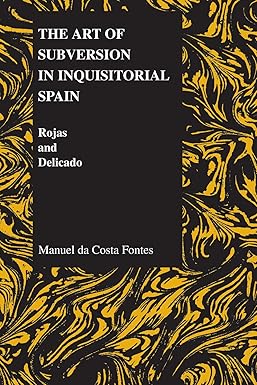
Book
The Art of Subversion in Inquisitorial Spain
Rojas and Delicado
Manuel De Costa Fontes
Purdue University Press · Print & ebook · January 18, 2005
Reading lane: Iberian Lit Crit
Rojas's Celestina (1499) is perhaps the second greatest work of Spanish literature, right after Don Quixote , and Delicado sought to surpass it with La Lozana andaluza (1530), an important precedent of the picaresque novel.
At a Glance
Who It's For
Book Details
- Authors
- Manuel De Costa Fontes
- Publisher
- Purdue University Press
- Published
- January 18, 2005
- Format
- Print & ebook
- Theme
- Iberian Lit Crit · Caribbean & Latin American Criticism
- Reading lane
- Iberian Lit Crit
Affinity
Publisher Categories
Iberian Lit Crit
16th-Century Literary Criticism
Religion in Literature
About This Book
Rojas's Celestina (1499) is perhaps the second greatest work of Spanish literature, right after Don Quixote , and Delicado sought to surpass it with La Lozana andaluza (1530), an important precedent of the picaresque novel. Both works were written during the height of the Inquisition, when the only relatively safe way for New Christian writers of Jewish extraction like Rojas and Delicado to express what they felt about the discrimination they suffered and their doubts regard...
Read full description
Similar Books

The Inquisitor's Wife
Jeanne Kalogridis · St. Martin's Press
Affinity signal
Renaissance Fiction
Medieval Historical Fiction
The Lead Books of Granada
E. Drayson, Elizabeth Drayson · Palgrave Macmillan
Affinity signal
History
Religion & Spirituality

Admiration and Awe
Antonio Urquízar-Herrera, Antonio Urquizar-Herrera · Oxford University Press
Affinity signal
European History