
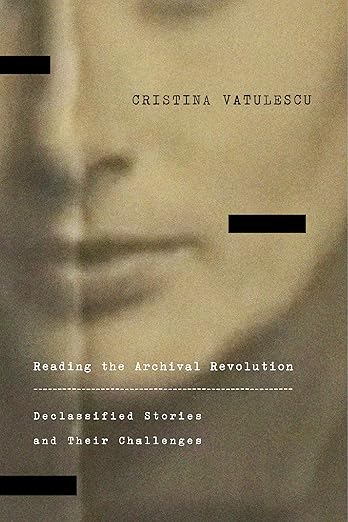
Book
Reading the Archival Revolution
Declassified Stories and Their Challenges
Cristina Vatulescu
Stanford University Press · Print & ebook · November 5, 2024
Reading lane: East European Literary Criticism
The opening of classified documents from the Soviet era has been dubbed the archival revolution due to its unprecedented scale, drama, and impact.
At a Glance
Who It's For
Book Details
- Authors
- Cristina Vatulescu
- Publisher
- Stanford University Press
- Published
- November 5, 2024
- Format
- Print & ebook
- Theme
- East European Literary Criticism · Eastern European History
- Reading lane
- East European Literary Criticism
Affinity
Publisher Categories
Eastern European History
East European Literary Criticism
Russian & Post-Soviet Politics
About This Book
The opening of classified documents from the Soviet era has been dubbed the archival revolution due to its unprecedented scale, drama, and impact. With a storyteller's sensibility, Cristina Vatulescu identifies and takes on the main challenges of reading in these archives. This transnational study foregrounds peripheral Eastern European perspectives and the ethical stakes of archival research. In so doing, it contributes to the urgent task of decolonizing the field of Easter...
Read full description
Similar Books
KGB Literati
Kovacevic, Filip Kovacevic · University of Toronto Press
Affinity signal
Russian Lit Crit
Soviet-Era Russia
![The Gulag Archipelago [volume 1] by Aleksandr I. Solzhenitsyn](https://img.bookfrontier.com/9780061253713.jpg?v=4ccd25cacb776c49)
The Gulag Archipelago [volume 1]
Aleksandr I. Solzhenitsyn, Aleksandr Solzhenitsyn · HarperCollins
Affinity signal
Russian Lit Crit
Eastern European History

In Isolation
Stanislav Aseyev · WW Norton
Affinity signal
Eastern European History
Eastern European Collections

Worlds Apart
Benjamin Paloff · Columbia University Press
Affinity signal
Literature & History
East European Literary Criticism