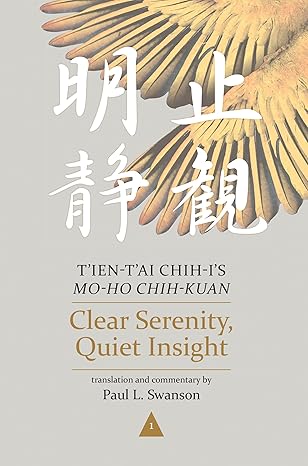
Clear Serenity, Quiet Insight
T'ien-t'ai Chih-i's Mo-ho Chih-kuan, 3-volume Set
University of Hawaii Press · Print & ebook · October 31, 2017
The Mo-ho chih-kuan (Great cessation-and-contemplation) by T’ien-t’ai Chih-i (538–597) is among the most influential treatises in the long history of Buddhist scholarship.
We earn from qualifying purchases.
- Who it’s for
- Explore Chih-i’s treatise through a complete translation, extensive annotations, and supplementary materials.
- Genres
- Buddhist Sacred Writings, Buddhist Thought, Buddhist History
- Published
- University of Hawaii Press, October 31, 2017
Nearest books
Matched by what the books are about, then ordered by what their readers also loved.
 UnbornBankei55% matchShares Buddhist Thought
 The Holy Teaching of Vimalakä«rtiVimalakirti, Robert A. F. Thurman52% matchShares Buddhist Sacred Writings and Buddhist Thought
 The Platform SutraRed Pine, Hui-Neng58% matchShares Buddhist Sacred Writings
 The Other ShoreThich Nhat Hanh49% matchShares Buddhist Sacred Writings and Buddhist Thought
 The Way of Chuang TzuThomas Merton, Dalai Lama XIV63% match
 The Zen Teaching of BodhidharmaBodhidharma, Red Pine58% matchShares Buddhist Sacred Writings
 The Bamboo Texts of GuodianScott Cook, Scott Bradley Cook58% match
 The Enlightened MindStephen Mitchell57% match
For younger readers: A Pebble for Your Pocket, Each Breath a Smile
Start with three books, and this one can be the first.
Members get a new edition every morning: a route out from their books to essays, research and talks, with the reason for each.
Join the waitlistAbout this book
The Mo-ho chih-kuan (Great cessation-and-contemplation) by T’ien-t’ai Chih-i (538–597) is among the most influential treatises in the long history of Buddhist scholarship. It is known for its brilliant insights and its systematic and comprehensive treatment of the Buddhist tradition. Clear Serenity, Quiet Insight is the first complete, fully annotated translation of this prodigious work by one of today’s foremost scholars on T’ien-t’ai (Tendai) Buddhism.
Continue reading
The extensive annotation accompanying the translation (Volumes 1 and 2) will help readers understand the original text and implications of crucial passages and ideas, as well as the place the Mo-ho chih-kuan occupies in the development of Chinese, Korean, Vietnamese, and Japanese Buddhism and its critical importance for figures such as Nichiren, who considered Chih-i the “great master” and quoted profusely from the text in his own writings. Volume 3 contains ample supplementary materials, including translations of related texts, a comprehensive glossary, and lists of Chinese terms and explanations of various sources.
Chih-i’s Treatise
Explore Chih-i’s treatise through a complete translation, extensive annotations, and supplementary materials.
Come here for
- A complete, annotated translation of the Mo-ho chih-kuan
- Context on its place in four Buddhist traditions
Expect
- Annotations explain crucial passages and ideas
- Volume 3 includes related texts, a glossary, and source lists
Where it sits
| Buddhist Sacred Writings | 47% |
|---|---|
| Buddhist History | 41% |
| Buddhist Thought | 26% |
Percentages are BookFrontier’s reading of the book.
Publisher categories
- Buddhist Thought
- Buddhist History
- Buddhist Sacred Writings
- Authors
- Paul L. Swanson
- Publisher
- University of Hawaii Press
- Published
- October 31, 2017
- Format
- Print & ebook
- Reading lane
- Buddhist Thought