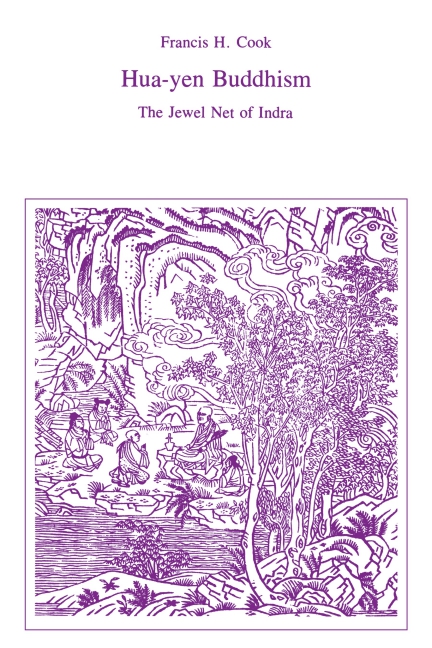
Hua-yen Buddhism
The Jewel Net of Indra
Penn State University Press · Print & ebook · September 15, 1977
Hua-yen is regarded as the highest form of Buddhism by most modern Japanese and Chinese scholars.
We earn from qualifying purchases.
- Genres
- Buddhist Thought, Buddhism - General, Buddhist History
- Published
- Penn State University Press, September 15, 1977
Nearest books
Matched by what the books are about, then ordered by what their readers also loved.
 Awakening of the HeartThich Nhat Hanh47% match
 The Platform SutraRed Pine, Hui-Neng55% match
 The Essence of ShintoMotohisa Yamakage43% match
 The Diamond SutraRed Pine, Anonymous50% matchShares Buddhist Thought
 The Zen Teaching of BodhidharmaBodhidharma, Red Pine52% match
 The Holy Teaching of Vimalakä«rtiVimalakirti, Robert A. F. Thurman52% matchShares Buddhist Thought
 The Perennial PhilosophyAldous Huxley52% match
 Clear Serenity, Quiet InsightPaul L. Swanson50% matchShares Buddhist Thought and Buddhist History
For younger readers: Wide Awake
Start with three books, and this one can be the first.
Members get a new edition every morning: a route out from their books to essays, research and talks, with the reason for each.
Join the waitlistAbout this book
Hua-yen is regarded as the highest form of Buddhism by most modern Japanese and Chinese scholars. This book is a description and analysis of the Chinese form of Buddhism called Hua-yen (or Hwa-yea), Flower Ornament, based largely on one of the more systematic treatises of its third patriarch. Hua-yen Buddhism strongly resembles Whitehead's process philosophy, and has strong implications for modern philosophy and religion.
Continue reading
Hua-yen Buddhism explores the philosophical system of Hua-yen in greater detail than does Garma C.C. Chang's The Buddhist Teaching of Totality (Penn State, 1971). An additional value is the development of the questions of ethics and history. Thus, Professor Cook presents a valuable sequel to Professor Chang's pioneering work. The Flower Ornament School was developed in China in the late 7th and early 8th centuries as an innovative interpretation of Indian Buddhist doctrines in the light of indigenous Chinese presuppositions, chiefly Taoist. Hua-yen is a cosmic ecology, which views all existence as an organic unity, so it has an obvious appeal to the modern individual, both students and layman. Read more
Where it sits
| Buddhism - General | 69% |
|---|---|
| Buddhist Thought | 53% |
| Buddhist History | 47% |
Percentages are BookFrontier’s reading of the book.
Publisher categories
- Buddhist Thought
- Buddhism - General
- Buddhist Practice & Ritual
- Buddhist Sacred Writings
Show all 5 publisher categories
- Religious Ethics
- Authors
- Francis H. Cook, Francis Harold Cook
- Publisher
- Penn State University Press
- Published
- September 15, 1977
- Format
- Print & ebook
- Reading lane
- Buddhist Thought