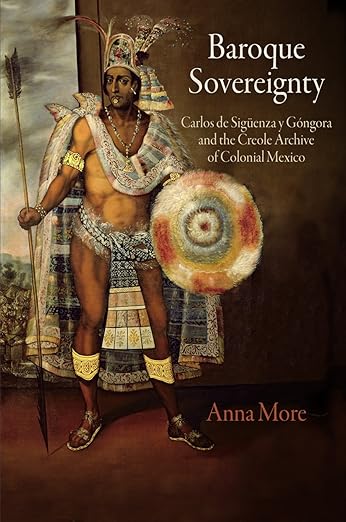
Baroque Sovereignty
Carlos De Sigüenza Y Góngora and the Creole Archive of Colonial Mexico
University of Pennsylvania Press, Inc. · Print & ebook · January 2, 2013
In the seventeenth century, even as the Spanish Habsburg monarchy entered its irreversible decline, the capital of its most important overseas territory was flourishing.
We earn from qualifying purchases.
- Who it’s for
- Anna More traces how Sigüenza’s writings and the creole archive imagined local authority in colonial Mexico.
- Genres
- Mexican History, 17th-Century History, Baroque & Rococo Architecture
- Published
- University of Pennsylvania Press, Inc., January 2, 2013
Nearest books
Matched by what the books are about, then ordered by what their readers also loved. Most of these share its genre: Mexican History.
 Marvels of MedicineYarí Pérez Marín60% match
 A Hero for the AmericasRobert Calder55% match
 First Stop in the New WorldDavid Lida55% match
 Admiration and AweAntonio Urquízar-Herrera, Antonio Urquizar-Herrera54% match
For younger readers: Borderlands and the Mexican American Story, Reaching Out, Mexico (enchantment of the World)
Start with three books, and this one can be the first.
Members get a new edition every morning: a route out from their books to essays, research and talks, with the reason for each.
Join the waitlistAbout this book
In the seventeenth century, even as the Spanish Habsburg monarchy entered its irreversible decline, the capital of its most important overseas territory was flourishing. Nexus of both Atlantic and Pacific trade routes and home to an ethnically diverse population, Mexico City produced a distinctive Baroque culture that combined local and European influences.
Continue reading
In this context, the American-born descendants of European immigrants—or creoles, as they called themselves—began to envision a new society beyond the terms of Spanish imperialism, and the writings of the Mexican polymath Carlos de Sigüenza y Góngora (1645-1700) were instrumental in this process. Mathematician, antiquarian, poet, and secular priest, Sigüenza authored works on such topics as the 1680 comet, the defense of New Spain, pre-Columbian history, and the massive 1692 Mexico City riot. He wrote all of these, in his words, "out of love for my patria." Through readings of Sigüenza y Góngora's diverse works, Baroque Sovereignty locates the colonial Baroque at the crossroads of a conflicted Spanish imperial rule and the political imaginary of an emergent local elite. Arguing that Spanish imperialism was founded on an ideal of Christian conversion no longer applicable at the end of the seventeenth century, More discovers in Sigüenza y Góngora's works an alternative basis for local governance. The creole archive, understood as both the collection of local artifacts and their interpretation, solved the intractable problem of Spanish imperial sovereignty by establishing a material genealogy and authority for New Spain's creole elite. In an analysis that contributes substantially to early modern colonial studies and theories of memory and knowledge, More posits the centrality of the creole archive for understanding how a local political imaginary emerged from the ruins of Spanish imperialism.
Sigüenza’s Creole Archive
Anna More traces how Sigüenza’s writings and the creole archive imagined local authority in colonial Mexico.
Come here for
- Readings of Sigüenza’s writings on the 1680 comet
- The 1692 Mexico City riot and pre-Columbian history
Expect
- A study of Baroque culture shaped by local and European influences
- An account of creole political thought amid Spanish imperial decline
Where it sits
| Mexican History | 83% |
|---|---|
| 17th-Century History | 47% |
| Baroque & Rococo Architecture | 22% |
Percentages are BookFrontier’s reading of the book.
Publisher categories
- Caribbean & Latin American Criticism
- Iberian Lit Crit
- Authors
- Anna More
- Publisher
- University of Pennsylvania Press, Inc.
- Published
- January 2, 2013
- Format
- Print & ebook
- Reading lane
- Caribbean & Latin American Criticism