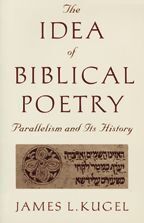
The Idea of Biblical Poetry
Parallelism and Its History
Johns Hopkins University Press · Print & ebook · June 26, 1998
Is there poetry in the Bible?
We earn from qualifying purchases.
- Who it’s for
- Kugel questions the prose-and-verse divide and traces how biblical poetry has been understood across centuries.
- Genres
- Poetry Criticism, Wisdom Literature (Bible), Old Testament Interpretation
- Published
- Johns Hopkins University Press, June 26, 1998
Nearest books
Matched by what the books are about, then ordered by what their readers also loved. Most of these share its genre: Old Testament Interpretation.
 A Guide to Old Testament Theology and ExegesisWillem A. VanGemeren46% match
 The Poetics of Biblical NarrativeMeir Sternberg51% match
 Discourse Grammar of the Greek New TestamentSteven E. Runge, Daniel B. Wallace44% match
 A Brief History of Old Testament CriticismMark S. Gignilliat46% match
 Old Testament Wisdom LiteratureCraig G. Bartholomew, Ryan P. O'Dowd45% matchAlso shares Wisdom Literature (Bible)
 GenesisBruce K. Waltke44% match
 The Art of Biblical PoetryRobert Alter64% matchAlso shares Poetry Criticism and Wisdom Literature (Bible)
 Ancient Israelite Literature in Its Cultural ContextJohn H. Walton60% match
For younger readers: The Rhyme Bible Storybook, With a Mighty Hand
Start with three books, and this one can be the first.
Members get a new edition every morning: a route out from their books to essays, research and talks, with the reason for each.
Join the waitlistAbout this book
Is there poetry in the Bible? Does it have rhyme or meter? How did ancient Hebrew writers compose their works? James Kugel's provocative study provides surprising new answers to these age-old questions. Biblical "poetry" is not a concept native to the Bible itself, he proposes, and the idea that the Bible is divided into prose and verse is merely an approximation of the reality of biblical style.
Continue reading
Arguing that the Bible presents a continuum of speech heightened in varying degrees by different means, Kugel sets out to describe Hebrew's high style on its own terms. He also offers a thorough history of the idea of biblical poetry, starting with Philo of Alexandria and Josephus in the first century C.E. and charting its development through the Church Fathers, medieval Jewish writers, the Christian Hebraists of the Renaissance, and on into modern times. The story of how each age understood the nature biblical poetry, Kugel concludes, is a key to understanding the Bible's place in the history of Western thought.
Hebrew High Style
Kugel questions the prose-and-verse divide and traces how biblical poetry has been understood across centuries.
Come here for
- Kugel’s account of Hebrew high style on its own terms
- A history of biblical poetry from antiquity into modern times
Expect
- An argument for biblical style as a continuum of heightened speech
- Perspectives from Philo and Josephus through medieval and modern writers
Where it sits
| Wisdom Literature (Bible) | 49% |
|---|---|
| Poetry Criticism | 38% |
| Old Testament Interpretation | 36% |
Percentages are BookFrontier’s reading of the book.
Publisher categories
- Old Testament Studies
- Authors
- Prof James Kugel, James L. Kugel
- Publisher
- Johns Hopkins University Press
- Published
- June 26, 1998
- Format
- Print & ebook
- Reading lane
- Old Testament Studies