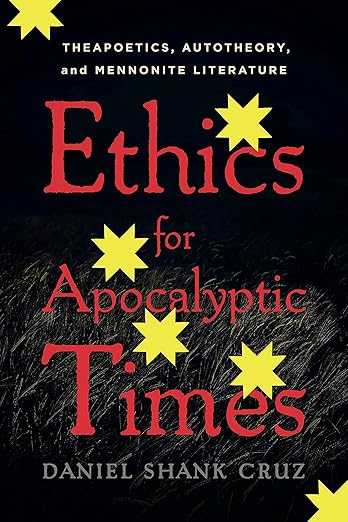
Ethics for Apocalyptic Times
Theapoetics, Autotheory, and Mennonite Literature
Penn State University Press · Print & ebook · July 15, 2025
We earn from qualifying purchases.
- Who it’s for
- Daniel Shank Cruz explores how theapoetic reading can shape a relational ethic amid present-day crises.
- Genres
- Queer Literary Criticism, Feminist Lit Crit, Mennonite Christianity
- Published
- Penn State University Press, July 15, 2025
Nearest books
Matched by what the books are about, then ordered by what their readers also loved.
 The Social ImperativePaula L. Moya, Paula Moya61% matchShares Feminist Lit Crit
 Worlds ApartBenjamin Paloff56% match
 Art As Performance, Story As CriticismCraig S. Womack55% matchShares Queer Literary Criticism
 Transpacific ImaginationsYunte Huang55% match
 Feminist Revision and the BibleAlicia Suskin Ostriker54% matchShares Feminist Lit Crit
 Writing the GoodlifePriscilla Solis Ybarra54% match
 Blast, Corrupt, Dismantle, EraseBrett Josef Grubisic, Gisèle M. Baxter54% match
 Situating ExistentialismJonathan Judaken, Robert Bernasconi54% match
Start with three books, and this one can be the first.
Members get a new edition every morning: a route out from their books to essays, research and talks, with the reason for each.
Join the waitlistAbout this book
Ethics for Apocalyptic Times is about the role literature can play in helping readers cope with our present-day crises, including the COVID-19 pandemic, climate change, and the shift toward fascism in global politics.
Continue reading
Using the lens of Mennonite literature and their own personal experience as a culturally Mennonite, queer, Latinx person, Daniel Shank Cruz investigates the age-old question of what literature’s role in society should be, and argues that when we read literature theapoetically , we can glean a relational ethic that teaches us how to act in our difficult times. In this book, Cruz theorizes theapoetics―a feminist reading strategy that reveals the Divine via literature based on lived experiences―and extends the concept to show how it is queer, decolonial, and equally applicable to secular and religious discourse. Cruz’s analysis focuses on Mennonite literature―including Sofia Samatar’s short story collection Tender and Miriam Toews’s novel Women Talking ―but also examines a non-Mennonite text, Samuel R. Delany’s novel The Mad Man , alongside practices of haiku and tarot, to show how reading theapoetically is transferable to other literary traditions. Weaving together close reading and personal narrative, this pathbreaking book makes a significant and original contribution to the field of Mennonite literary studies. Cruz’s arguments will also be appreciated by literary scholars interested in queer theory and the role of literature in society.
Theapoetic Reading
Daniel Shank Cruz explores how theapoetic reading can shape a relational ethic amid present-day crises.
Come here for
- A theory of theapoetics as a feminist reading strategy
- Close readings of Mennonite and non-Mennonite literature, haiku, and tarot
Expect
- Personal narrative alongside literary analysis
- Queer, decolonial interpretations across religious and secular discourse
Where it sits
| Mennonite Christianity | 49% |
|---|---|
| Feminist Lit Crit | 37% |
| Queer Literary Criticism | 37% |
Percentages are BookFrontier’s reading of the book.
Publisher categories
- Queer Literary Criticism
- 21st Century Literature
- Literary Criticism
- Mennonite Christianity
Show all 5 publisher categories
- Religion & Gender
- Authors
- Daniel Shank Cruz
- Publisher
- Penn State University Press
- Published
- July 15, 2025
- Format
- Print & ebook
- Reading lane
- Queer Literary Criticism