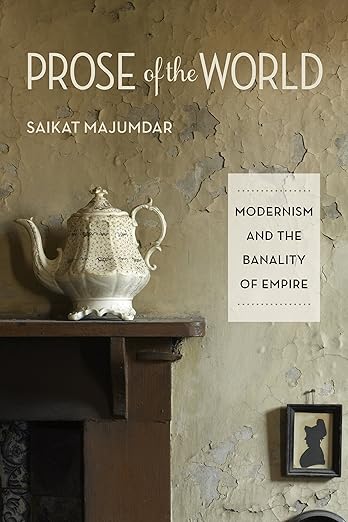
Prose of the World
Modernism and the Banality of Empire
Columbia University Press · Print & ebook · January 8, 2013
Everyday life in the far outposts of empire can be static, empty of the excitement of progress.
We earn from qualifying purchases.
- Who it’s for
- Saikat Majumdar traces how boredom on the colonial periphery reshapes modernist narrative aesthetics.
- Genres
- Comparative Literature, 20th-Century Literary Criticism, Race & Culture in Literature
- Published
- Columbia University Press, January 8, 2013
Nearest books
Matched by what the books are about, then ordered by what their readers also loved. Most of these share its genre: 20th-Century Literary Criticism.
 Rabindranath Tagore's the Home and the WorldPradip Kumar Datta59% match
 The Antinomies of RealismFredric Jameson58% match
 Modernism's Inhuman WorldsRasheed Tazudeen56% match
 Modernism: a Very Short IntroductionChristopher Butler56% match
 Ethnic ModernismWerner Sollors55% matchAlso shares Race & Culture in Literature
 Trials of Arab ModernityTarek El-Ariss55% matchAlso shares Race & Culture in Literature
 The Rise of Pacific LiteratureMatthew Hayward, Maebh Long54% matchAlso shares Comparative Literature
 Incomparable EmpiresGayle Rogers54% matchAlso shares Comparative Literature
For younger readers: Imperialism
Start with three books, and this one can be the first.
Members get a new edition every morning: a route out from their books to essays, research and talks, with the reason for each.
Join the waitlistAbout this book
Everyday life in the far outposts of empire can be static, empty of the excitement of progress. A pervading sense of banality and boredom are, therefore, common elements of the daily experience for people living on the colonial periphery. Saikat Majumdar suggests that this impoverished affective experience of colonial modernity significantly shapes the innovative aesthetics of modernist fiction.
Continue reading
Prose of the World explores the global life of this narrative aesthetic, from late-colonial modernism to the present day, focusing on a writer each from Ireland, New Zealand, South Africa, and India. Ranging from James Joyce's deflated epiphanies to Amit Chaudhuri's disavowal of the grand spectacle of postcolonial national allegories, Majumdar foregrounds the banal as a key instinct of modern and contemporary fiction—one that nevertheless remains submerged because of its antithetical relation to literature's intuitive function to engage or excite. Majumdar asks us to rethink the assumption that banality merely indicates an aesthetic failure. If narrative is traditionally enabled by the tremor, velocity, and excitement of the event, the historical and affective lack implied by the banal produces a narrative force that is radically new precisely because it suspends the conventional impulses of narration.
Banality and Empire
Saikat Majumdar traces how boredom on the colonial periphery reshapes modernist narrative aesthetics.
Come here for
- A study of banality in modernist and contemporary fiction
- Writers from Ireland, New Zealand, South Africa, and India
Expect
- Discussion of James Joyce and Amit Chaudhuri
- A rethink of banality as a source of narrative force
Where it sits
| Comparative Literature | 71% |
|---|---|
| Race & Culture in Literature | 34% |
| 20th-Century Literary Criticism | 27% |
Percentages are BookFrontier’s reading of the book.
Publisher categories
- African Lit Crit
- British & Irish Literary Criticism
- Asian Lit Crit
- Authors
- Saikat Majumdar
- Publisher
- Columbia University Press
- Published
- January 8, 2013
- Format
- Print & ebook
- Reading lane
- African Lit Crit