Why America Built the SS United States, and Who Talked It Into It
Picture the funnels first: red, white, and blue, still enormous after decades of peeling at a Philadelphia pier.
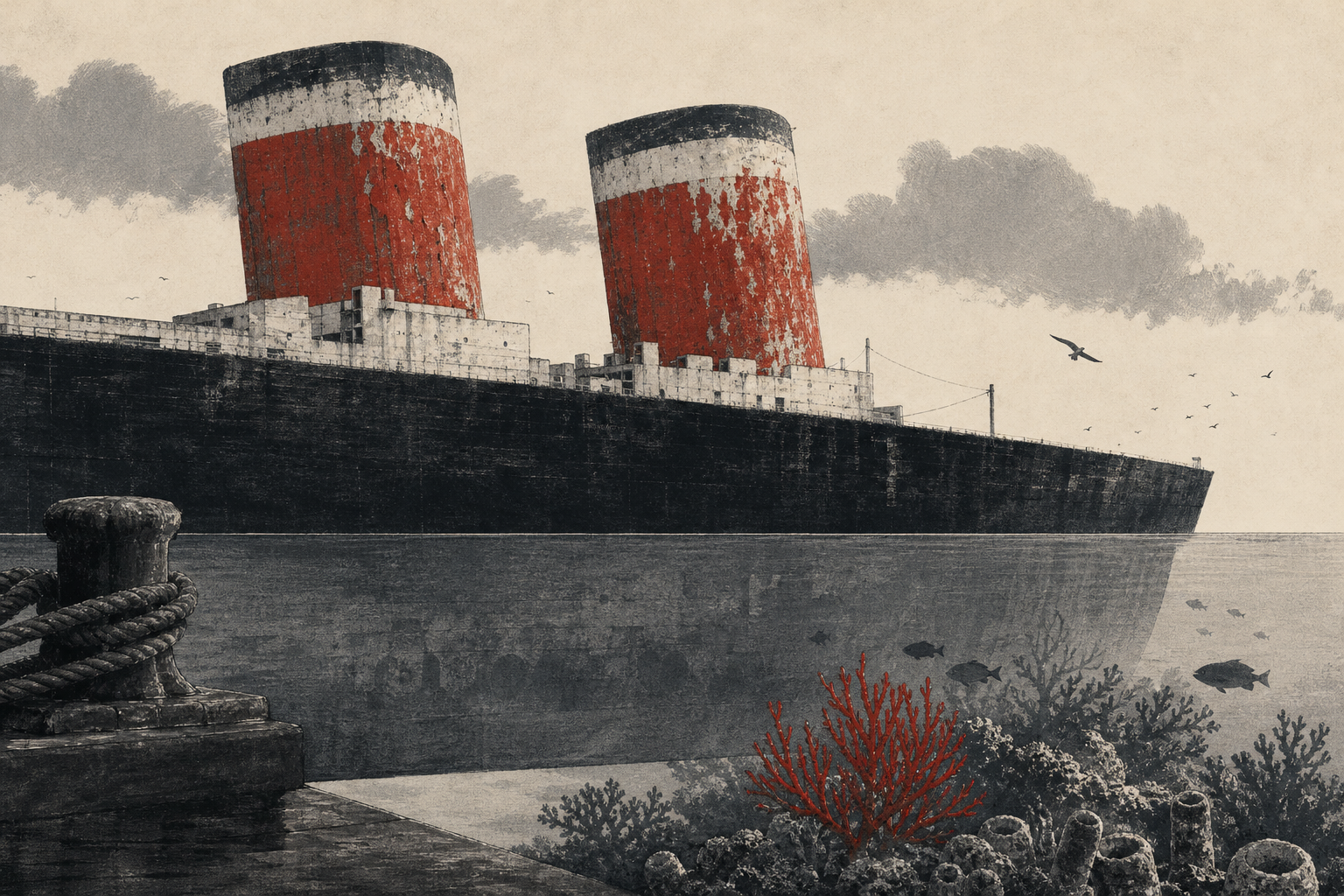
Picture the funnels first. There are two of them, painted red, white, and blue, still enormous after decades of peeling at a Philadelphia pier, where the SS United States sat so long it became part of the waterfront's furniture. That ship, longer than the Titanic and once the fastest liner afloat, is now bound for the seabed off the Florida coast, where it is meant to become the world's largest artificial reef. Fish will move into the cabins, and divers will pay to swim the corridors where passengers once dressed for dinner. The news arrives already shaped like an obituary with a happy ending. Underneath it is a man who spent forty years imagining that ship before a single plate of it existed, and who would probably have had firm opinions about the grouper.
Most coverage treats the sinking as an elegy for the age of ocean liners, a story about passengers in evening dress. The ship's record points somewhere harder. The federal government helped pay for it because it could be converted into a fast troop transport for a war that planners in the early 1950s thought might come. Its designer wanted it close to fireproof, which is why so much of the interior was aluminum, and its true top speed stayed secret for years. The reef closes a Cold War file. It also leaves a question the headlines skip: why a country sank so much money and pride into one ship, and what kind of person talked it into doing so.
Steven Ujifusa answers that question by writing a biography first and a ship history second. A Man and His Ship follows William Francis Gibbs, who by the 1940s and 1950s was considered America's best naval architect, and sets his career against the politics, culture, and business of twentieth-century America. The publisher places it in the tradition of David McCullough, and the method matches: one stubborn builder, followed closely enough that a giant object starts to look like a personal decision.
Gibbs's early life explains the ship. His family's sudden financial ruin forced him out of Harvard, and he never got formal training in the field that would make him famous. He also carried a crippling shyness well into adulthood. A man in that position cannot lean on credentials, so the work has to serve as the credential. Read that way, the United States looks like an argument Gibbs was making about himself, in steel, at a size nobody could ignore.
He spent forty years dreaming of the ship, and those decades give the book its spine. When the liner was finished in 1952, it was hailed as a technological masterpiece at a moment when "made in America" meant the best. Ujifusa pays close attention to that slogan, and it lets him tie one obsessive engineer to a national mood without pretending the two were identical. Gibbs wanted the fastest ship afloat for his own reasons. The country, fresh from the war, wanted a trophy, and his private ambition happened to arrive right on schedule.
The McCullough tradition also has a cost. Comparing Gibbs to John Roebling of the Brooklyn Bridge and Frank Lloyd Wright of Fallingwater flatters him, and the great-builder genre tends to make expensive bets look inevitable in hindsight. Roebling's bridge still carries traffic and Fallingwater still draws visitors, while the United States lost its purpose within about a decade, once jets crossed the Atlantic in hours, and spent far longer idle than it ever spent at sea.
Ujifusa writes with real sympathy for his subject, and that sympathy goes soft on the ship's short working life. Gibbs made a design choice. He built for a future of fast ocean crossings and possible troop convoys, and that future lasted about ten years. The reef ending makes the book more useful to you now, because you can hold Ujifusa's portrait of a visionary up against the way the story actually finished and decide how much of the vision survives the comparison.
Watching a famous thing become habitat carries its own sadness, and the headlines lean into it. Ujifusa's book gives you a steadier view of the same event. Its center is the person who wanted this ship to exist badly enough to spend forty years on it, and who poured much of the country's postwar self-image into its steel. Pick it up if the sinking leaves you wondering whose idea all that steel was. By the last page you will know the shy, relentless man who willed it into the water, and whose ambition is now settling onto the Gulf floor to hold up a reef.
Why this book
The sinking is mostly a story about cost, and the book supplies the history behind the bill. A ship built to cross an ocean faster than anything else, while staying ready to carry troops, is hard to repurpose once that job disappears. The United States sat in Philadelphia for nearly thirty years while activists fought to save it, and every rescue effort ran into the same problem: a vessel too big and too specialized to pay its own way. Speed, the quality Gibbs fought hardest for, meant nothing to any owner who came after him. So when footage of the scuttling circulates this November, the Gibbs story gives you something to measure it against. The reef is the one use left that fits the object, since a steel hull that size is finally valued for being heavy and durable. Gibbs wanted his ship to perform, and I suspect he would have tolerated a working retirement on the seafloor better than the people mourning on his behalf. Ujifusa gives you enough of the man's priorities to make that case for yourself, and a news clip has no room for any of them.
Bridges by email
A news story and the book that goes with it, whenever we publish one.